Media black-out against the marginalized must stop

“The media, journalists are the vanguard of justice and truth, if they fail in this duty, the society will suffer. There is no justice without justice for marginalized voices. The world cannot move faster if the underserved continue to be marginalized.”. Above are some of the submissions at African Investigative Journalism Conference 2024 which was held at Johannesburg South Africa from Wednesday October 30- Friday 1st November. 2024.
African Investigative Journalism Conference is an annual event that brings the best of the continent’s investigative, media and journalists from across the world. It is organized by Wits centre for journalism, a unit within Witwatersrand University, Johannesburg’s Journalism department. The event is always packaged with activities: talks, panel sessions, masterclasses, networking, award sessions, dinners among many others.
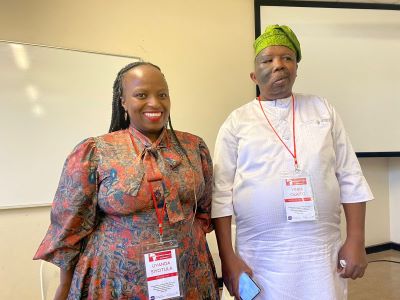
L-R (The session moderator , Siyotula Uyanda and Yinka Olaito)

Being a second timer, the Executive Director of Africa Foundation for Young media professionals and Centre for Disability and Inclusion Africa, Yinka Olaitio is one of the speakers in this 2024 edition. His focus was on “Bringing the marginalized voices to the fore in investigation”. Aside from sharing the impact of the two organizations Yinka Olaito represented, the session exposed participants to enhanced skills in effective storytelling in disability and inclusion reporting, what to look out for and how to build collaboration and partnerships for an inclusive society.
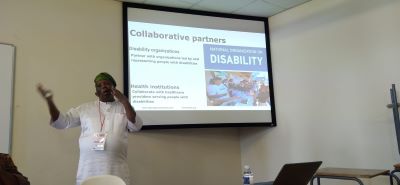
Yinka Olaito during his presentation

Opening the session, the moderator, Uyanda Siyotula, who is theNational coordinator, SOS Coalition, a South African Public media service initiative charged participants to pay attention as it has been observed this area of journalism had suffered so much while it comes to reporting. Siyotula said “We are all here to learn and I strongly believe by the time we are living this one-hour session, we will all be equipped to do better stories”.

Yinka Olaito why opening the session shared on why the voices of the marginalized should be covered by the medic in itself. Some of the reasons he gave include: marginalised population suffer most of the abuses, media blackout issues that concern them is enormous, there is no inclusive society without voices of the marginalized, justice is not a privilege for the few but for everyone.

Yinka Olaito identified the challenges of investigative journalists in covering this important population like low knowledge of issues and reporters’ barriers. To report effectively, Yinka Charged investigative journalists to be intentional about covering voices of the marginalized. 

This starts with knowing the laws and acts of the ecosystem as well as charged newsrooms to lead by examples. “A newsroom that cannot champion inclusion has no right to preach this” Yinka Olaito said. To do effective storytelling, knowledge of data, understanding the marginalized ecosystem, collaboration, creating safe spaces for the population and risk awareness will go a long way.

The Africa investigative journalism Conference 2024 edition brought together over 450 delegates from about 55 countries

N.B story adapted from Nigeriagrassrootnews
READ MORE
Inclusion demands

Project truth, not stereotypes, Journalists warned

Society does not benefit, but is thrown into darkness if the media only amplifies the stereotypes. When Journalists do their job, the society is better off. But when Journalists exemplify ignorance, the society will suffer. Hence there is a need for journalists and broadcasters to constantly upskill their knowledge.

“Journalists have a role as purveyor of the truth. A society without journalists will wallow in darkness and people will be uninformed. To ensure a society free of biases, knowledge should unearth every form of stereotypes and ensure only the truth is communicated”.

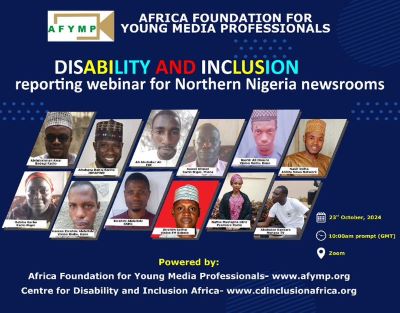
Above and many others were the thoughts shared by Africa Foundation for Young media professionals as well as Centre for Disability and Inclusion Africa’s executive director in a webinar jointly organization for selected newsrooms from Northern Nigeria tagged “Disability and Inclusion reporting for Northern Newsrooms”.

The Journey into the joint hosting of the webinar began when a request was sent by one of the training participants sent a mail to the two organizations g=having followed the passion and leading role the two organizations had been playing in ensuring journalists/broadcasters become better informed in this area of journalism.

Prior to now the common observation in many situations had been misunderstanding as well as lack of appropriate knowledge in many of the newsrooms involved. The impact of this is shown in the coverage of the issue. Many of the reports read had a way of reinforcing stereotypes on Language use in the reports showed no level of professionalism on the part of the reporters.

In her opening remark, Busola Oladotun, the program officer of the organization charged the participants to pay close attention to the information they were about to be exposed to as it has capacity to make the difference in their reportage.

Taking the participants through the process of “Why disability and inclusion reporting?” Yinka Olaito explained some of the reasons why many journalists did not pay attention to this important aspect of journalism. To Yinka Olaito “Up till date many journalists continue to assume the number of persons with disabilities are insignificant which does not require any close attention”.

With facts and figures, Yinka explained the negative effect of overlooking inclusion in a society and charged the participants to understand a need to be deliberate so as not to strengthen stereotype or misinformation about disability and inclusion. “Journalists must prioritise knowledge so as to combat every form of stereotypes among other issues” Yinka encouraged.

Participants expressed their gratitude during the feedback session. “This is the first time; I am exposed to this kind of the knowledge” One of the participants said. Another participant who was worried about some newsrooms which refused to be inclusive and will not hire a trained journalist with disabilities wanted to know what legal action should be taken?

In his reply, Yinka Olaito said, why that may sound discriminatory, newsroom leadership must be given enough time as many of them may still be clueless about the issue. A conversation must be stepped up, which one of the duties Africa Foundation for Young Media Professionals as well as Centre for Disability and Inclusion Africa continue to advocate for. 

READ MORE

#InternationalGirlChildday24, CDIA’s statement

On International Girl Child day, we at Centre for Disability and Inclusion Africa celebrate all women and girls especially women and girls with disabilities who have are seven times more likely to lack access than their male counterparts and twice more likely to suffer gender based violence than women and girls without disabilities.

We celebrate your courage, your tenacity despite the multidimensional poverty, stigmatising discrimination and several of your rights that have been abused or denied.. We assure you that we remain committed to equal access and the defence of your fundamental human right. 

 We hereby advocate for equal access from government, private sector, civil societies, media and general public. It is civic responsibility to mainstream disability for the achievement of equal rights and access for women and girls with disabilities

 It is important to prioritise their empowerment, education, quality health delivery, their gender and reproductive rights, the digital rights, accommodation and accessibility to enhance their capacity and wellbeing.

READ MORE
Call for Actions

World Eye Day ’24, let us celebrate those who stand for…

Statistics had shown that eye health challenges are discovered daily across the globe. There is an average of 285 million visually impaired people in the world,

World Health Organization’s statistics is even staggering as it posited that an average of 2.2 billion people have a near or distance vision impairment. Visual impairment refers to any form of loss in vision. For some, there is a permanent damage while others can see with difficulties. Visual impairment can be a result of several factors: refractive errors or cataracts. Vision impairment continues to be a threat and financial burden it takes from the economy annually aside from global productivity cost is estimated to be US$ 411 billion.

Whatever we say, persons with visual impairment are still humans who must be accorded dignity, honour and should be given their fundamental rights as humans. They must not be seen as a burden as the level of their creativity has been noted to be very high.

As an organization we do forget the global battle against #eyehealth disease. Neither do we forget those who had made a commitment to reduce the challenges through advocacy, funding as well as those who honour, respect and refuse to stigmatise millions among us who have visual-impairment challenges  .

On our part also, we continue to advocate and push for persons with visual impairment rights in all ramifications. We also continue to raise issues that can reduce or eliminate the menace as we continue to hold conversations with community, policy makers as well as charge those who have a voice to speak out against every form of injustice against any human being irrespective of status.

Today like every other, we join in raising awareness about a possible world where we can reduce effects of visual impairment into the barest minimum.

READ MORE
Inclusion in Nigeria

How to Mainstream Disability and Inclusion in the Media and its content

Persons with Disabilities(PWDs) and Disability issues suffer   different types of discrimination compared to persons without disability. Disability inclusion implies that attention is given to disability issues and Persons with Disabilities. 

Discrimination against persons with disability in the media takes different forms(We and a sister organization is doing a lot helping newsrooms to adjust, from very little representation of Persons with Disabilities in Nigeria Newsroom, to little coverage of disability issues. There is also the use of stigmatizing and inappropriate language in news reports.

The problems do not stop there, there is lack of knowledge and low training among journalists, even though our commitments here are changing the landscape. More than the above, there is also a clear low enthusiasm among journalists and media entrepreneurs  who consider disability and inclusion reporting not a very lucrative and profitable expedition.

Some of the above have contributed to the low media literacy about disability and exclusion in the media as well as media contents.

The following are tips to mainstream disability inclusion in media and ensure a disability inclusive media house plus media contents.

1.   Intentionally increase coverage of disability issues by setting smart goals for coverage of disability issues.

2.    Readiness and willingness to cover and showcase great and impactful disability activities   by promoting the rights and dignity of persons with disability as well as their success stories.

3.   Constant and strategical newsrooms members training around on specialized disability skills: Disability etiquette, proper language use, disability interviewing techniques.

4.   Creation of a disability desk in the Newsroom. Hiring of PWD reporters, PWD experts to amplify their voices and perspective

5.   Make reasonable accommodations for staff with disabilities. In media content production, there is a need to use simple language for persons with cognitive impairment.

6.   When in training session, ensure the use large fonts for audience with low vision as well as Use high contrast colours for   persons with colour blindness

7.   For your audio visual contents, incorporate Caption for your hearing impaired news consumer audience.

8.   During your major bulletins, incorporating a sign language interpreter which allows hearing0impaired audience news items consumers to follow/enjoy

9.   When it’s a show that include journalists and guest, it is ideal to provide image descriptions of guests for audience with bvisual-impairment

10, Do not always forget to mention the name of your guest so visually impaired viewers can relate

N.B First Published on Nigeriagrassrootnews

READ MORE
Inclusion Matters Braodcast

How to Organise Inclusive event that integrates all

Event is one of the tools organization communicate value and impact to everyone. Unfortunately, many ignore basic issues that can help enhance the value of the organization. Many also think inclusion is far away from their domain, not knowing inclusion should be mainstreamed and promoted by everyone.

Given that level of ignorance, Yinka Olaito, our Executive Director decided to share some tips individuals, organizations need to know when they are planning event which they do hope will not leave anyone behind.

While the list is not exhaustive, listeners and viewers can pick a few things from these 10 minutes’ video below

READ MORE
Seminar

Air transportation services in Nigeria: accessibility issues

Air transportation services in Nigeria for persons with disabilities have always been a challenge. The disability and inclusion community continues to raise a lot concern. While the aviation regulatory agencies had done all its best but things have not improved considerably.

It is time to come together to engage in meaningful dialogue. So on Wednesday October 2, 2024 by 10:00am (GMT +1), We will be having a zoom seminar. We have a very good line up of speakers who understand the terrain. Please join us.

Yusuf Olatunji Rahee,

 Panellists

Yusuf Olatunji,  CEO, Yutex Global, Mobility-Impaired and accessibility advocate

Oluwayemisi Adekunle

Yemisi Adekunle, A senior corporate communication Manager, Mobility-Impaired and PWD advocate

Barr, Salami Abolarinwa

Bar Abolorinwa, Attorney and National Association of the Blind’s Secretary General

Special contribution, Dr Chike Okogwu, Technical Specialist, Federal House of Representative Disability and Inclusion Committee

Objective: The Disability Right Webinar is an online platform created by our organization to educate Persons with disabilities (PWDS) on their rights, engage with stakeholders who are key to t accessibility and inclusion etc. Key outcomes of each episode are shared with several Organisations of Persons with Disabilities, key stakeholders and the public.

Outcomes

Inaccessibility   for passengers with Disabilities comes in various forms: facilities and infrastructure (Inaccessible toilets, elevator, ramps, inadequate signs. direction), It differs according to impairment

Inaccessibility includes: untrained staff in disability etiquette, lack of proper information channel, inconsistency in policy, lack of synergy between infrastructure and human resources.

The Discrimination Act in Nigeria 2019 made provision for persons with disability in air travel and compel airlines to provide service to PWDs. It is the duty of airlines to provide service to passengers without pushing accessibility responsibility to PWD to make personal provision.

Litigation of Violation of the act

There is a need to go beyond the advocacy aspect of the discrimination act and test it through litigation.

  A consideration should be made for the establishment of disability and Inclusion Desk in airports and airline should provide supports

Post legislative compliance

There is need to challenge airlines ‘inefficiency, regulatory agencies carefree attitude in noted areas of Discrimination that are captured in DAPDA 2018Act to

Increased advocacy and orientation as well as collaborations among the stakeholders. knowledge sharing should be provided especially by ministry of information, national orientation agency to sensitize the public about the act.

PWDs need to start looking inward to proffer solutions accessibility challenges themselves issue they understand the issues.

There is a need for more engagements among PWD groups.

READ MORE
Inclusion matters Broadcast

‘Inclusion Matters Broadcast’ launched

The continuous demands for inclusion is no longer an issue that can be swept under carpet. There is no sustainable society if over 1 Billion of the society across the globe, over million Africans as well as 35 Million Nigerians is not a small population to be ignored,

Besides it has also been proven that persons with disabilities’ creativities may not be matched with many without disabilities. To annex these potentials capable of bringing sustainable development into our world, we must remove the barriers, stereotypes, myths and many other stuff that constitute hindrances in their ways.

From our field work, it is also obvious many of the persons with disabilities living in rural communities are not aware of several opportunities which are available to them to make significant changes. The level of ignorance among uneducated persons with disabilities in Nigeria and Africa is still very huge. For the small number that are educated, the level of barriers they face, since they are not also in the majority, also hamper the speed at which they could have been flying.

Given the above scenarios, the responsibility of stepping up conversation around some of these issues must be borne by those who have knowledge and a voice to speak up, challenge the status quo as well as collaborate with others in ensuring all barriers are eliminated.

The above and many others are some of the reasons we believe our broadcast “Inclusion Matters” is ripe enough and situated to handle and discuss some of the issues so we can all build a strong, virile and sustainable system that works for all.

It will be a conversation that cuts across accessibility, disability, Inclusion, Universal design, workplace readiness, education, health, transportation and every vital conversation that can enhance inclusive and sustainable society.

We will therefore appeal that you collaborate, show intention to join discussion, follow, subscribe to our communication channels and help spread the word.

Below is the first episode which borders on ‘Nigeria accessibility legislation and religious bodies’. A short interview with Dr Adebayo Adebukola, an accessibility advocate, disability and inclusion leader and consultant on Policy and governance.


READ MORE
Inclusion demands

Summit of the future Declaration, Our joy

Towards summit of the future summit in New York, knowing we would not be able to attend, Our Executive Director made a clarion call on the world leaders: starting from United Nations Secretary –General Antonio Guterres and other national leaders who would be attending to pay critical attention to issue of Disability and inclusion.

Having gone through the agenda and we saw far reaching decisions were to be made on several issues, our call was focused on disability and inclusion. On Sunday September 22, 2024, a declaration and pact, 66-page document was released. Some of the decisions, commitments that have significant value for disability and inclusion are highlighted below. This we believe if executed will ensure a future for all


The need for full and equal participation of persons with disabilities in all aspects of life, from decision-making processes to the workplace.

-A strong commitment to making digital technologies accessible and affordable for everyone. If executed it will ensure  no one is left behind in the digital age.

-A decision was made to increase  investments in assistive technologies, empowerment of people with disabilities and a commitment to ensure they thrive independently in the society.

-There is a commitment to have a special focus on youth with disabilities, continually equip them with the tools, resources, and opportunities  which can lead to a fulfilled life for them.

The message is clear: inclusion and accessibility are not optional—they are essential for a sustainable, equitable future.

Reading through the pages, we are glad to see the whole world moving towards a future where everyone has a voice, and no one is left behind.
We do hope these will move from paper documents into action. Cheers to the disability and inclusion community. But at the national and local levels, we all have a duty to put pressures on every actor to accelerate action towards realizations of commitment made,

READ MORE
Call for Actions

United Nations Summit of the future 2024, A Clarion call on World leaders

As the world leaders converge in New York, USA between September 20-21, 2024 for the United Nations ‘Summit of The future 2024, Our Executive Director made a call to the world leaders to prioritise issue of Disability and inclusion

My Name is Yinka Olaito, I identify as an advocate, voice for disability and inclusion as well as for underrepresented and underserved population.

More also I am the Executive Director of Centre for Disability and Inclusion Africa I am making this call As the world leaders converge in New York from September 20-21,2024 for the Summit of The future with a possibility to make far reaching decisions which will produce an inter-governmentally negotiated, action-oriented

Pact for the Future in Sustainable development and financing for development; International peace and security; Science, technology and innovation and digital cooperation; Youth and future generations; and Transforming global governance.

I call on the United Nations Secretary General. Mr António Guterres and other world leaders to step up conversation about disability and inclusion matters. As much as we agree there has been a shift in this area.

But as we all know, it is also very clear that the issue of Disability and inclusion is still largely missing at the table of global decision making.

We must understand there is no sustainable society without inclusion.

Over I Billion population issues must gain prominence and prioritise as we are just 6 years away from SDG 2030. It is high time to challenge leaders of government especially in the Global south to step up action on disability and inclusion

READ MORE