Disability and rights to work

Young Adults with Disabilities and business career choice

Gloria Martinez

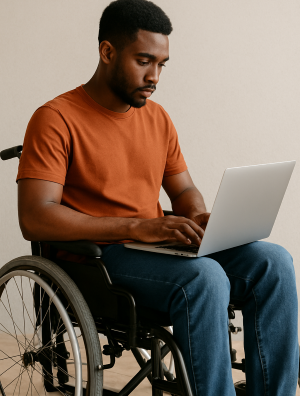
A business career presents a wealth of opportunities for young adults with disabilities. Far from being limiting, the dynamic nature of business allows for diverse roles that can be tailored to individual strengths and talents. By embracing a career in business, young adults with disabilities can not only achieve personal success but also contribute unique perspectives that drive innovation and inclusivity in the workplace.

A work Environment that Suits Your Need

In today’s business landscape, the ability to customize your work environment is crucial, particularly for young adults with disabilities. Many positions now offer the flexibility to work remotely or to adjust working hours, empowering you to work in ways that best fit your physical and mental needs. This flexibility allows for necessary breaks and adaptations in the workspace, ensuring optimal performance and well-being.

Cultivating Essential Skills

A career in business is a powerful avenue for developing key life skills such as communication, problem-solving, and critical thinking. These skills are invaluable, helping to equalize the playing field with peers and navigate complex business scenarios effectively. The more you immerse yourself in business challenges, the better equipped you become to handle professional and personal obstacles, enhancing your overall life experience.

Achieve Financial Stability and Independence

One of the most significant advantages of pursuing a business career is the potential for economic independence. Financial stability is essential for anyone, but for young adults with disabilities, it can be particularly empowering. A stable income allows you to make decisions based on your desires rather than your limitations. With financial independence, you gain control over your life, making it easier to plan for the future, invest in personal growth, and contribute to your community.

Unlock Entrepreneurial Opportunities

A business background primes you for entrepreneurship, where you can design a business model that specifically accommodates your needs and passions. Entrepreneurship challenges traditional employment barriers, providing the flexibility to innovate and drive change in your chosen field. This not only leads to personal fulfillment but also has the potential to impact others positively, establishing you as a leader and innovator in the business community.

The Power of Effective Networking

In the digital era, the art of in-person networking remains a crucial career builder, especially for young adults with disabilities seeking to break through barriers. Attending industry events and meetings not only bolsters your visibility but also opens doors to tailored opportunities and essential resources. To network effectively, actively engage, follow up with new contacts, and leverage these relationships to align with your professional goals. Despite the conveniences of online connections, face-to-face interactions hold unmatched potential for fostering meaningful collaborations and advancements.

Advocate for Yourself in the Workplace

Navigating the business world enhances your ability to advocate for yourself, an essential skill that ensures you receive the necessary accommodations to succeed. As you advance in your career, mastering self-advocacy allows you to effectively communicate your needs and rights, improving your workplace environment. This proactive approach not only benefits your career development but also serves as a benchmark for inclusivity, promoting a more equitable work culture.

Building Confidence Through Success

Achieving success in a business role boosts confidence and self-esteem, especially for young adults with disabilities who may encounter doubt and discrimination. Each success, big or small, validates your capabilities and contributes to a stronger sense of self-worth. By excelling in your role and exceeding expectations, you challenge and change societal perceptions, showcasing that your talents surpass any perceived limitations. This newfound confidence empowers you to pursue broader goals with vigor and resilience.

Choosing a business career can open doors to numerous opportunities for young adults with disabilities. This field not only values diverse perspectives but also provides the flexibility and support needed to thrive professionally. By stepping into the world of business, you can build a fulfilling career that leverages your unique strengths and contributes to a more inclusive workforce. The path is yours to shape, offering both personal growth and the chance to make a lasting impact.

(Photo credit : Freepik) Join the Centre for Disability and Inclusion Africa in championing a transformative society that embraces the rights and uniqueness of persons with disabilities across Africa

READ MORE

In pursuit of inclusive election and democracy in Nigeria

The beauty of democracy is in the aggregation of different and diverse voices within an entity. Democracy is essential because it incorporates voices of every population within the society. More than anything, ddemocracy provides an environment which respects human rights and fundamental freedoms. This is because democracy allows individuals to freely express their wills.

But when democracy comes with exclusions, it will be fraught with anger and distrust. Inclusive democracy is essential because ‘inclusive democracy fosters democracies’ acceptance and appreciation of diversity’.  When this is missing, democracy cannot foster an open society that embraces all. 

This position has been affirmed by the Kettering foundation when it put it succinctly “If democracy is the rule of the people, from this perspective “the people” is understood not as a unitary, homogeneous group, but rather as the whole people in all its diversity.”

One fundamental of democracy is election. The full benefits of democracy can only be achieved if all voices count during this process. Across the world, inclusive election and democracy is full of challenges. While the advanced world is trying hard to eliminate barriers, the developing world cannot be said to be making significant progress in this area.

Within Nigeria, several challenges continue to be on the road to achieve inclusive election and democracy. We must admit efforts are being made by stakeholders, which include Independent National Electoral commission (INEC), the highest electoral body in the nation. 

But our field work and research especially across Southwest Nigeria had exposed many of the flaws different disability clusters are complaining of because of their persistence exclusion. These clusters include mobility-impaired, visual and hearing impaired, Persons with Albinism as we as Persons with leprosy.

Centre for Disability and Inclusion Africa team with Mr Buba, INEC Lagos state PWDs Officer

In the wake of the coming elections in Edo and Ondo states among others, a three-person team member of our organization through its #Inclusiveelection #Inclusivedemocracy campaign engaged with the Independent Electoral Commission, Lagos state’s officer in charge of Persons with disabilities desk, Mr Buba.

The meeting extensively discussed the challenges of different clusters of persons with disabilities that had been identified and proffered possible solutions we had envisaged.

Mr Buba in conversation with CDIA team

Mr Buba, while speaking on behalf of INEC commended the work of the organization as he could see we had done a great work. Mr Buba also highlighted many of the steps taken by INEC to ensure inclusive elections across Nigeria. According to him “INEC continues to be an unbiased and inclusive organization that prioritizes everyone irrespective of status or shape”.

He further identified some of the challenges faced by INEC in the discharge of its duties to every citizen.  He showed some of the items made specifically to aid voting of persons with visual impairment, braille, efforts made to ensure there are sign language interpreters at polling booths as well as specific printed materials, posters, which contain direction, process on how to vote persons with hearing challenge can read where no sign language interpreter is available

At the end, we both agreed there is a need for ongoing conversation on how to ensure smooth transition of the process

.*Report put together by our Executive Director

READ MORE
Inclusion demands

Without data, Women with disabilities’ SRH will suffer untold hardship- Yinka Olaito

Persons with disabilities in Nigeria and especially, women with disabilities face a lot of social and institutional challenges. While Nigeria had signed various international charters of rights of persons with disabilities and had actually enacted Discrimination Against Persons with Disabilities Acts 2018 with over 75% of its state governments enacted disability laws  within the states, nothing much had changed.

A major problem facing implementation of the laws is the absence of data. While efforts are being made by various stakeholders to ensure accurate data are made available for planning, the speed of this is still snail-speed. 

Many women with disabilities continue to suffer untold hardship when it comes to proper planning and assessing sexual reproductive health needs. Governments at every level seem to be missing the mark when it comes to inclusive health, a major part of a sustainable and inclusive society.

More than ever before, if Nigeria will meet the global demand of an inclusive and sustainable society, there is an urgent need for  more publicity, awareness creation, sensitization, lobbying and full implementation of the national and state disability laws as well as their full domestication. To push for this, our ED, Yinka Olaito was on Wave FM 91.7 Portharcourt Nigeria on Wednesday July 31, 2024 during the Radio’s news segment from 6am, 12noon and 5pm

Here are some of things he emphasized

#Disabilitydata #Inclusion #Womenwithdisabilities #Sexualreproductivehealth The absence of credible and reliable data is a source of worry for persons with disabilities, (PWDs), in Nigeria.

In an interview on #Wave91.7fm Portharcourt as, the Executive Director of Centre for Disability and Inclusion Africa, I emphasized that the lack of data worsens hardships for individuals with disabilities in the country.

2. He  urged proper data collection and documentation of persons with disabilities to plan and support inclusive development.

3-He also urged stakeholders involved in sustainable development to prioritize inclusivity by completely addressing the needs of individuals with disabilities.

4. He stressed that policymakers remain unaware of how to effectively plan and implement inclusive smart cities, worsening the
challenges faced by PWDs, especially women with disabilities

READ MORE
Call for Actions

Green Africa Airline, Hon Olanrewaju: What we demand

About four days ago, a concerned member of community of persons with Disabilities reported a case of Green Africa Airline’ refusal to board Hon Olanrewaju Oladosu, a special Assistant to Osun state Governor on Disability matter as well as a Person with disability who was going in company of other 2 states official (Ekiti state Special Assistant to the governor on Disability Matter-Akin Obanise and Hon. Folasade Arise, Chair, Disability board of Ondo state) who were all going from Akure Airport to Abuja for an  official function that had to do with Disability Act review.

After a chat with this source, we saw a case of infraction of rights of persons with disability and decided to ask for redress. We created a campaign and shared online while other media houses were calling us to be involved.  We did ask for caution pending when we have all the facts. But more importantly, we requested to speak with the affected person in the case and every other party.

We did have a conversation with Hon. Olanrewaju who felt brutalized and accused the Airline of discrimination against him. He expressed regret that the Airline caused heightened levels of stress and other mental health issues for him. He acknowledged he was able to travel eventually by paying heavily to join Overland Airway to Abuja the same day. So did Green Africa discriminate against him?

Hon Olanrewaju said he had to go with another airline after the Akure station manager of Green Africa Airline told him they do not have space for his wheelchair among many other reasons. 

Meanwhile the organizer of the event who bought the tickets told him they had confirmed from the Airline if it would pick physically challenged passengers. He also pointed to lack of knowledge about disability laws as well as hostility towards PWDs by the ground staff.

To get the view of the Green Africa Airline, we  called the mobile of the station manager of the Airline in Akure, one Mr Tola, picked the call. After enquiries, he maintained the Airline does not have a policy against boarding a PWD but that the issue was that their plane doors are too narrow and a mandatory requirement for them was that passengers must not be a near zero mobility person like Hon Olanrewaju presented, Given the nature of their aircraft, a zero mobility person could not be helped through the aircraft doorway.

In addition to this, for emergency and on air evacuation, their policy requires a form of mobility by all passengers. That was the reason they (Green Africa Airline) always ask almost or complete zero mobility people to consider buying tickets from Airline operators with bigger planes if they are aware in advance. It was confirmed they returned the ticket fee paid so he could buy a ticket from another airline.

We spoke to both Hon Arise Folasade and Hon Akin Obanise, who are also PWDs and government officials on the same trip. These two individuals were allowed to board the same Green Africa Aircraft which had been pre booked for the three of them. While these individuals are also physically challenged, they do not have a near zero mobility but a higher level of reduced and can walk unassisted.

These two did confirm that the event organizer claimed they asked if the airline would pick physically challenged passengers before they bought the tickets. According to them, Green Africa customer service  was positive.

Hon Olanrewaju’s ticket, Green Africa promised Ramp and Wheelchair proviison

Unfortunately, the part of near zero mobility was never discussed with them. Also these two officials also complained bitterly about Green Africa Airline’s ground staff hostility and lack of knowledge of rights of PWDs passengers. They said they were subjected to queueing. This they had to make a case for as they were forced to be on a long queue while boarding at both Akure and in their return journey from Abuja.

The two also agreed that the kind of aircraft Green Africa Airline was using that day has a very narrow doorway which may not allow two passengers at the same time (The Physically challenged and the two who would assist in carrying him inside) 

Their major grouse was that none of the airline staff explained this but just insisted they have no space for wheelchair

What are the major issues we are raising in our campaign?

-Airlines need to be transparent in their policy. If aircraft at any of their routes may not accommodate a potential near zero mobility customer, let that be stated before passengers commit their money. We expect that if Airline cannot board a passenger with near zero mobility, it should be   clearly stated on their website or at the point of purchase.

-Airline ground staff, ground and in service, must be thoroughly tutored about excellent customer service especially when it comes to taking care of persons with disabilities wellbeing, on ground or in service.

-It is still very clear many Airline staff and operators do not know anything about disability rights and laws. Asking persons with disabilities to be on queue is a criminal offence.

-Greater awareness must be created within the PWDs communities to the effect that they must learn how to demand for their rights when this is denied.

READ MORE
Inclusion demands

Create disability and inclusion desk, Newsrooms charged

A commitment to the issue of disability and inclusion is seen when actions correspond with speeches.  A concerted action from every stakeholder will provoke faster acceleration of goals.  Issue of inclusion is everyone’s duty.  Everyone must be positioned to do their parts. The above and other thoughts were shared by faculty and participants at the Disability and inclusion reporting fellowship for Newsrooms in Northern Nigeria and Federal Capital Territory, a project that the centre ran in conjunction with   Africa Foundation for Young Media professionals as part of media initiative project

Cross section of the participants

The project is the second phase of Disability and inclusion reporting fellowship, which has been a yearly project since 2022. If the society must run faster in its inclusive and sustainable society drive, every stakeholder, including the media must be active in pushing the agenda. Media role in behavioural change communication is huge.

The 2-day intensive workshop event in Abuja, which was held between June 12-13, 2024, kick started the 2024 fellowship. The centre’s Executive Director, Yinka Olaito, took participants on the foundation of the course as well as charged them to understand that society can no longer wait. But first, if the media must readily do its work, they need knowledge about the issues they want to communicate.

Yinka Olaito called on Newsrooms to see the need to urgently create a disability and inclusion desk. “Newsrooms cannot stay behind if they truly want a change in societal behaviour. Journalists must be seen to do the right thing as well as lead the change”.

Oluseyi Olufemi, another faculty, on the other hand talked about the value of data in disability and inclusion reporting. He emphasized “data is not just about numbers; it must help the society see its impacts or failure”. Oluseyi demonstrated how data can enhance disability and inclusion reporting without been sensational,

On the second day of the event, Yinka Olaito also charged the participants to embrace learning in the area of appropriate language use. Words are powerful. “Even though the language use in the community is evolving, the more aware reporters are the better for their reportage” Yinka Olaito concluded.

Hannah Olayinka, an accessibility expert, charged participants on the need to embrace international protocol as well as good grasp of various charters of human rights of persons with disabilities entail so they can help cascade these to the rural community.

Adebayo Adebukola on his part challenged the participants to increase their knowledge about building collaboration and partnership for disability and inclusion reporting. While Journalists are supposed to know something about everything, they still need informed experts as sources in creating credible news items that are empowering as well as propel actions from the consumers.

Participants expressed their gratitude to the vent organizers about the new knowledge they just gained and itemised action steps they will be embarking on.

Aisha Shuaibi Baddegi of Citizen FM said “I have gained new insights and will begin to inculcate these in my reporting”. Another participant, Laraba Murrey, a reporter with Abuja Inquirer said “I am so happy to be part of this fellowship this year as I missed the fellowship narrowly last year. I am now better equipped than before and ready to distil this new found knowledge in my reporting”

Duro Maliki shared “I now have a better and informed understanding of disability and Inclusion Reporting. With this new armed knowledge, I see a new direction I should follow as a broadcast journalist with interest in disability and inclusion Reporting”.

READ MORE
Inclusion demands

Disability complaint, inclusive society requires stakeholders input-Yinka Olaito

As part of the Centre for Disability and Inclusion Africa’s media action and advocacy for a disability complaint and inclusive society, the Executive director, Yinka Olaito, continues the drive to ensure Nigeria(ns) as well as every actor are alive to their roles in promoting sustainable society that enables everyone to be their best.

In a 45-minute interview on Citizen FM Abuja, the host and Yinka Olaito talked about challenges that continue to hinder disability and inclusion policy as well as roles individuals can play to make the reality of sustainability a reality. For every open society, everyone is important. It is the agglomeration of all the interest as well of potential that can really make the difference.

Some of the nuggets Yinka Olaito discussed are:

-Society is as good as the people that make it up

-Living some behind will slow down growth and development of the society

-Disability and inclusion issues are not just an addendum but must be at the centre of every conversation.

-Persons with disabilities’ rights are also human rights.

-Persons with disabilities levels of creativity and innovation are very high and should not be underutilized.

– Discrimination against persons with disabilities bills, 2019 is already 5 years, it is time to uphold the demands of the bills.

-Encouraging and empowering under-represented voices will help the society more than side-lining their voices.

For a full interview, please listen to the recording below.

READ MORE
Inclusion demands

Impact Story, Osun state passes Disability Bill

In a landmark victory for Disability and Inclusion Community in Osun State and in Nigeria at large, it gladdens our heart as an organization to hear of the passage of Discrimination against Persons with Disabilities Bill yesterday by Osun State’s House of Assembly led by RT (HON) Egnetokun, who is the speaker of the state’s legislative arms.

Hon Adeyemi Irekandu, sponsor of the Osun Disability Bill with our Executive director.

With this passage, while waiting for the final consent of the Governor, Osun state had joined other South West states and many others in Nigeria in affirming the rights and privileges of persons with disabilities in the state,

As an organization, we have been following, monitoring progress of the bills from its introduction in the last legislative house. The bill was introduced by Hon Adeyemi Irekandu then but it did not see the light of the day because of party politics among others.

Hon Adeyemi Irekandu at CDIA Osun state Disability and Inclusion Stakeholders’Community Policy Dialogue.

With the inception of the new administration and legislative tenure, our effort had been direct and indirect in nature. One of our disability and Inclusion reporting participants/journalists and Publisher of Insight Media based in Osogbo has been our direct contact working with the Assembly and he was actually involved in the public hearing.

Members of Osun state Disability and Inclusion Community in CDIA program for the state.

Our indirect approach has also been to engage with the law maker sponsoring the bill(Hon. Adeyemi Irekandu) itself and in February 2024 during our Disability and Inclusion Stakeholders Policy roundtable in Osun State, we also engaged Hon. Adeyemi Irekandu on the progress and possibility of the bill seeing the light of the day. 

At the meeting, Hon Adeyemi Irekandu assured us the bill will be passed by the second quarter of the year latest.

As an organization, we believe this is the beginning of progress. We also know it will still be a long journey to freedom. The Governor will have to accent, then implement the demands of the bills: Persons with disabilities rights, establishment of Disability boards and its management among many other hurdles. 

We do know  states like Oyo and Ekiti, which had passed the bill are yet to have real structure in place and if anything at all, it is still at the inception stage.

All the same, congratulations to Osun State Disability and inclusion community and us. We see total victories at last

READ MORE
Digital Rights

16 African Journalists trained on Disability and Inclusion reporting

The global landscape and demand for inclusion in every sphere is putting pressure on every profession to play its roles. Journalism, media play vital roles in serving as catalyst for development as well as a channel of change orientation. If the world must get it right, journalists, broadcasters need to be ahead of all in information sharing which will strengthen inclusion protocols.

It is very clear that if journalists, broadcasters remain in the dark concerning any area, the hope of society of excelling in that area is slim. Disability and inclusion reporting is a technical area that requires knowledge and strong ability of media practitioners to communicate and break down issues in this area will make a great difference especially in Africa where the orientation about persons with disabilities related to ‘god is punishing the individual or the parents who gave birth to one.

A session on partnership and collaboration led by Treasures Uchegbu

The approach of many to persons with disabilities had largely been influenced by charity or humanitarian outlook. The media industry has a major role in dispersing such stereotypes as well as traditional beliefs that are not empowering.

Given the above scenario, Africa Foundation for Young Media Professionals(AFYMP) in conjunction with Centre for Disability and Inclusion Africa continues to organize yearly fellowship on Disability and Inclusion Reporting fellowship which spans six months beginning with 2  day intensive workshop where experts are brought together to expose participants(broadcasters, journalists across Africa) to fundamental of such reporting. This is often followed by mentoring as well as story publishing to affirm authenticity of knowledge gain.

2024 Disability and inclusion reporting started with a call for applications to select about 16 journalists, broadcasters. The call for application attracted over 200 submissions. The two days’ workshop (organized in hybrid form) was held at University of Ibadan Hotels. While welcoming the participants who had expressed willingness to learn, engage with relevant information that can help them become effective; Yinka Olaito, Executive director of AFYMP charged participants to place a premium on every section of the training as every section means so much if they will gain enhanced knowledge.

T

A session on essential of data to Disability and Inclusion reporting led by Disability and inclusion Consultant , Dr Toyn

he two days had experts from the industry exposed the participants fundamental and etiquette of disability and inclusion reporting, urgency, importance of data, language use, partnership and collaboration building, from awareness to action, group presentation etc

Feedback from the seven in-persons’ participants indicated that the simplicity of the session through breakdown of technical knowledge made a lot of difference. Another participant expressed her appreciation by saying “I used to carry the erroneous belief that PWDs are cursed or inhuman but with this training I had come to understand PWDs are as humans as every other person on street and that their rights are human rights as well”,

READ MORE
Inclusion demands

There is no end to discrimination against PWDs except… -Yinka Olaito

While it is a crime to discriminate or unjustly maltreat a person with disabilities(PWDs), it is a common knowledge, the act is pervasive and majority of such occur daily and are also under reported. The chances of stopping discrimination against PWDs is very slim especially across Nigeria and Africa at large where ignorance of the rights of PWDs are not promoted. Many PWDs do not even know they have rights, This is traceable to the fact that only three percent and one percent of males and females with disabilities respected fully are even educated.

The level of ignorance of existing laws, both at the global, continental, national or state level in Nigeria, of discrimination against persons with disabilities are very high.

Ignorance of the laws is not only limited to PWDs. Majority of individuals, state actors are not even aware. What many believe is that every act toward a PWD is just an act of charity. For instance, right of way when there is a long queue or emergency for PWDs is not a matter of courtesy but a criminal offence which attracts a fine or jail or even both. This fact is not known to people without disabilities.

A bus driver, either private or public, must stop fully to pick or disembark a PWD and should not ask him/her to jump out when the bus is still in motion.

Making a reasonable accommodation for an employee with disabilities so s/he can effectively discharge assigned duties are also fundamental.  So as long as ignorance pervades the system, PWDs are not also empowered to ask for their rights, the society should forget the cry for an inclusive society.

The above forms part of the conversation in this one-hour interview Yinka Olaito, our Executive Director, had on “The Conversation” program by Kaftan Television Abuja, which is aimed at examining existing policy and issues affecting the society.

Readers can listen to this in the link below

READ MORE
Disability and inclusion media traing

KFC and Debola Daniel, discriminations against PWDs in Nigeria must stop- Yinka Olaito

“To be a disabled in Nigeria is to be undesirable, unwelcome and unaccepted. As I’ve said before, it is lonely, it is a lonely, scary and isolated place”- Debola Daniels, a PWD

“Being disabled often rolls over my spirit, leaving behind a trail of shattered dignity and forgotten humanity. Nowhere more so than in Nigeria.”- Debola Daniel

The experience of Debola Daniel, a mobility impaired person who uses wheelchair. on March 26, 2024 continues to characterised discriminations many persons with disabilities experience in Nigeria. This is so for especially many with no voice or connection. Debola Daniel happened to be a passenger at Murtala Muhammed Airport this day and while waiting for his flight, he and his family made the choice of going Kentucky Fried Chicken(KFC) within the premise. But according to him, which he made a thread of on his X(twitter) account, a female manager of the service restaurant did not allow him in saying “No wheel chair allowed”.

From March 26, 2024, Debola Daniel had gained media front-page prominence, the Federal Airport Authority of Nigeria(FAAN) had wielded the big stick by closing the fast food brand because such behaviour contravenes discrimination against person with disabilities law in Lagos state among others. On his part, the executive director of the centre, Yinka Olaito, had through his media appearances and campaign against such inhuman treatment of Debola Daniel, which is just a fraction of many voiceless and unknown persons with disabilities in Nigeria go through.

While on TVC news, Yinka Olaito said the inhumane treatment, discrimination against persons with disabilities is very pervasive and grossly under reported. According to him “The point is there are many Debola Daniels among PWDs in Nigeria that experienced such discrimination daily. The fundamental or root cause of this is ignorance of laws as well as charity, humanitarian approach to PWDs rights. This must stop”.

Noting that many stakeholders are guilty in this area not even the government and its agencies are left out. For instance, Yinka Olaito said Debola Daniel’s flight  was delayed (this had become a regular occurrence with no penalty). Also that the elevator was not working made him look at the option of going to KFC.

Speaking on Wave FM Port Harcourt on the same issue, Yinka Olaito said “Government and its agencies must lead by example by making all its buildings accessible”.

Yinka Olaito concluded “Nigerians are good people with good interpersonal, cordial relationships with high sense of respect for their neighbours as well as a high regard for inclusiveness. Whatever had gone wrong must be corrected now”” He also called on the National Commission for Persons with Disabilities to scale up its work too in this area

READ MORE