
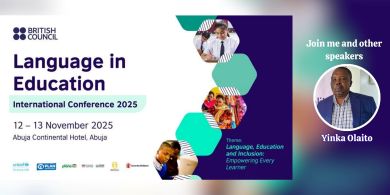
At British Council Language, Education and Inclusion conference CDIA advocates for Technology use
“The argument about mother tongue use in Nigeria coming up strongly at the this year’s conference to me is unnecessary if we have not settled the purpose or vision behind education in Nigeria. It is when we agree on what the foundation of education, which to me is literacy, is resolved we may not come to term with best approach to go”
“The fundamental purpose of education must begin with literacy (reading, speaking and listening). Language is a purveyor of knowledge and it is akin to identity, culture and class. When languages dies the culture of people die”
“To help strengthen language diversity for all learners, the use of technology, artificial intelligence here is important even though care must be taken so that technology should not deepen exclusion. “AI may not solve all language challenges, but ignoring minority languages will erode our diversity let’s ensure ai doesn’t deepen exclusion. Position AI as a “digital interpreter’ that promotes linguistic democracy in Classrooms”
Above are some of the submissions of Yinka Olaito, CDIA Executive Director, during his presentation on “Technology As a catalyst for Language Diversity for All learners’ session
The British Council, in partnership with the Federal Government and leading development organizations, convened a high-level dialogue to push forward bold strategies for inclusive, equitable, and transformative education across West Africa.
This the conference tagged “Language in Education International Conference 2025, with the theme “Language, Education and Inclusion: Empowering Every Learner.” Was attended by delegates from across sub–Saharan Africa, Asia and United kingdom. The high-level event had in present Nigeria’s Minister of Education, Dr. Maruf Tunji Alausa, who in his speech underscored the urgency of stronger collaboration among educators, policymakers, and institutions to deliver quality education for every Nigerian child.
The conference which held between12–13 Novemberat the Abuja Continental Hotel.
Over two intense days of plenaries, workshops, keynotes, and panel debates, participants examined the central role of language in shaping inclusive education. Discussions explored foundational learning, improved teacher training, responsive pedagogy for multilingual classrooms, and the power of technology and equitable assessment tools to support diverse learners.
“Language is more than a medium of instruction; it is a cornerstone of inclusion,” said John Simpson, Senior Advisor, English and School Education Programme, British Council. “This conference allowed us to reimagine education systems that reflect Africa’s linguistic and cultural richness—and ensure every child can thrive.”
Speaking further, Julian Parry, Director of English Programmes, Sub-Saharan Africa, described the British Council as “a trusted partner to governments and institutions, drawing on evidence, global insights, and deep listening to support context-driven educational change.”
The event strengthened cross-sector partnerships, elevated language as a critical pillar of education reform, and set the stage for actionable recommendations on language policy, teacher development, and inclusive classroom practices.
About the Conference
The Language in Education International Conference 2025, hosted by the British Council in Abuja, convened national and international stakeholders to explore how language can unlock inclusive and equitable education systems globally. The full programme is available in the conference brochure.
The conference now in its eighth year was organized with in conjunction with UNICEF, Plan International, FCDO PLANE, Sightsavers, Save the Children, and Sterling One Foundation. It brought together global and regional stakeholders: policymakers, educators, researchers, and development partners united by a single mission advancing language-driven, learner-centred education systems.