AI for All: Designing a Future That Leaves No One Behind
Artificial intelligence is rapidly transforming how we work, learn, communicate and solve everyday problems. But as AI becomes more embedded in our digital lives, one critical question must remain at the centre of innovation: Who is AI being designed for?
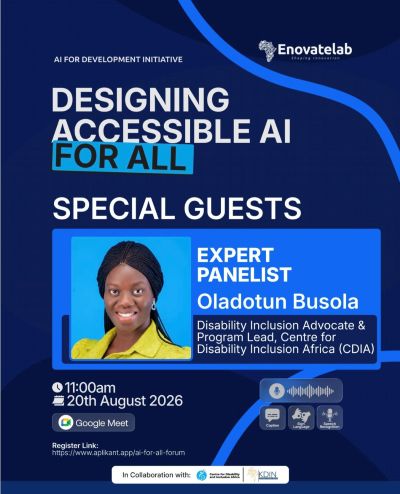
This question took centre stage at the Designing Accessible AI for All: Building a Digital Inclusive Future web summit, organised by Enovate Lab Kano and the Centre for Disability and Inclusion Africa (CDIA) in partnership with the Kano Digital Innovation Network. The summit brought together advocates, innovators, researchers and other stakeholders to examine how AI can become more accessible, affordable and relevant to everyone, particularly persons with disabilities and underserved communities.
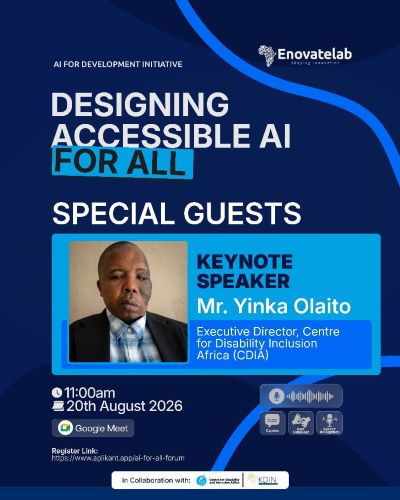
Delivering the keynote address, Yinka Olaito, Executive Director of the Centre for Disability and Inclusion Africa, challenged participants to think beyond simply creating “accessibility AI” towards designing accessible AI from the outset. He emphasized that inclusion must be intentional, moving beyond access to meaningful participation and empowerment.
Olaito outlined five commitments for building an inclusive AI ecosystem: design with people, build accessibility in, invest in assets, ensure accountability, and support new leaders. He also highlighted persistent barriers, including limited data, language diversity, affordability, policy gaps, algorithmic bias and inadequate representation.
A key message from the summit was that inclusive AI cannot be built in isolation. Government, the private sector, academia, technology developers, civil society and persons with disabilities must collaborate to ensure that AI reflects the realities of the communities it serves.
The panel discussion reinforced this position. Busola Oladotun, Senior Programme Lead at the Centre for Disability and Inclusion Africa, stressed that AI must leave no one behind. For her, accessibility means compatibility with assistive technologies, affordability, independence and the ability to address real-world needs.
The discussion also highlighted a significant Nigerian challenge: many existing AI-powered accessibility solutions are not sufficiently adapted to local realities. Issues around Nigerian accents, currencies, indigenous languages and limited local datasets can reduce the effectiveness of otherwise promising technologies.
The path forward therefore requires investment in local data, multilingual AI, research and development, inclusive policies and community-led innovation. Accessibility should not be treated as an afterthought or corporate social responsibility initiative; it should be embedded as a business and innovation priority.
For Africa, the opportunity is significant. Inclusive AI can help expand access to education, employment, healthcare, information and economic participation. But achieving that promise requires a deliberate shift from designing for communities to designing with them.
The summit ended with a clear call to action: build AI that leaves no one behind. As Africa shapes its digital future, inclusion must not be a destination added at the end of innovation. It must be part of the design from the beginning.
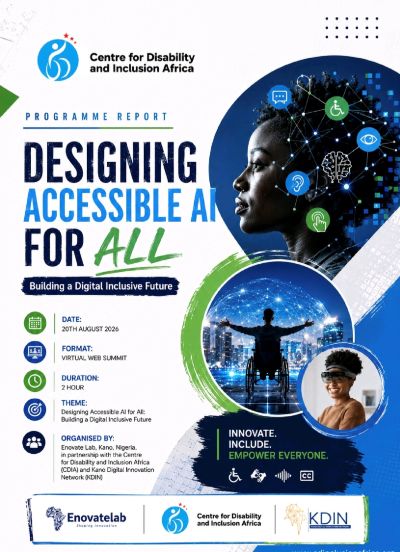
Read full report by clicking this You missed our ‘Designing Accessible AI for All webinar, get full detail here https://www.linkedin.com/posts/centre-for-disability-and-inclusion-afrioca_designing-accessinle-ai-for-all-project-report-activity-7496554422613950464-FTty?utm_source=social_share_send&utm_medium=android_app&rcm=ACoAAADvISMBTU41MOZ5_1tWjuc1uvWnb6jxACo&utm_campaign=whatsapp