
AI Must Hear Every Voice: Key Lessons from Disability–AI Dialogue in Lagos
Artificial Intelligence (AI) is rapidly reshaping how societies learn, work, communicate, and access services. From voice assistants and automated decision systems to educational technologies and biometric verification tools, AI is becoming deeply embedded in everyday life. Yet as these systems expand, a critical question continues to surface: who is being included in the design and training of these technologies, and who is being left behind?
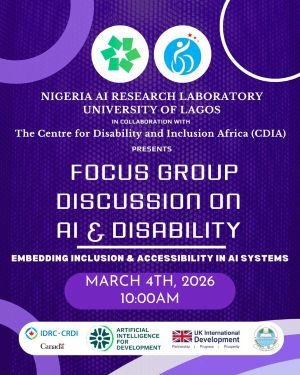
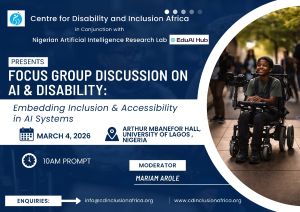
To explore this question, Centre for Disability and Inclusion Africa (CDIA), in collaboration with the Nigeria Artificial Intelligence Research Laboratory at the University of Lagos, convened a Focus Group Discussion (FGD) on Wednesday March 4, 2026, at Arthur Mbanefo Hall in Lagos. The event, themed “AI and Disability: Embedding Inclusion and Accessibility in AI Systems,” brought together persons with disabilities (PWDs), caregivers, AI researchers, Researchers, educators, and technology stakeholders to examine how emerging AI technologies intersect with the lived realities of people with disabilities in Nigeria.
Opening the session, representatives from the Nigeria AI Research Laboratory (Dr Oladipupo Senaike and Omotobora kemi)highlighted the importance of creating spaces where technology developers can listen directly to users whose experiences are often missing from innovation conversations. Yinka Olaito, Executive Director of the Centre for Disability and Inclusion Africa, encouraged participants to share openly and honestly so the discussion could produce meaningful insights and practical outcomes.
The dialogue quickly revealed a key concern: many existing AI systems are not designed with disability inclusion in mind.
The Invisible Bias in Artificial Intelligence
AI systems depend heavily on data. When the data used to train these systems lacks diversity, the resulting technology can unintentionally reproduce societal biases. Participants noted that facial recognition systems often struggle to identify individuals with certain physical characteristics, while voice recognition technologies may fail to interpret speech patterns associated with hearing or speech impairments.
For persons with disabilities, these are not simply technical glitches. They can translate into exclusion from essential services. In banking, security verification, digital learning platforms, and government systems, biometric technologies that fail to recognize diverse physical or sensory profiles can create new forms of digital discrimination.
Participants also highlighted structural challenges within Nigeria’s education system. Many special schools and inclusive learning institutions lack the digital infrastructure, assistive tools, and trained educators needed to expose learners with disabilities to emerging technologies such as AI, robotics, and data science. Without early exposure and adaptive learning opportunities, the next generation of students with disabilities risks being excluded from the innovation economy.
Recognizing the Diversity Within the Disability Community
Another key theme was the diversity within the disability community itself. Disability is not a single experience; it spans a wide spectrum of conditions including mobility impairments, visual disabilities, hearing impairments, albinism, and intellectual developmental disabilities.
Participants stressed that gender, social stigma, and economic inequality often deepen these barriers. Women with disabilities, for instance, frequently face additional challenges in accessing digital education and technology training. AI systems that fail to account for these intersecting realities risk reinforcing existing inequalities rather than solving them.
Listening to Lived Experiences
A major highlight of the focus group was the opportunity for participants to share their personal experiences with technology.
One participant, Mr. Femi Adeosun, who is hard of hearing, described the communication barriers faced by people with hearing impairments. He emphasized the need for real-time captioning tools that support local languages and African accents, noting that many existing solutions primarily function in global languages.
Another participant, Deborah, who is visually impaired, discussed the role AI-powered assistive technologies play in supporting independence. While tools such as screen readers and voice assistants have improved accessibility, she suggested the development of an AI-powered smart walking cane capable of detecting obstacles and guiding users through unfamiliar environments.
Caregivers also contributed valuable insights. Mrs. Abimbola, who cares for a child with an intellectual developmental disability, highlighted the potential of AI-powered educational tools that could simplify complex concepts and personalize learning experiences for children with diverse cognitive needs.
Artificial intelligence Cost Barrier
Despite the promise of AI-driven accessibility tools, affordability remains a major challenge. Many persons with disabilities cannot afford specialized devices such as smart mobility aids, assistive communication software, or adaptive learning technologies.
Participants called for increased investment in affordable assistive technologies, government support and subsidies, and stronger partnerships between researchers, technology developers, and disability communities. Ensuring affordability, they noted, is essential to prevent AI innovation from widening existing accessibility gaps.
From Dialogue to Inclusive Innovation
The presence of AI researchers and PhD students at the event underscored the value of direct engagement between technology developers and disability communities. Researchers acknowledged that the insights shared during the discussion would inform ongoing and future projects aimed at building more inclusive AI systems.
The focus group ultimately reinforced a powerful principle: inclusive technology must be designed with the participation of the communities it intends to serve.
Watch clip from the conversation on Youtube
As AI continues to shape the future of education, employment, and digital services, ensuring that its benefits are accessible to everyone is both a technological and social responsibility. By bringing together researchers, innovators, and disability advocates, this dialogue demonstrated that the future of AI must not only be intelligent it must also be inclusive by design.