Disability and multidimensional Poverty

Beyond Survival: Advancing Dignity, Rights and Economic Inclusion

The Centre for Disability and Inclusion Africa (CDIA) convened the October 2026 edition of its Disability Rights Webinar Series to examine the multidimensional nature of poverty among persons with disabilities and explore sustainable pathways towards inclusion, dignity, and equal opportunity.
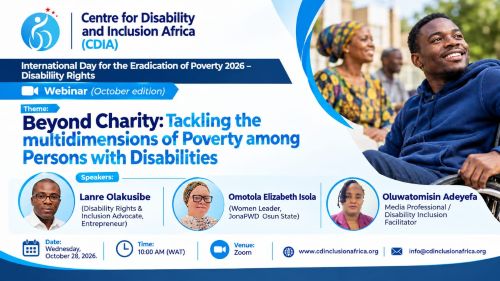
Facilitated by Busola, the webinar brought together disability rights advocates and inclusion practitioners, including Janet (Omotola Elizabeth Ishola), Lanre Olakusibe, and Tomisin Adeyefa, to discuss how poverty extends beyond financial hardship to encompass barriers to education, healthcare, decent work, social protection, accessible housing, justice, food security, and civic participation.

Rethinking Poverty Through a Rights-Based Lens

A central message from the discussion was the need to move beyond charity-driven interventions towards a rights-based approach that addresses the structural barriers perpetuating poverty among persons with disabilities.

Janet emphasised that exclusion is often reinforced by inaccessible environments, discriminatory institutions, limited economic opportunities, and negative social attitudes. She called for stronger enforcement of disability rights legislation, accessible education, inclusive employment, transparent empowerment programmes, and reliable data to identify those being left behind.

Her message was clear: persons with disabilities deserve equal rights, meaningful opportunities, and the conditions to live with dignity, not simply assistance to survive.

Sharing a personal experience, Lanre Olakusibe recounted being denied a job interview because the building was inaccessible. His experience illustrated how physical barriers can prevent qualified individuals from accessing employment before their abilities are even considered.

He outlined five priorities for reducing disability-related poverty: accessible education and skills development; decent work and employment opportunities; strengthened disability-inclusive social protection; accessible housing and transportation; and the meaningful participation of persons with disabilities in decision-making.

From Temporary Assistance to Sustainable Empowerment

Building on these priorities, Tomisin Adeyefa highlighted the importance of transforming charitable support into structured, accountable, and sustainable empowerment initiatives.

While acknowledging that charity can provide an essential safety net, she stressed that it must be complemented by clear objectives, monitoring, mentorship, and measurable outcomes. She also advocated targeted skills-development programmes linked to employment opportunities, alongside government incentives, such as tax relief, for businesses that employ persons with disabilities.

Participants further raised concerns about weak government channels for poverty reduction, the risk of empowerment programmes being managed by individuals without the necessary accountability, and the importance of transparent implementation.

Rita also emphasised the need to prioritise children with disabilities, noting that early support can foster confidence, independence, and positive attitudes towards participation from a young age.

Building an Inclusive Future Through Collaboration

The webinar concluded with a call for coordinated action among government institutions, the private sector, civil society organisations (CSOs), and organisations of persons with disabilities (OPDs). Participants stressed that effective poverty eradication requires persons with disabilities to be involved not merely as beneficiaries, but as active partners in designing, implementing, and evaluating solutions.

As follow-up actions, CDIA will continue sharing opportunities, including international scholarships for persons with disabilities, through its social media platforms, while webinar recommendations and the session recording will be shared with relevant stakeholders and interested participants.

The October edition reinforced an important principle: disability-inclusive poverty eradication must address systemic barriers, uphold rights, and expand opportunities for meaningful participation. Through sustained collaboration, accountability, and inclusive policies, CDIA remains committed to advancing a society where persons with disabilities can exercise their rights, realise their potential, and participate fully in all aspects of life.
READ MORE
Inclusion demands

Inclusive Hiring: The Competitive Advantage Modern Workplaces Can’t Ignore

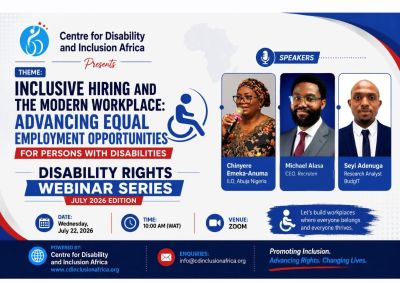
Building an inclusive workforce is no longer a matter of corporate social responsibility it is a business imperative and a human rights obligation. As organizations navigate the future of work, creating equitable employment opportunities for persons with disabilities (PwDs) is essential to building resilient, innovative, and diverse workplaces.

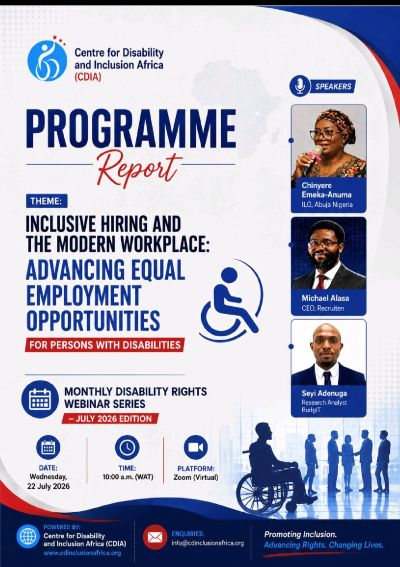
This was the central focus of the July edition of the Centre for Disability and Inclusion Africa (CDIA) Disability Rights Webinar Series, which convened policymakers, employers, development partners, advocates, and persons with lived experience to explore practical pathways toward disability-inclusive employment in Nigeria.

Opening the session, CDIA reaffirmed its commitment to fostering dialogue that holds governments, employers, and institutions accountable while promoting policies that guarantee equal opportunities for all. The webinar underscored a simple but powerful message: inclusion is not charity—it is good governance, sound business, and social justice.

Delivering the keynote presentation, Mrs. Chinyere Emeka-Anoma of the International Labour Organization (ILO) Nigeria Country Office examined the global and national frameworks driving disability inclusion in employment. She highlighted the ILO’s role in promoting inclusive labour standards through international conventions, policy guidance, and technical support while acknowledging Nigeria’s progress with the Discrimination Against Persons with Disabilities (Prohibition) Act, 2018, and the establishment of the National Commission for Persons with Disabilities.

However, she noted that legislation alone is insufficient without effective implementation. Persistent barriers—including inaccessible infrastructure, workplace stigma, weak enforcement mechanisms, and limited disability-disaggregated data—continue to hinder equal employment opportunities. She also advocated for Nigeria’s ratification of ILO Convention 159 on Vocational Rehabilitation and Employment of Persons with Disabilities to further strengthen the country’s commitment to inclusive labour practices.

From the employer’s perspective, HR consultant Michael Alasa challenged organizations to rethink recruitment processes through the lens of accessibility and equity. He emphasized that inclusive hiring is fundamentally a capability decision, not an act of goodwill.

Michael outlined practical strategies for employers, including writing accessible job advertisements, removing bias from recruitment systems, providing reasonable accommodations during interviews, ensuring recruitment technology is accessible, and using structured, competency-based assessments. He encouraged organizations to conduct end-to-end audits of their recruitment processes, establish partnerships with disability organizations to widen talent pipelines, and track inclusion metrics at leadership level to drive accountability.

Adding a powerful personal perspective, Seyi Adenuga, Research and Policy Analyst at BudgIT and a person with lived experience, highlighted the intersection between disability inclusion, public budgeting, and employment. She revealed that despite persons with disabilities representing an estimated 15 percent of Nigeria’s population, budget allocations targeted at disability inclusion remain disproportionately low, with implementation gaps further limiting impact.

Seyi announced commitments to translate budget analysis documents into Braille and other accessible formats, monitor disability-related budget implementation quarterly, advocate for the full implementation of the 5 percent employment quota for persons with disabilities in public institutions, and expand remote work skills training in areas such as graphic design and video editing. She also proposed fellowship opportunities to amplify the voices and research contributions of persons with disabilities.

The interactive discussion that followed reinforced a recurring theme: the greatest barriers to inclusion are often systemic rather than individual. Participants called for stronger enforcement of disability legislation, greater awareness among HR professionals, accessible workplaces, and a shift in organizational culture that recognizes disability inclusion as a strategic advantage.

At CDIA, we believe that meaningful inclusion requires collective action. Governments must enforce existing laws. Employers must intentionally remove barriers to employment. Development partners must continue supporting inclusive policies and capacity building. Together, these efforts can transform workplaces into environments where talent not disability—defines opportunity.

Creating an inclusive workplace is not simply about opening doors; it is about ensuring that once those doors are open, everyone has an equal opportunity to thrive.

Read full report here or click this link https://www.linkedin.com/feed/update/urn:li:activity:7485680499429052417/

READ MORE
#JusticeforUcheCampaign

The Closure. Impact of the #JusticeforUche Campaign

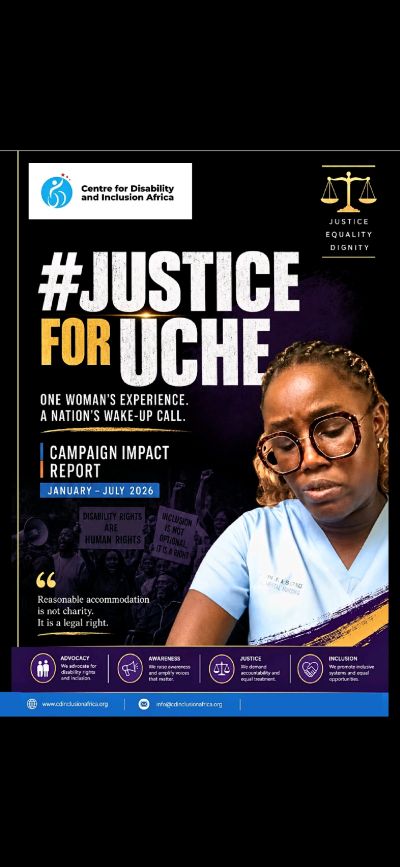
The Centre for Disability and Inclusion with mixed feelings is bringing a closure to #JusticeforUcheCampaign. Between January and June 2026, the Centre for Disability and Inclusion Africa (CDIA) led the #JusticeforUche campaign, a strategic advocacy initiative that transformed the experience of one visually impaired nurse into a nationwide conversation on disability rights, institutional accountability, and inclusive education in Nigeria.

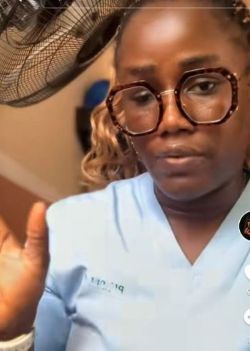
The campaign was launched after Uche Olivia, a registered nurse with visual impairment, publicly alleged that she was denied reasonable accommodation during an entrance examination for a post-basic mental health nursing programme. Her account highlighted a challenge faced by many persons with disabilities: exclusion from educational and professional opportunities due to inaccessible systems and practices.

CDIA responded by positioning the issue not as an isolated grievance, but as a broader human rights concern linked to the Discrimination Against Persons with Disabilities (Prohibition) Act in Nigeria. The campaign sought to demand justice for Uche, raise public awareness of the legal obligation to provide reasonable accommodation, influence institutional reform, and mobilise citizens, disability organisations, media stakeholders, and policymakers around the cause of inclusion.

The campaign achieved significant visibility and engagement. More than 14 million stakeholders were reached, generating over 40 million impressions across media platforms. An estimated 96% of frontline media houses in Nigeria provided coverage, including national newspapers, online publications, radio stations, and television networks across the South and West of the country. This extensive coverage amplified the campaign’s message and contributed to its rapid spread across digital platforms.

@uchey_olivia

#tiktokviraltrending #viraltiktokvideo #visualimpairment #disabilitytiktok #discrimination the sad thing about fighting for a particular cause in Nigeria, is the fact that as long as it doesn’t have a direct effect on other Nigerians, they do not care if the system gets fixed. But they also forget that, people are one mistake, one carelessness, and one failed system away from becoming persons with disability.

♬ original sound – Uchey_Olivia
@uchey_olivia

#tiktokviraltrending #viraltiktokvideo #visualimpairment #disabilitytiktok #discrimination I was discriminated against and refused, reasonable accommodation as a person living with disability, during an examination in a city in Nigeria. I tried to seek for Justice and this is the story on how far it has been. At the end of the day, in Nigeria, if you want to fight a bad system, you have to first fight your fellow Nigerian. It has been a sad experience.

♬ original sound – Uchey_Olivia

As public attention intensified, the Forum of Lawyers with Disabilities became involved and indicated readiness to pursue legal action against the institution at the centre of the allegations The FederalNeuoro-Psyschaitric Post Basic Mental Health Nursing School Enugu.

 This development prompted efforts toward a noted lobbying effort to appease to the victim through direct engagement with the victim which was turned down.. However, the legal process was later complicated by the withdrawal of a key witness and Uche’s subsequent admission to an academic programme outside Nigeria, which affected the prospects for court proceedings.

Despite these challenges, the campaign delivered important outcomes. It significantly increased national awareness of disability discrimination and the importance of reasonable accommodation. Through coordinated media engagement, opinion articles, interviews, and digital storytelling, the narrative shifted from sympathy for an individual to a demand for systemic reform. The hashtag #JusticeforUcheOlivia became a rallying point for disability advocates and citizens who shared similar experiences and called for institutional accountability.

The campaign also strengthened the public understanding that disability inclusion is fundamentally a rights issue, not a charity initiative. It provided an evidence-based platform for engaging policymakers and educational institutions on compliance with disability legislation and reinforced CDIA’s position as a leading voice for disability policy, advocacy, and inclusive media in Africa.

Several lessons emerged from the campaign, including the need for stronger institutional responsiveness, sustained coalition-building, and closer examination of barriers that may discourage witnesses and vulnerable individuals from pursuing justice.

Read full report here or click this link https://www.linkedin.com/feed/update/urn:li:activity:7484961742993940480/

Overall, #JusticeforUche stands as a powerful example of how strategic communications and advocacy can elevate a single voice into a movement for national reflection and reform. While long-term policy outcomes are still evolving, the campaign has already made a meaningful contribution to advancing disability inclusion and reinforcing the principle that equal opportunity requires accessible systems, reasonable accommodation, and accountable institutions.

READ MORE
Accessibility Audit and Design

Digital Apartheid: Nigeria’s Visually-Impaired Left Behind

When registered nurse Uche Olivia Moujekwu was denied exam accommodations at the Federal Neuropsychiatric School in Enugu, her story exploded across Nigerian social media. #JusticeforUcheOlivia trended. News outlets covered it. Disability advocates mobilised.

But when Esther lost a scholarship because an inaccessible website forced her to ask for help, and that helper made a mistake, nobody knew. No hashtag. No outrage. No justice.

This is the difference between visible and invisible exclusion. Physical barriers can be filmed, shared, and spark movements while digital barriers, the ones that lock 1.3 million blind Nigerians out of websites every single day,  happen in silence.

The data showed that 73 strategic Nigerian websites fail blind users, revealing systematic exclusion across government, media, and civil society. But numbers alone cannot convey what it means to live within this digital darkness, to wake up each morning knowing that the platforms structuring modern life were built without you in mind.

These are the voices of four visually-impaired Nigerians, a business owner, a disability rights advocate, a young professional, and a counsellor-entrepreneur, who navigate a digital world that refuses to see them.

The Email She Never Knew: Philomina’s JAMB Ordeal

Ukwueze Ifeanyi Philomina is a counsellor and entrepreneur who has been technically blind for most of her life. Her JAMB experience isn’t just frustrating it’s proof that bad design can quietly wreck a blind person’s future. “When I wrote JAMB, they asked for an email. I tried to do it myself,” she says. “But TalkBack doesn’t read everything.”

Key fields showed up as blank “edit boxes.” Navigation was invisible. The system didn’t just fail her it shut her out. After hours of trying, she did what many visually-impaired Nigerians are forced to do: she handed over control. “The person helping me used his own email,” she recalls. “It felt like a quick fix. It seemed fine.” It wasn’t. She got her result. She gained admission. Life moved on until graduation. “We checked the JAMB matriculation list. My name wasn’t there. I was shocked.”

Her entire academic record was tied to someone else’s email. That person was gone. So was access. “He gave me three different emails. None worked. I was locked out. Completely.”

A shortcut forced by inaccessible design came back years later—nearly costing her graduation. This wasn’t about performance. It was about design failure. The system forced dependency. Dependency created risk. And that risk almost erased her progress. To fix it, Philomina had to physically visit a JAMB office multiple times. What others do in minutes on a phone took days of stress, explanations, and bureaucracy.

And the pattern doesn’t end there.

On the NIMC platform, helpers misspelled her name. On recruitment portals, her screen reader pushed her forward only for the system to reset and wipe everything. Same story. Every time: Inaccessible design to Forced dependency to Systemic vulnerability and  Real loss. Philomina’s story isn’t rare. It’s the system working exactly as designed.

The Scholarship Lost to a Wrong Date: Esther’s Story

Adams Esther 

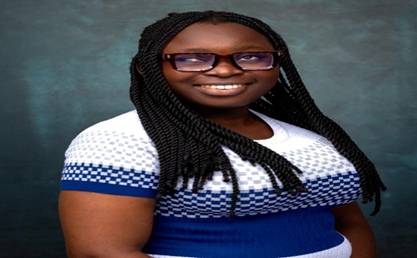
. Esther has been visually impaired for 21 years. In the last six years, she’s built and sustained her own wristwatch business independent, capable, thriving. But her encounter with the NCDMB Foundation scholarship reveals a brutal reality: inaccessible design doesn’t just frustrate—it disqualifies. “When I was in 200 level, I qualified for the scholarship,” she says. “I tried to fill the form myself. But I couldn’t. I had to give it to someone else.” The portal was a dead end unlabeled fields, broken date pickers, screen reader chaos. Independence wasn’t possible.

So she trusted someone. “Unknown to me, the person entered a wrong date,” she says. “Imagine. They told me I was qualified, but there were errors and I lost it.” One wrong date. One invisible mistake. One opportunity gone not because she failed, but because the system did. Today, Esther depends on sighted help for over half her digital life banking, shopping, applications handing over her phone, her passwords, her privacy.

“It makes me feel like my dignity is reduced,” she says. “I want to live like everyone else. But giving people my phone—it feels like my privacy is constantly invaded.”

Then it happened again. She prepared everything for a grant—essay ready, documents complete. But the upload button wouldn’t work with VoiceOver. Again, she had to hand over control. “The person submitted it without my consent,” she says. “I didn’t even get to review it.” Her application went out unfinished. Not because she couldn’t do it—but because the system wouldn’t let her. This is what inaccessible design does: it doesn’t just exclude—it erases.

 “Create With Us, Not For Us”: Oluwakemi’s Call to Action

Oluwakemi Odusanya 

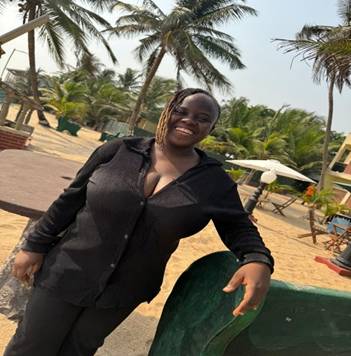
Oluwakemi Odusanya has lived with visual impairment for 20 years. She’s a disability inclusion advocate. A broadcast professional. A voice for participation. Yet a government portal (INEC) had erased her vote. In 2022, she tried to get a new PVC. The INEC platform demanded face verification. “I tried… I could not do it.” That was it. No workaround. No alternative. No vote. “That’s why I did not participate in the last election.” A system built for citizens locked one out completely. The irony isn’t subtle. It’s systemic. The same exclusion follows her into everyday life.

Experience with PiggyVest

She downloads PiggyVest. It doesn’t just fail it vanishes. “It becomes silent. Not clickable. I had to delete it.” For others, it’s a savings app. For her, it’s nothing. The mobile app, where Nigeria actually lives shuts her out. Silence becomes denial.

Then her CIPM exam.

The CIPM test platform is another story? Inaccessible. The solution? A human reader had to be provided. The problem? The reader couldn’t read. “The person… cannot even pronounce the signs and symbols. “in this situation, she’s not just taking an exam, she had to simultaneously decode someone else’s confusion. The problem was compounded because she can’t use her own screen reader. This challenge might result to her answers being flagged as fraud. Invariably this isn’t just assessment but a major obstruction and by extension an exclusion.

Her fix is blunt: “Create with us. Not for us.” Accessibility isn’t expensive. Neglect is. “If you include us from the start, it’s easy. It’s when you remember us at the end that it becomes costly.”

The Zoom Incident

Esther forgets to mute during a class. Her dog starts barking. People shout: mute yourself. She can’t find the button. “I had to switch off my phone to leave.” What could have been a one-second tap for others became a full shutdown for her. That is a huge gap in the design.

Banking As Visually-Impaired is terror

Philomina opens a banking app. Silence. “The screen reader just stops talking.”  As some of the apps features made it inactive. No voice. No access. No control. So she faces a choice: stay locked out or hand over her financial life. PINs. Balances. Transactions. “When it’s money, you only call someone you trust… otherwise, it’s risky.” Privacy becomes a privilege. Even when apps improve, they punish speed. OTP codes expire before she can navigate back. “Swipe, swipe… by the time you return, it says timed out.” Security works for some. For her, it blocks.

What Accessibility Actually Means?

Ask what they want, and the answers are simple. “Better productivity.” “Independence.” “Speed.” Not extras. Just basics. They already work. Build. Study. Contribute. But slower. Harder. Limited. Not by blindness, but by design. “We are getting things done,” Esther says, “but not as great as it should be.” For Philomina, it comes down to one thing: “You must finish what you start… or go find someone.” Accessibility changes that. It doesn’t just improve experience. It restores control.

Read full story written by Fawaz adebisi here

READ MORE
Disability and Entrepreneurship

Women With Disabilities Demand Inclusion, Confidence and Policy Action at Lagos Summit

A daily experience of many women with disabilities in Nigeria is perpetual exclusion. For them exclusion is a next dorr neighbour not a faraway stranger. For this major reason, today, being Wednesday 21sst January, 2026 in Lagos, this reality took centre stage as women with disabilities, alongside their parents and carers, came together for a landmark summit organised by the Star Children Development Initiative.

The gathering was more than a conference; it was a space for shared stories, reflection and renewed determination. Participants spoke openly about the social attitudes, policy gaps and structural barriers that continue to push women with disabilities to the margins of Nigerian society.

Held under the theme “Women with Disabilities, Parents and Carers Summit,” the event drew disability rights advocates, caregivers, professionals and community leaders from across sectors. Through conversations, skills-building sessions and collaborative strategising, attendees examined how exclusion persists—not only in public spaces and institutions, but also in decision-making processes meant to protect their rights and improve their quality of life.

Central to the discussions was the lived reality of women with disabilities who remain largely invisible in policy debates, despite being directly affected by laws and programmes on health, education, safety and economic participation. For many in the room, the summit represented both a moment of affirmation and a call to action: that inclusion must move beyond rhetoric to deliberate, sustained change.

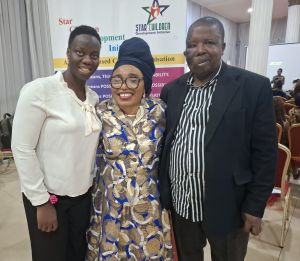
Our team with The ED Star children, at the event

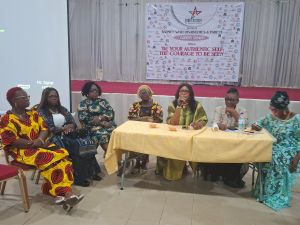
iA panel session during the Summit

n her keynote address, Prof Chinwe Nwani challenged participants to embrace authenticity, reject internalized stigma which can strengthen and build their confidence as a pathway to personal and collective transformation. “Authenticity is power,” she told the audience. “When women with disabilities show up fully as confidence and prepared without apology, they can easily challenge stereotypes, disrupt exclusion and create new possibilities for leadership and visibility.”

Read full post here

Feedback from the event

READ MORE
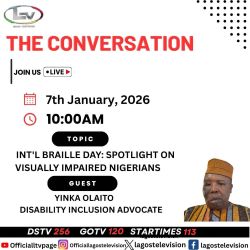
International Braille Day 2026

CDIA Sends a Strong Message on World Braille Day 2026

World braille Day, marked annually on January 4, commemorates the birth of Louis Braille, whose revolutionary invention transformed access to information for millions of blind and visually impaired people worldwide. Braille remains a powerful tool for literacy, learning, and independence, enabling blind and partially sighted persons to read the same books, periodicals, and educational materials as those printed in standard visual formats.

Beyond its practical value, Braille is fundamental to education, freedom of expression, access to information, and social inclusion. Its importance is firmly recognized by the United Nations and enshrined in Article 2 of the Convention on the Rights of Persons with Disabilities (CRPD), which affirms accessible communication as a basic human right, not a privilege.

Yoruba Language talk on Honor FM Ibadan- “Gbagede Oro

However, World Braille Day must go beyond ceremonial celebration. It is also a critical moment to raise awareness about the lived realities of persons with visual impairments—whether partial sight loss, long-distance vision challenges, or total blindness. Globally, over 2.2 billion people live with some form of visual impairment, according to the World Health Organization. In Nigeria alone, an estimated 1.3 million people are affected. These figures underscore the urgency of sustained advocacy, inclusive policies, and systemic reform.

Selaye on Harmony FM Ilorin

Across Nigeria and much of Africa, many visually impaired persons continue to face deep-rooted discrimination and social exclusion. Too often, they are treated as less than fully human, with stigma extending even into families, where some parents and caregivers struggle to publicly identify with or support their children. These social attitudes are compounded by weak implementation of disability inclusion policies at various levels of government.

Yoruba news on Fresh FM Ibadan

As a result, access to quality education, healthcare, financial services, social protection and employment opportunities for visually impaired persons continues to deteriorate. This reality reinforces the need for deliberate, strategic advocacy, robust policy engagement, and accountability-driven inclusion efforts.

In line with this commitment, the Executive Director of the Centre for Disability and Inclusion Africa (CDIA) used World Braille Day 2026 as a platform for high-impact media engagements and advocacy interventions across multiple radio and media outlets, in both local languages and English. These engagements focused on promoting Braille literacy, challenging harmful stereotypes, and calling for stronger government action to uphold the rights of persons with visual impairments.

World Braille Day is not only a celebration of an invention it is a call to action. CDIA remains steadfast in amplifying this call until accessibility, dignity, and inclusion become lived realities for all.

READ MORE
#JusticeforUcheoliviaCampaign

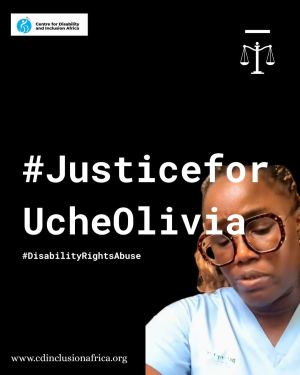
CDIA Launches #JusticeForUcheOlivia Campaign to Defend Disability Rights

Today, January 6, 2026, the Centre for Disability and Inclusion Africa (CDIA) has launched a powerful new advocacy campaign #JusticeforUcheOlivia calling for justice for a visually impaired nurse in Nigeria who was unjustly denied the right to sit her professional Mental Health Nursing Examinations by the Post Basic Mental Health Nursing School, Federal Neuro-Psychiatric Hospital, Enugu.

This campaign is not just about one nurse; it is a bold stand against systemic barriers that continue to impair the educational and professional aspirations of persons with disabilities across Nigeria and the African continent.

Who is Uche Olivia and Why Her Case Matters

Uche Olivia is a dedicated visually impaired nurse whose commitment to serving communities is rooted in resilience, compassion, and professionalism. After years of study and preparation, she was unlawfully barred from sitting her Mental Health Nurse qualifying exams — a decision that not only undermines her dignity and rights but sends a discouraging message to all persons with disabilities pursuing careers in health care. This act is a stark violation of her constitutional and human rights, including her rights to: equal access to education and professional examinations, reasonable accommodation and support. dignity, respect, and non-discrimination

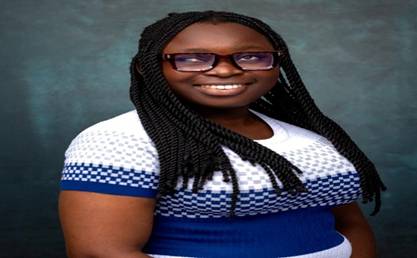
Uche olivia(photo Credit: Uche olivia)

Uche is just one out of hundred persons with disabilities in Nigeria who suffered such and by launching the #JusticeforUcheOlivia campaign, CDIA asserts that no Nigerian or African with a disability should be sidelined from opportunities they have worked hard for, simply because of bias, lack of accommodation, or institutional inertia.

Why This Campaign Matters to CDIA

At the Centre for Disability and Inclusion Africa, our mandate is clear:

To uphold the rights, dignity, and full participation of persons with disabilities in all spheres of life education, employment, health, policy, and civic engagement.

The denial of access to examinations for a visually impaired professional strikes at the heart of our mission and reflects broader societal challenges: persistent misconceptions about the capabilities of persons with disabilities, lack of reasonable accommodations in educational and professional setting, weak enforcement of disability rights and inclusion policies

The #JusticeforUcheOlivia campaign is not only about correcting an injustice it is a call to transform systems and mindsets that continue to marginalize persons with disabilities.

What CDIA Will Do to Achieve Justice and Equity

To drive meaningful change, CDIA has outlined a strategic set of actions that combine advocacy, legal engagement, community empowerment, and policy influence:

1. Public Awareness and Advocacy Through the #JusticeforUcheOlivia campaign, CDIA will: amplify the voices of Uche, other nurses, and persons with disabilities. use media, social platforms, and community forums to highlight barriers in professional education, educate institutions about disability rights, equitable access, and best practices for accommodations

2. Policy Engagement

CDIA will engage government bodies, regulatory agencies, professional schools, and nursing councils to: revise and enforce inclusion policies, publish clear accommodation guidelines for examinations, monitor compliance with the Disability Rights Law and national , inclusive education mandates

3. Capacity Building and Support Networks

We will work with education institutions to:  Train staff on disability inclusion, develop accessible learning and examination support systems, create peer support networks for students and professionals with disabilities. We will also build capacity, publish scorecards for higher institution and examination bodies as well as students’ guiderails for other visually imp [aired as well as persons with disabilities on what they need to know or demand as their rights etc

On a lat note, we may institute

4-Legal Support and Strategic Litigation

CDIA will collaborate with disability rights lawyers and leg al aid organizations to: File appropriate legal actions to challenge the discriminatory decision seek redress and reasonable accommodations for Uche and future candidates, Advocate for enforcement of disability inclusion laws

The story of Uche Olivia is a reminder that justice delayed is dignity denied. But it is also a call to action  to governments, institutions, professionals, allies, and citizens to stand up for inclusion, equity, and human rights.

We invite you to:

Support #JusticeforUcheOlivia, Share Uche’s story on your platforms, Advocate for disability inclusion in your institutions, Join us in holding duty-bearers accountable

A Future Without Barriers

Inclusion is not an optional extra  it is a fundamental right. When we remove barriers, we create spaces where every person, regardless of disability, can contribute, lead, and thrive.

At the Centre for Disability and Inclusion Africa, we believe in a Nigeria and an Africa where no ambition is stifled by prejudice or policy gaps. Through this campaign and sustained advocacy, we are committed to turning that belief into reality.

Stand with us. Stand with Uche. Stand for justice. #JusticeforUcheOlivia

Join the Movement for Justice and Inclusion. To support this campaign, please send mail to info@cdinclusionafrica.org

READ MORE
CDIA Impact Story

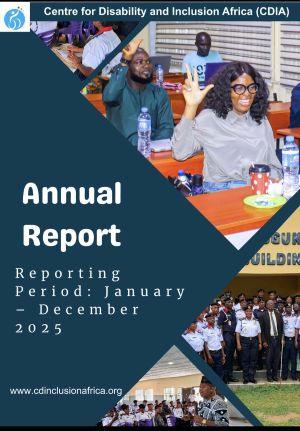
CDIA Celebrates 2025, Publishes Project Successes

With the closure of 2025 in the last 8 days, the Centre for Disability and Inclusion Africa (CDIA) pause to reflect not just on the passage of another year, but on the tangible progress made in advancing disability rights, inclusion, and social justice across Nigeria and beyond.

This year had been one of bold advocacy, strategic partnerships, and measurable impact. Despite persistent systemic barriers faced by persons with disabilities, CDIA remained steadfast in its mission: to challenge exclusion, influence policy, and amplify the voices of those too often left unheard.

Driving Justice and Accountability

One of CDIA’s most visible successes in 2025 was its national advocacy #WheelChairNotLuggage as well as  access to education  for persons with persons with disabilities across the nation. Through sustained media engagement, policy briefs, and strategic reports, CDIA helped push disability accommodation from the margins into national discourse. The  #WheelCAhirNotLuggage campaign became a rallying point mobilizing civil society, journalists, legal experts, and regulators to confront discriminatory practices that criminalize disability.

Strengthening Inclusive Systems

Beyond advocacy, CDIA delivered targeted programmes aimed at strengthening institutional inclusion. Working with schools, examination bodies, and public institutions, the organization supported the development of disability inclusion guidelines, promoted reasonable accommodation standards, and built the capacity of duty-bearers such as Nigeria Security and Civil Defence Corps in Ogun and Osun States Nigeria to comply with Nigeria’s Disability Act. Beyond this, the Centre also ran its Disability and inclusion reporting fellowship with Africa foundation for young Media professionals. The yearly media fellowship aimed at equipping journalists, broadcasters and other media professionals or sustained shift narrative that position disability issues in human right frame

These efforts directly contributed to improved awareness, pilot reforms, and renewed commitments from key stakeholders to institutionalize inclusive practices rather than treat them as discretionary acts of goodwill.

Strategic Partnerships and Continental Engagement with disability inclusion ecosystem and other collaborators

In 2025, CDIA deepened collaborations with national and international partners, including disability-focused funders, media organisations, and development actors. These partnerships expanded CDIA’s reach, enabling cross-border learning, stronger advocacy coalitions, and alignment with global disability inclusion frameworks.

The organisation also played an active role in shaping conversations on gender, democracy, and freedom of expression—ensuring disability inclusion remained central to broader development and human rights agendas across Africa.

Evidence, Visibility, and Voice

A defining feature of CDIA’s work this year was its commitment to evidence-based advocacy. Through research, policy analysis, and storytelling, CDIA documented lived experiences of exclusion while proposing practical, rights-based solutions. Its thought leadership—published through blogs, opinion pieces, policy briefs, and media appearances—helped reframe disability from a charity issue to a justice and governance imperative.

Looking Ahead

As CDIA publishes its 2025 project successes, it does so with clarity and resolve. Progress has been made, but the work is far from done. In 2026, CDIA will scale its advocacy, deepen monitoring of policy implementation, and expand programmes that place persons with disabilities at the centre of decision-making.

READ MORE
Inclusion demands

Denied, Humiliated, excluded: The Cost of Being Visually Impaired in Nigeria

In Nigeria, losing your sight too often comes with something far worse than blindness: the loss of dignity. Across exam halls, hospital corridors, and government offices, visually impaired citizens are routinely denied basic accommodations, shamed for seeking help, and systematically shut out of opportunities that others take for granted.

This is not a story of personal tragedy or misfortune—it is a damning indictment of a system that treats disability as a nuisance, not a matter of rights.

Uche Olivia, A Visually Impaired Nurse Alleges Discrimination at Federal Neuropsychiatric Post Basic Mental Health Nursing School, Enugu

Uche Olivia, a registered nurse licensed in 2022, says she experienced this cruelty firsthand. Diagnosed in October 2024 with optic nerve atrophy—a condition causing severe vision loss—she was determined to specialize in mental health nursing. But her ambition collided with a rigid, unaccommodating system.

In a video that went viral in 2025, Uche alleged that the Federal Neuropsychiatric School of Post-Basic Mental Health Nursing, Enugu, denied her reasonable accommodations during its entrance examination. She had formally requested large-print question papers, a reader, or extra time—and followed up days before the exam.

On the morning of the test, Uche arrived before 8:00 a.m., only to find that accreditation began two hours later, and the exam itself did not start until about 5:00 p.m.a reflection, she says, of a system that thrives on waste and disorganization.

Despite repeated reminders to examiners of her condition, no accommodations were provided. When she sought help during the exam, an examiner allegedly told her: “If you knew you were not able to read, why did you come to school or apply?” The encounter left her in tears.

Later, when Uche met with the provost and offered to present her medical documentation, she claims she was dismissed and advised to: “Answer the ones you can see, leave the ones you cannot.”

Humiliated and discriminated against, Uche is now seeking admission to a more inclusive institution while urging authorities to investigate the barriers faced by persons with disabilities across Nigeria’s education system.

At the time of publication, the Federal Neuropsychiatric School had not responded to repeated requests for comment.

Nigeria’s Law is Clear

The law leaves no room for ambiguity: denying visually impaired candidates accommodations is illegal.

The 1999 Constitution guarantees equal educational opportunities and prohibits discrimination. The Discrimination Against Persons with Disabilities (Prohibition) Act, 2018 goes further, mandating inclusive education and reasonable accommodations in all learning and assessment processes.

Candidates are entitled to Braille or large-print papers, audio or electronic formats, approved scribes, extended exam time, quiet venues, and the use of assistive devices. Denial of these accommodations is not merely administrative it is a punishable offense.

“Keeping quiet without punishment is inappropriate. Today it is Uche Olivia, tomorrow it can be another person,” said Susan Ihouma Kelechi, a disability advocate.

Voices of rage, Advocates and Experts React

Leaders of the Joint National Association of Persons with Disabilities (JONAPWD) condemned the school’s treatment of Uche.

Abdullahi Usman, National President, described it as “a display of ignorance in a federal institution. The law is explicit about reasonable accommodations for visually impaired candidates. We will investigate and ensure the highest authorities act.”

State chairpersons echoed the sentiment. Ondo State’s Olusegun Abiodun called it “inhuman treatment” and demanded swift action. Bayelsa State’s Mayo Ekpomomukor said: “Everyone has the right to education. The school must apologize and implement policies to prevent future injustices.”

Yusuf Olatunji and Susan Kelechi, both leading disability advocates condemn the act as a sign of a system that continued to be rigid when the whole world is moving fast in its inclusion journey. “How do we continue to deny visually-impaired and other PWDs their rights and assume nothing is wrong” both of them echo.

Dapo Taiwo, National President of Association of Assistive Technology Professionals berate the school, if act still took place in 2025, as there is no legitimate reason when every institution can receive help necessary from relevant organizations so they can better serve their potential students”

Disability advocates and lawyers, including Felix Areo and Salami Abolarinwa, emphasized the legal obligations schools owe. Areo, visually impaired himself, said: “This sends the wrong signal from a federal institution. Denial of accommodations should be challenged legally, and oral exams or assistive measures should have been options.”

Barrister Abolarinwa cautioned that some details needed verification but added: “Even with missing information, there is a clear element of discrimination and denial of rights against Uche Olivia. She was not given a fair chance as the law demands.”

Government Officials Speak Out

Special Assistants on Disability Inclusion in Osun and Bayelsa states, including Oladosu Olatunbosun and Mayo Ekpomomukor, criticized the federal institution’s actions. Princess Folashade Arise, Ondo State Chairperson for Welfare of Persons with Disabilities, expressed frustration: “Why are we still discussing discrimination and abuse of rights in this age? It is disheartening and base.”

Who Must Act and Why It Matters

Visually impaired Nigerians face routine exclusion from exams and professional assessments. Educational institutions must institutionalize disability support, professional bodies must enforce clear accommodation protocols, and regulators and ministries must stop issuing hollow circulars. The National Commission for Persons with Disabilities must act decisively.

The media, too, has a role: disability must be reported as a rights issue, not charity.

A candidate asking for Braille, assistive technology, or extra time is not seeking an unfair advantage they are demanding fairness. Until Nigeria treats inclusive assessment as central to education, claims of progress remain hollow. Disability is not inability. Exclusion is.

READ MORE
Inclusive Accommodation in Nigerian higher Institutions

From Access to Inclusion: Nigeria Universities Must Uphold Disability Rights

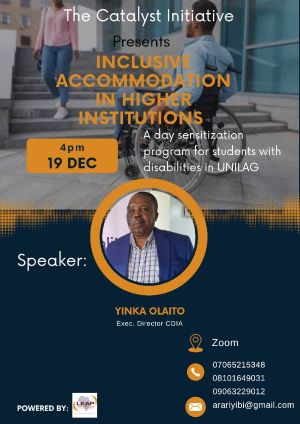
Inclusive accommodation within Nigeria’s university system is not an act of charity it is a fundamental human right. Once an institution makes the decision to admit a student with a disability, that decision must automatically translate into full inclusion across academic, social, and residential life. Any form of exclusion or denial of these rights is unacceptable in this day and age and must be firmly discouraged.

These were some of the key concerns raised by Yinka Olaito, Executive Director of the Centre for Disability and Inclusion Africa (CDIA), during a stakeholders’ meeting convened for students with disabilities at the University of Lagos by The catalyst initiative. The meeting, themed “Inclusive Accommodation in Nigeria’s Higher Institutions,” brought together students, advocates, and disability cluster leaders, with Olaito serving as the lead speaker.

Advocating for Accessible Campus Accommodation

The session focused on the urgent need to improve accessibility and inclusion for students with disabilities within university hostels and campus infrastructure. Discussions explored practical steps such as the establishment of disability-focused units or groups within institutions to address accommodation gaps, policy failures, and systemic barriers.

Olaito emphasized the importance of:Clear and enforceable inclusive accommodation policies, strong legal and institutional frameworks and disability awareness and sensitivity training for university staff and students

Participants were encouraged to assert their rights, demand accountability from university authorities, and work collectively toward the establishment of functional disability desks across campuses. A key outcome of the discussion was a call for the formation of a unified association representing students with disabilities within the university system.

Inclusive Education and Legal Frameworks

Speaking on inclusive education in Nigerian universities, Olaito underscored that students with disabilities have an equal right to access, participation, and dignity. He highlighted the need for coordinated institutional policies, accessible facilities, and the removal of physical, academic, social, and digital barriers that continue to limit participation.

He also pointed participants to existing legal instruments including the Discrimination Against Persons with Disabilities (Prohibition) Act, 2018, as well as relevant international conventions ratified by Nigeria—as powerful tools students can use to advocate for their rights.

The Reality of Disability Accommodations on Campus

Assessing the current state of accommodations in Nigerian universities, Olaito noted that provisions remain largely below acceptable standards. Essential supports such as accessible learning materials, assistive technologies, extended examination time, and disability-friendly hostels are either inadequate or completely absent in many institutions.

He further stressed the importance of disability awareness training to help staff and students better understand the diverse needs across different disability clusters. Anti-discrimination policies, inclusive student activities, and clear reporting mechanisms for rights violations were identified as critical steps toward meaningful inclusion.

Strengthening Disability Structures in Universities

Olaito also called for the institutionalization of disability inclusion through the creation of disability desks and the appointment of dedicated inclusion officers within universities. These structures, he noted, are essential for providing sustained support and ensuring compliance with national and international disability rights standards.

Contributions from student leaders added further depth to the discussion. Ajibade Oluwaseyi, a former president of the National Association of Nigerian Visually Impaired Students, spoke on ongoing efforts to establish a unified association for all students with disabilities at the University of Lagos. Falola, representing students with mobility challenges, emphasized the need for stronger representation and awareness for physically challenged students.

The session concluded with a call for participants to complete a questionnaire and provide feedback to help guide future advocacy and programming.

The Way Forward: Collaboration and Collective Action

In outlining next steps, Olaito emphasized the importance of collaboration in establishing a strong and representative Students with Disabilities Association at the University of Lagos. He reaffirmed CDIA’s commitment to working closely with students and university authorities to achieve this goal.

READ MORE