The Centre for Disability and Inclusion Africa with is overarching goal to build or create an inclusive African society where persons with disabilities fully enjoy their inherent rights, participate equitably in civic life, and are represented fairly in media and public policies has launched a new service for the Disability and inclusion ecosystem called DEI-HUB. The Centre for Disability and Inclusion Africa has been recently named Africa leading Disability Inclusion Nonprofit
DEIHUB is set to be a leading Africa-based Diversity, Equity, and Inclusion (DEI) advisory and consulting service unit aimed at helping organizations build inclusive workplaces that drive innovation and growth. DEIHUB will blend global best practices with deep African insights to deliver tailored training, strategic advisory, and culture transformation programs. DEIHUB is simple: to unlock Africa’s full potential by turning diversity into a competitive advantage for individuals and organizations across the continent.
The executive Director of the centre, Yinka Olaito while announcing this project said “It is our delight to help build structure and systems for individuals and forward looking organization which prioritizes diversity, equity and inclusion but lack the technicality of making such work”. Yinka Olaito while sharing also made the it clear that “Disability Inclusion is a core development issue no one wants to overlook as it effects can be highly detrimental.
DEIHUB is poised to offer the following helps to organizations across Nigeria and the continent. Strategic DEI Advisory, it will do this by offering guide to leadership teams to embed diversity and equity into their core strategies. Tailored Training Programs: From unconscious bias to inclusive leadership, our sessions are designed to shift mindsets and behaviors.
DEIHUB will also offer Organizational Culture Transformation. Through this it will help organizations create inclusive systems, policies, and cultures that drive innovation and sustainable growth.
The uniqueness of this project under Centre for Disability and Inclusion Africa is that it offers only African Context, Global Standards, evidence-Based Approach as well impact-Driven, measurable and transformative change and sustainable inclusion
Promoting Disability inclusion must be preceded with intentionality and goal.Championing inclusion means more than acknowledging diversity. it requires actively building a fair and equitable environment where every individual feels valued, supported, and empowered to contribute fully. This commitment is demonstrated through intentional actions such as challenging biases, raising awareness, setting clear DEI goals, promoting diverse representation, offering mentorship opportunities, and ensuring accessible systems and practices.
When organizations champion inclusion, they not only foster higher employee engagement and stronger performance, but also unlock greater creativity, drive innovation, and contribute to a more equitable society by attracting and retaining diverse talent.
Strategies for leading inclusion crusade
Championing inclusion rests on several core principles. The first is advocacy, which involves actively promoting the value of diversity, equity, and inclusion (DEI) in both policies and practices. Equally important is awareness and education, where individuals and organizations commit to building awareness about the importance of inclusion and educating others on the many dimensions of diversity.
Another principle is fostering a culture of belonging creating environments where everyone feels safe, respected, and encouraged to share their unique perspectives and experiences. Finally, it is essential to emphasize equity over equality, ensuring that opportunities and outcomes are fair. This approach recognizes that people may require different forms of support to succeed.
What others can learn and do about championing Inclusion To champion inclusion effectively, individuals and organizations must translate principles into action. To start with, individuals must learn to challenge biases when you noticed discriminatory behavior, be bold to question long-held assumptions about diversity. This may be impossible if an individual does not have a balanced and diverse perspectives of what diversity really means. It takes a mind that actively solicit and embrace different viewpoints that can enrich decision-making. Read full story here
For disability inclusion issues to be mainstreamed properly and shared effectively with every stakeholder, the media, especially the Journalism industry must play a major role in ensuring right information that shatters stereotypes, wrong beliefs, biases, prejudices etc are daily addressed so the public can be informed.
— Centre for disability&inclusionafrica (@cforinclusion) July 8, 2025
As an organization, we had noticed a perceived knowledge gap in this area hence the need to organize this yearly fellowship with the Professionals, a pan Africa media industry skills development nonprofit recently named as 2025 Leading pioneers in media industry Development in Africa, has become imperative.
— Africa Foundation for Young Media Professionals (@africamediafdn) July 8, 2025
This yearly media fellowship has been running for four years consecutively and it is jointly organized for early and mid -level journalists, broadcasters selected from various newsrooms across Africa.
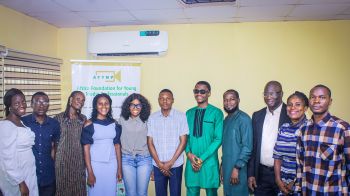
This year selected only 16 participants who are broadcasters, print and online journalists from various newsrooms across Africa. The outcome and excitement were palpable among the delegates as they leave the initial intensive one day workshop that usually kickstart the 3-4 months fellowships where participants go through training, virtual mentoring and story publishing sessions
One of the participants, Wahab Hussain said ” I have attended several trainings in the past but sincerely speaking, this is one oi the best… this is not just a workshop, but a reminder or further information on what we had known. This is is an entire world that is very concerning…. no one should be left behind, very unique” Hannah Omokafe said “it is an honoured to be part of this” Salmon Rukaya Eniola said ” i walked into the training thinking I had good understanding of disability, I walked out with a broader , deeper and a more humans len,s understanding that inclusion is not about ticking the box or a pith party”
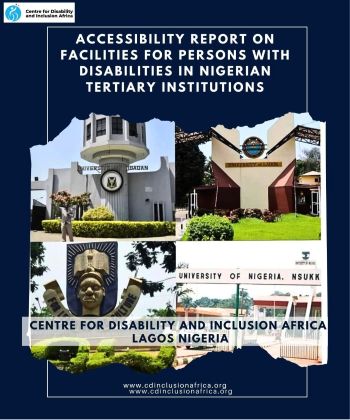
The Centre for Disability and Inclusion Africa is set to launch its Accessibility Reports on Nigerian Tertiary Institutions facilities for Students/Persons with Disabilities.
The report process which covers sample of all the tertiary Institutions within six geo-political zones of Nigeria is now ready for release on Wednesday April 30, 2025.
The launching will run consecutively with the organization’s monthly Disability Rights Webinar Series of April, 2025.
The Executive Director, Yinka Olaito, said he was happy at the development as the report showed some of the fundamental issues the organization had often raised with regards to educational rights of persons with disabilities in Nigeria and how facilities available are making this seem impossible.
According to Yinka “Even though this report is a pilot study that covered all the accessibility basics as well as the first in Nigeria that covered the six geo-political zones Tertiary Institutions, we do hope it will serve as a pointer to what needs to be done urgently”.
The report which revealed a lot about the lack of preparedness of the majority of Tertiary institutions in Nigeria to accommodate students/persons with disabilities did also affirm that many of the institutions have disability friendly policies on Paper among others.
Centre for Disability and Inclusion Africa continues to use every platform to push for a better and inclusive society for all. Conversation and dialogue building with stakeholders remain one of the best ways to achieve meaningful progress.
January 2025 edition of Disability Rights Webinar Series (DRWS) was organized to step up conversation around ongoing corporate campaigns aimed at combating rights abuses of persons with disabilities with specific references to Physically-challenged persons in Nigerian Society.
Yusuf Olatunji
The campaign- #WheelChairNotLuggage challenged behavioural and attitudinal acts directed at this cluster which over the years had remained a concern to everyone. While the campaign has enjoyed massively the support of the media as it has become viral, more conversations are still needed, coupled with other physical activities.
Comrade Mayor Ekpomomukor
The four speakers in this January webinar were Susan Ihuoma (gender and Inclusion Advocate), Yusuf Olatunji (Accessibility Expert), Mayor Ekpomomukor (Senior Special Assistant to Bayelsa State Governor on General Duties as well as Chairman, Bayelsa state Chapter of Joint Association of Persons with Disabilities) and Mohammed Abba Isa9Senior Special Assistant to the President on Special Needs and Equal Opportunities)
Susan Ihuoma
A common and resounding echo that was reinforced by all the speakers was that there is need for behavioural change and stakeholders’ orientation, especially public transport operators. More importantly it was agreed that government and policy makers need to do more than they are currently offering.
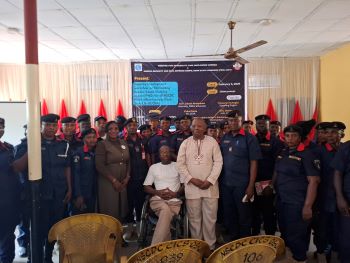
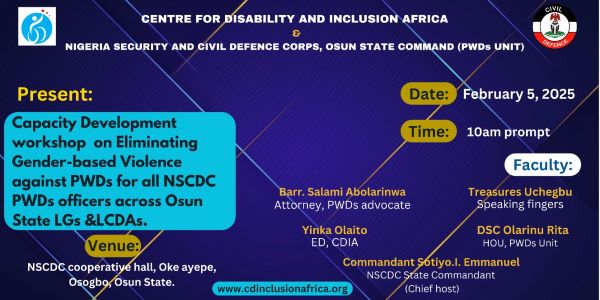
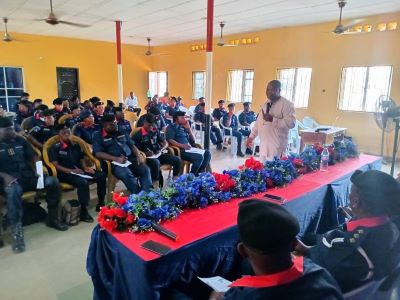
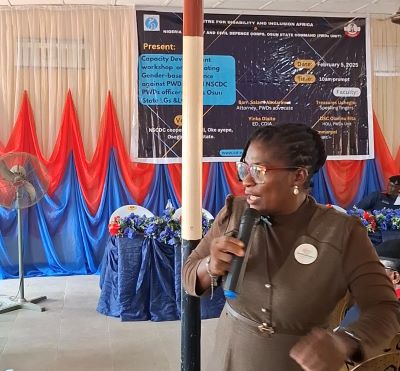
Centre for Disability and Inclusion Africa (CDIA) held a one-day capacity development workshop for Osun State Command of Nigerian Safety Civil Defense Corps (NSCDC) PWDs Unit officers on Eliminating gender based violence against Person with Disabilities (PWDs).
The training which took held on Wednesday, 5th of February at the NSCDC co-operative thrift Hall Oke-Ayepe, Osun state, had in attendance experts and advocates in the disability field as faculties such as, Yinka Olaito(E.D CDIA), Treasures Uchegbu and Barrister Salami Abolarinwa who joined via zoom.
While Opening the workshop, the representative of NSCDC state Commandant, Commandant Sotiyo I. Emmanuel appreciated the CDIA team for such a huge contribution to the state’s Officers. According to him “We honour such a huge sacrifice from CDIA as we are aware this is not funded but a commitment to make a change””. The Commandant then charged his officers to “Pay attention to the knowledge to be shared
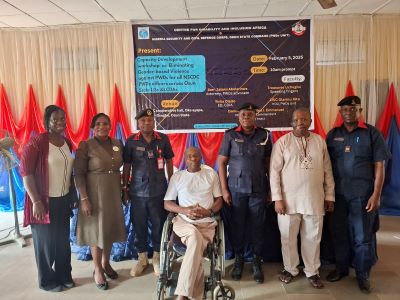
NSCDC Osun State Commandant representative, State head of training, state’s head of PWDs unit and CDIA team
The head of the PWDs Unit in the state’s Command DSC Rita Olarinu, also commended CDIA team for coming to Osogbo for the capacity Development workshop.
Yinka Olaito took the first session of the lecture titled “Strengthening Inclusive Society Through Disability Knowledge” Yinka Olaito explained the different types of disabilities and their categories. He also stated there are 7 recognized clusters of persons with disabilities in Nigeria namely; The physically challenged, Albino, Dwarf, Visually impaired, hearing impaired, Intellectually challenged and Speech impairment.
He also talked about the discrimination against PWDs and terms that should be used and not be used. For example, we should avoid the use of words like deaf and dumb or should call a Visually impaired person blind. Then as officers, when attending to PWDs, they should describe who they are as a person as well as a warm person
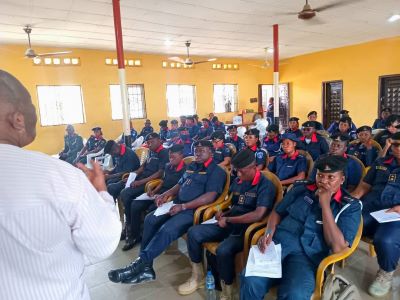
Cross section of some of the participating Officers
n his second lecture titled” Introduction to Gender Based Violence (GBV), Yinka olaito explained the different kinds of gender based violence where he listed psychological violence, physical violence, sexual violence amongst other. Also stating the causes of GBV such as poverty, conflict and crisis and so on.
Yinka Olaito noted that Gender Based Violence is on the rise especially against PWDs but many cases are not reported because of getting justice. He charged officers to make sure people get justice whenever cases are reported and not shun them up. Because when the victims don’t get justice, it creates more room for oppression.
Treasures Uchegbu took the third session. The lecture was titled; Gender-Based Violence Against Person with Disabilities”” She made it clear during the lecture that women with disabilities are the major victims of GBV. From sexual harassment, forced marriage, Rape and psychological violence.
Treasures explained that when women/girls with disabilities encounter any of these forms of GBVs, many of them never get justice. When a person with disability reports a rape case, they get responses like ” you should thank God someone slept with you” and this makes them more vulnerable to their oppressors and also put the victim into depression. She highlighted that some women with disabilities are forced into marriages they do not want because their parents feel “they are doing them a favour.
Treasures stated during the lecture that PWDs have a mind and rights of their own and they shouldn’t be seen as lesser humans and their opinions should be respected.
Treasures Uchegbu
At the end she urged officers to give attention to PWDs and communicate with them often. She also shared a sign language booklet to participants of the workshop.
Legal Framework and Best Practices for Promoting and Enforcing PWDs’ Rights session was taken virtually by Barr. Salami Abolarinwa. He shared extensively on the laws guiding the rights of PWDs and legal procedures around it.
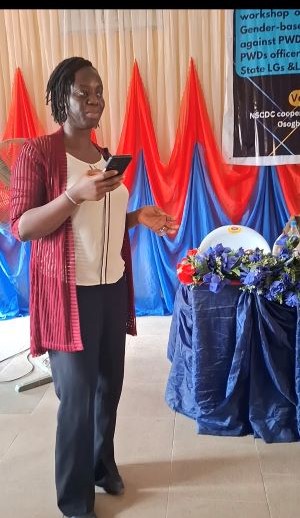
Busola Oladotun, the project officer for CDIA explained the policies for PWDs
Busola Oladotun
During the questions and answers session, one of the participants asked that in a case where a Visually impaired person is the victim of GBV, how can we be sure he/she recognizes the oppressor? Yinka Olaito answered that most Visually impaired person’s uses their sense of smell to Identify people.
Closing the workshop, DSC. Olarinu Rita who is the Head of Unit for the PWDs desk NSCDC Osun State thanked the CDIA team for the eye opening workshop. She acknowledged that there were things she got to know for the first time through the workshop and she assured that officers are going to make sure they will be zero tolerance for Gender Based violence in each of their districts.
The 77 Officers who participated in the trade were selected from all the 33 Local Governments and LCDAs across Osun State.
The journey of inclusive society is a long walk to freedom. Almost all the states within South West in Nigeria now have its own state’s Disability Laws. The challenge of Ogun state’s Disability Acts is still a concerned to all as the state has something it can refer to as Disability Acts since 2017 but we believe quite a lot of grey areas in the Laws remain a concern and therefore we cannot wholeheartedly say Ogun Disability Acts is really what it is.
Anyway for Osun State, which recently joined others in enacting state’s Disability Laws in 2024, can be said to be on the right course. Unlike many other states where long delay in setting up implementation processes. Osun state in the less than a year had started full implementation of the law, within six months, Osun state Bureau of Persons with Disabilities had been established with the appointment of an Executive Secretary- Ayobami Ayotunde, and other key officers are now in place.
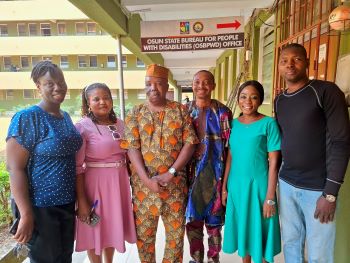
An operational office has also been created for the Bureau within Ministry of Finance. Even though the office is yet to be fully equipped so as to allow full operations but at least the office offer a take-off place of operation. As a sign of readiness to commence full action, the Agency request a policy and collaborative meeting with the Centre for Disability and Inclusion Africa on Tuesday 4th February, 2025 at its office in Osogbo Osun State.
At the meeting, while welcoming CDIA team, Mrs Jumoke Femi-Ojetola, a senior staff pf the Agency said “’It is our pleasure to have your team tin our office. It shows your commitment to the Disability ecosystem”.
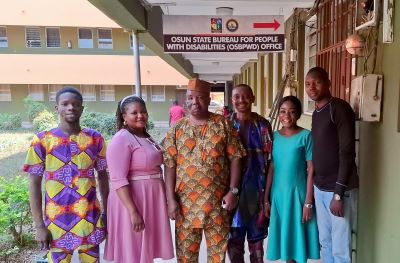
CDIA team and OSun state Bureau of Persons with Disability Agency
The Executive Secretary, Aypbami Oyetunde on his part praise CDIA for its commitment to Disability Inclusion matters across Nigeria and Africa as the organization’s work speaks for it. According to Ayotunde “It is our pleasure to meet within your team as we look forward to partnership and collaboration which can help push our corporate objective forwards”.
He also called on CDIA to keep giving necessary support through capacity development and other useful collaborations especially at this early stage of the Bureau when it has no funding which we hope to secure form the Governor soon.”
While responding, Yinka Olaito, Executive Director of CDIA, praised the speed at which the implementation of the Disability Bills in Osun state implementation process is going. Having a commission set in place with eight months after enactment of the Bill is praise worthy. “We are happy at the speed Disability Bills in Osun state is moving and this is commendable” Yinka Olaito said.
On possible collaborations and support Yinka Olaito said “As much we are also NGO with limited funding, what we are sure is that we will support the Agency with in the area of capacity Development, knowledge management and information sharing as well as in guidance in the area of operational, corporate governance system which help the Bureau to be properly positioned to get required attention from other global development Agencies and support organization”
“The media, journalists are the vanguard of justice and truth, if they fail in this duty, the society will suffer. There is no justice without justice for marginalized voices. The world cannot move faster if the underserved continue to be marginalized.”. Above are some of the submissions at African Investigative Journalism Conference 2024 which was held at Johannesburg South Africa from Wednesday October 30- Friday 1st November. 2024.
African Investigative Journalism Conference is an annual event that brings the best of the continent’s investigative, media and journalists from across the world. It is organized by Wits centre for journalism, a unit within Witwatersrand University, Johannesburg’s Journalism department. The event is always packaged with activities: talks, panel sessions, masterclasses, networking, award sessions, dinners among many others.
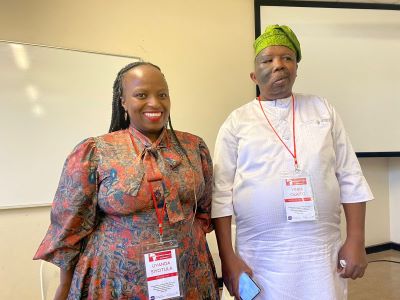
L-R (The session moderator , Siyotula Uyanda and Yinka Olaito)
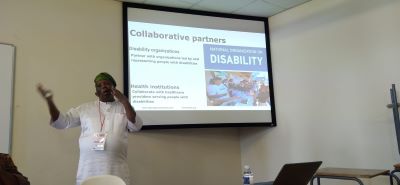
Being a second timer, the Executive Director of Africa Foundation for Young media professionals and Centre for Disability and Inclusion Africa, Yinka Olaitio is one of the speakers in this 2024 edition. His focus was on “Bringing the marginalized voices to the fore in investigation”. Aside from sharing the impact of the two organizations Yinka Olaito represented, the session exposed participants to enhanced skills in effective storytelling in disability and inclusion reporting, what to look out for and how to build collaboration and partnerships for an inclusive society.
Yinka Olaito during his presentation
Opening the session, the moderator, Uyanda Siyotula, who is theNational coordinator, SOS Coalition, a South African Public media service initiative charged participants to pay attention as it has been observed this area of journalism had suffered so much while it comes to reporting. Siyotula said “We are all here to learn and I strongly believe by the time we are living this one-hour session, we will all be equipped to do better stories”.
Yinka Olaito why opening the session shared on why the voices of the marginalized should be covered by the medic in itself. Some of the reasons he gave include: marginalised population suffer most of the abuses, media blackout issues that concern them is enormous, there is no inclusive society without voices of the marginalized, justice is not a privilege for the few but for everyone.
Yinka Olaito identified the challenges of investigative journalists in covering this important population like low knowledge of issues and reporters’ barriers. To report effectively, Yinka Charged investigative journalists to be intentional about covering voices of the marginalized.
This starts with knowing the laws and acts of the ecosystem as well as charged newsrooms to lead by examples. “A newsroom that cannot champion inclusion has no right to preach this” Yinka Olaito said. To do effective storytelling, knowledge of data, understanding the marginalized ecosystem, collaboration, creating safe spaces for the population and risk awareness will go a long way.
The Africa investigative journalism Conference 2024 edition brought together over 450 delegates from about 55 countries
On International Girl Child day, we at Centre for Disability and Inclusion Africa celebrate all women and girls especially women and girls with disabilities who have are seven times more likely to lack access than their male counterparts and twice more likely to suffer gender based violence than women and girls without disabilities.
We celebrate your courage, your tenacity despite the multidimensional poverty, stigmatising discrimination and several of your rights that have been abused or denied.. We assure you that we remain committed to equal access and the defence of your fundamental human right.
We hereby advocate for equal access from government, private sector, civil societies, media and general public. It is civic responsibility to mainstream disability for the achievement of equal rights and access for women and girls with disabilities
It is important to prioritise their empowerment, education, quality health delivery, their gender and reproductive rights, the digital rights, accommodation and accessibility to enhance their capacity and wellbeing.
The beauty of democracy is in the aggregation of different and diverse voices within an entity. Democracy is essential because it incorporates voices of every population within the society. More than anything, ddemocracy provides an environment which respects human rights and fundamental freedoms. This is because democracy allows individuals to freely express their wills.
But when democracy comes with exclusions, it will be fraught with anger and distrust. Inclusive democracy is essential because ‘inclusive democracy fosters democracies’ acceptance and appreciation of diversity’. When this is missing, democracy cannot foster an open society that embraces all.
This position has been affirmed by the Kettering foundation when it put it succinctly “If democracy is the rule of the people, from this perspective “the people” is understood not as a unitary, homogeneous group, but rather as the whole people in all its diversity.”
One fundamental of democracy is election. The full benefits of democracy can only be achieved if all voices count during this process. Across the world, inclusive election and democracy is full of challenges. While the advanced world is trying hard to eliminate barriers, the developing world cannot be said to be making significant progress in this area.
Within Nigeria, several challenges continue to be on the road to achieve inclusive election and democracy. We must admit efforts are being made by stakeholders, which include Independent National Electoral commission (INEC), the highest electoral body in the nation.
But our field work and research especially across Southwest Nigeria had exposed many of the flaws different disability clusters are complaining of because of their persistence exclusion. These clusters include mobility-impaired, visual and hearing impaired, Persons with Albinism as we as Persons with leprosy.
Centre for Disability and Inclusion Africa team with Mr Buba, INEC Lagos state PWDs Officer
In the wake of the coming elections in Edo and Ondo states among others, a three-person team member of our organization through its #Inclusiveelection #Inclusivedemocracy campaign engaged with the Independent Electoral Commission, Lagos state’s officer in charge of Persons with disabilities desk, Mr Buba.
The meeting extensively discussed the challenges of different clusters of persons with disabilities that had been identified and proffered possible solutions we had envisaged.
Mr Buba in conversation with CDIA team
Mr Buba, while speaking on behalf of INEC commended the work of the organization as he could see we had done a great work. Mr Buba also highlighted many of the steps taken by INEC to ensure inclusive elections across Nigeria. According to him “INEC continues to be an unbiased and inclusive organization that prioritizes everyone irrespective of status or shape”.
He further identified some of the challenges faced by INEC in the discharge of its duties to every citizen. He showed some of the items made specifically to aid voting of persons with visual impairment, braille, efforts made to ensure there are sign language interpreters at polling booths as well as specific printed materials, posters, which contain direction, process on how to vote persons with hearing challenge can read where no sign language interpreter is available
At the end, we both agreed there is a need for ongoing conversation on how to ensure smooth transition of the process