A daily experience of many women with disabilities in Nigeria is perpetual exclusion. For them exclusion is a next dorr neighbour not a faraway stranger. For this major reason, today, being Wednesday 21sst January, 2026 in Lagos, this reality took centre stage as women with disabilities, alongside their parents and carers, came together for a landmark summit organised by the Star Children Development Initiative.
The gathering was more than a conference; it was a space for shared stories, reflection and renewed determination. Participants spoke openly about the social attitudes, policy gaps and structural barriers that continue to push women with disabilities to the margins of Nigerian society.
Held under the theme “Women with Disabilities, Parents and Carers Summit,” the event drew disability rights advocates, caregivers, professionals and community leaders from across sectors. Through conversations, skills-building sessions and collaborative strategising, attendees examined how exclusion persists—not only in public spaces and institutions, but also in decision-making processes meant to protect their rights and improve their quality of life.
Central to the discussions was the lived reality of women with disabilities who remain largely invisible in policy debates, despite being directly affected by laws and programmes on health, education, safety and economic participation. For many in the room, the summit represented both a moment of affirmation and a call to action: that inclusion must move beyond rhetoric to deliberate, sustained change.
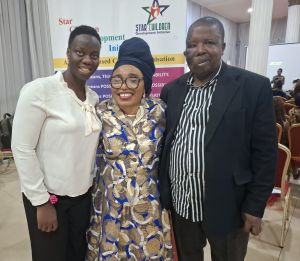
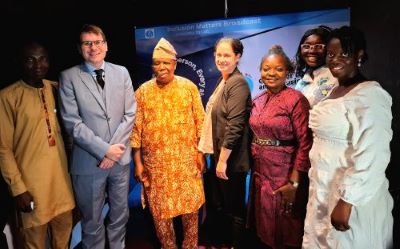
Our team with The ED Star children, at the event
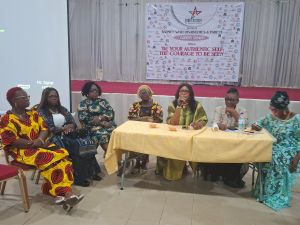
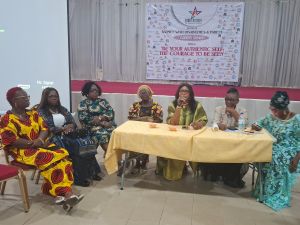
iA panel session during the Summit
n her keynote address, Prof Chinwe Nwani challenged participants to embrace authenticity, reject internalized stigma which can strengthen and build their confidence as a pathway to personal and collective transformation. “Authenticity is power,” she told the audience. “When women with disabilities show up fully as confidence and prepared without apology, they can easily challenge stereotypes, disrupt exclusion and create new possibilities for leadership and visibility.”
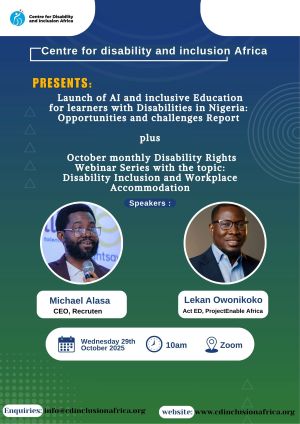
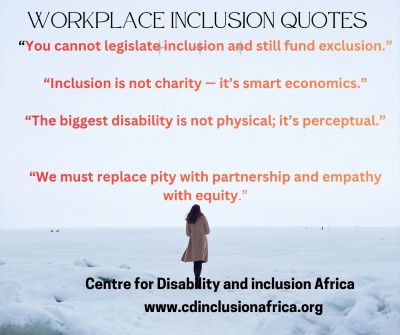
Centre for Disability and inclusion Africa’s October 2025 Disability Rights Webinar Series centred around National Disability Employment Awareness Month advocacy. The theme is “Disability Inclusion and Workplace accommodation?
A major concern of the organization is to advance the discourse on inclusive employment, showcasing success stories, and catalyzing action among stakeholders. Among the major objectives of this event are: To encourage employer’s public, private, non-profit to create equitable, accessible, and diverse workplaces as well as to advocate for policy or institutional changes to reduce barriers and support reasonable accommodation and equal opportunity.
The event was preceded by the launch of ‘Ai and inclusive Education for learners with Disabilities in Nigeria report’. While opening the session, Busola Oladotun, the Senior Program officer of the Centre for Disability and Inclusion Africa maintained “The October edition of the monthly Disability Rights Webinar centered on workplace inclusion as part of National Disability Employment Awareness Month.
According to Busola. “The aim of this session is to establish a need for an equitable workplace so that persons with disabilities will overcome barriers such as stigma, discrimination, and inaccessible environments to excel academically and professionally”.
After this, Yinka Olaito, CDIA Executive director, welcomed participants and charged them to give their 110% to the conversation of the day as the two speakers were well-suited to discuss the issue.
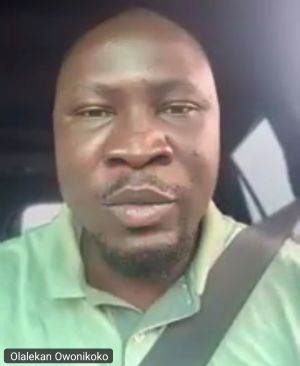
The first speaker, Olalekan Owonikoko, Acting Executive director of ProjectEnable in his speech maintained among others that Inclusion goes beyond compliance, leadership and policy are essential. There is need for inclusive career growth as well as a need to leverage technology as equalizer for a flexible work environment”
Olalekan Owonikoko
Owonikoko concluded “Building an inclusive, equitable, and accessible workspace is not charity or compliance but a strategic move
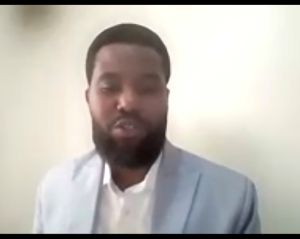
The second speaker, Michael Alasa, the CEO of Recruten consulting on his part stressed the need for workplace equity, diversity, accessibility and different sectors’ responsibilities in the game.
Michael Alasa
Michael Alasa in his call to action emphasized “Public sector should Integrate accessibility in policy design and infrastructure, Private sector mustmeasure and report inclusion outcomes while –Nonprofits: Practice representation, not advocacy alone. Finally, he advised all sectors must collaborate as inclusion cannot succeed if only one acts
Ekiti State had responded to disability and inclusion ecosystem demand for an urgent need to establish a specialized board which will oversee Disability Inclusion matters in the state. We decided to wait until now before making any official comment on this because we were eager to see full implement of the board and effective take off of its activities
The board was constituted on October 7, 2024 and took effect immediately. The board has Dr Ogunlade Ebenezer, from Persons with Albinism Cluster as its Chairman. Official Gazeta release confirmed this.
The Office of Disability Affairs under the Governor Office supervision is “established to address the needs and rights of individuals with disabilities in Ekiti State, Nigeria. It aims to ensure that persons with disabilities have access to education, healthcare, social services, and are protected from discrimination. The board is responsible for implementing policies and programs to promote inclusion and accessibility for people with disabilities in the state.”
Members of the public will recall that at our 7th February, 2024 Ekiti State PWDs Policy hangout a major demand we and all the Ekiti State Disability ecosystem made was a call for a reconstituted, functional disability Board where a Person with Disability should be the head instead of what was obtain then where the Executive order which established the existing commission then allowed an Executive Secretary, who is a career officer to serve. As of then, the Executive Secretary was a woman without disabilities which many ecosystem members felt did not have full import of disability inclusion issues.
For this (board constitution and its effective running) development which we had monitored in the past 7 months and which we strongly believe is on a good start,: we are happy to have been part of those who raised their voices for this and its fulfilment for us is a cheery news. We must also commend the State Governor, His excellency Abiodun Oyebanji for being a listening leader.
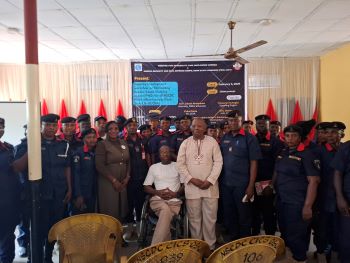
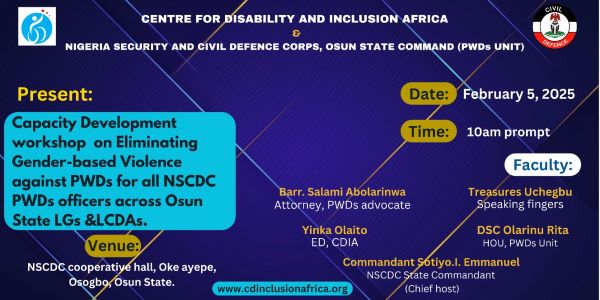
Centre for Disability and Inclusion Africa (CDIA) held a one-day capacity development workshop for Osun State Command of Nigerian Safety Civil Defense Corps (NSCDC) PWDs Unit officers on Eliminating gender based violence against Person with Disabilities (PWDs).
The training which took held on Wednesday, 5th of February at the NSCDC co-operative thrift Hall Oke-Ayepe, Osun state, had in attendance experts and advocates in the disability field as faculties such as, Yinka Olaito(E.D CDIA), Treasures Uchegbu and Barrister Salami Abolarinwa who joined via zoom.
While Opening the workshop, the representative of NSCDC state Commandant, Commandant Sotiyo I. Emmanuel appreciated the CDIA team for such a huge contribution to the state’s Officers. According to him “We honour such a huge sacrifice from CDIA as we are aware this is not funded but a commitment to make a change””. The Commandant then charged his officers to “Pay attention to the knowledge to be shared
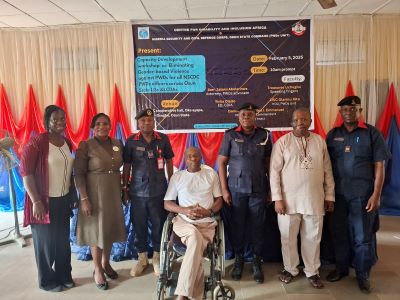
NSCDC Osun State Commandant representative, State head of training, state’s head of PWDs unit and CDIA team
The head of the PWDs Unit in the state’s Command DSC Rita Olarinu, also commended CDIA team for coming to Osogbo for the capacity Development workshop.
Yinka Olaito took the first session of the lecture titled “Strengthening Inclusive Society Through Disability Knowledge” Yinka Olaito explained the different types of disabilities and their categories. He also stated there are 7 recognized clusters of persons with disabilities in Nigeria namely; The physically challenged, Albino, Dwarf, Visually impaired, hearing impaired, Intellectually challenged and Speech impairment.
He also talked about the discrimination against PWDs and terms that should be used and not be used. For example, we should avoid the use of words like deaf and dumb or should call a Visually impaired person blind. Then as officers, when attending to PWDs, they should describe who they are as a person as well as a warm person
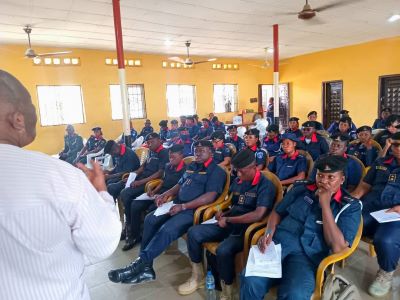
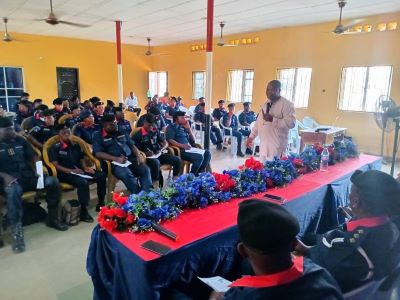
Cross section of some of the participating Officers
n his second lecture titled” Introduction to Gender Based Violence (GBV), Yinka olaito explained the different kinds of gender based violence where he listed psychological violence, physical violence, sexual violence amongst other. Also stating the causes of GBV such as poverty, conflict and crisis and so on.
Yinka Olaito noted that Gender Based Violence is on the rise especially against PWDs but many cases are not reported because of getting justice. He charged officers to make sure people get justice whenever cases are reported and not shun them up. Because when the victims don’t get justice, it creates more room for oppression.
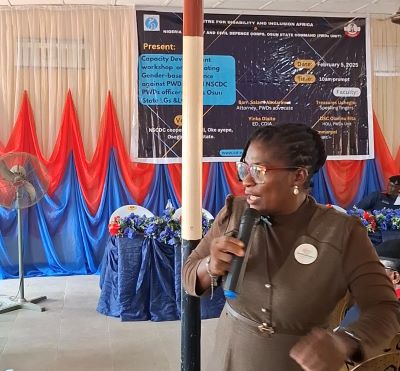
Treasures Uchegbu took the third session. The lecture was titled; Gender-Based Violence Against Person with Disabilities”” She made it clear during the lecture that women with disabilities are the major victims of GBV. From sexual harassment, forced marriage, Rape and psychological violence.
Treasures explained that when women/girls with disabilities encounter any of these forms of GBVs, many of them never get justice. When a person with disability reports a rape case, they get responses like ” you should thank God someone slept with you” and this makes them more vulnerable to their oppressors and also put the victim into depression. She highlighted that some women with disabilities are forced into marriages they do not want because their parents feel “they are doing them a favour.
Treasures stated during the lecture that PWDs have a mind and rights of their own and they shouldn’t be seen as lesser humans and their opinions should be respected.
Treasures Uchegbu
At the end she urged officers to give attention to PWDs and communicate with them often. She also shared a sign language booklet to participants of the workshop.
Legal Framework and Best Practices for Promoting and Enforcing PWDs’ Rights session was taken virtually by Barr. Salami Abolarinwa. He shared extensively on the laws guiding the rights of PWDs and legal procedures around it.
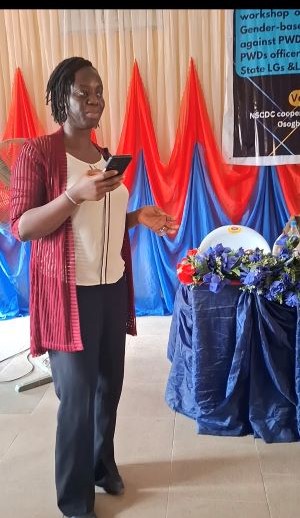
Busola Oladotun, the project officer for CDIA explained the policies for PWDs
Busola Oladotun
During the questions and answers session, one of the participants asked that in a case where a Visually impaired person is the victim of GBV, how can we be sure he/she recognizes the oppressor? Yinka Olaito answered that most Visually impaired person’s uses their sense of smell to Identify people.
Closing the workshop, DSC. Olarinu Rita who is the Head of Unit for the PWDs desk NSCDC Osun State thanked the CDIA team for the eye opening workshop. She acknowledged that there were things she got to know for the first time through the workshop and she assured that officers are going to make sure they will be zero tolerance for Gender Based violence in each of their districts.
The 77 Officers who participated in the trade were selected from all the 33 Local Governments and LCDAs across Osun State.
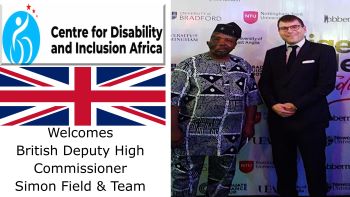
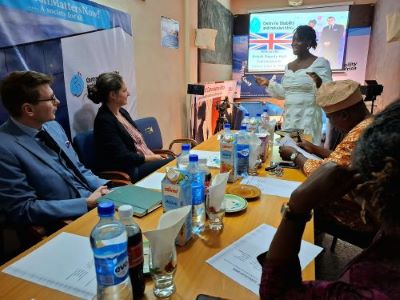
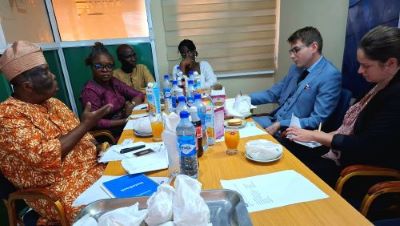
In its bid to amplify Challenges faced by Persons with Disabilities in Nigeria, build collaborative network with international community around its work, Centre for Disability and Inclusion Africa (CDIA) hosted British High Commission’s diplomatic team in Lagos Nigeria
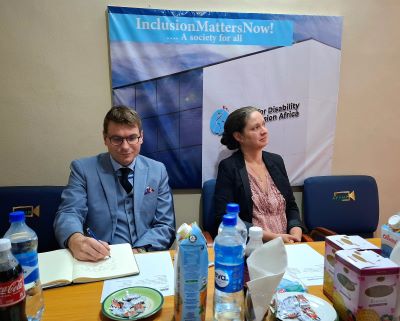
The team which was led by Deputy Head of Mission Simon Field and included Kathrine Femandes, Second-secretary(Political), in the British High Commission in Lagos visited the CDIA corporate headquarters on December 18th, 2024.
Busola Oladotun
The program Officer, Busola Oladotun, while welcoming the team appreciated the efforts of the team to learn more the centre does. In his welcome address, Yinka Olaito, the executive Director of the centre, praised the British government and its officials for their consistency, strong desire that the world we live in becomes inclusive where each person’s potentials are maximized.
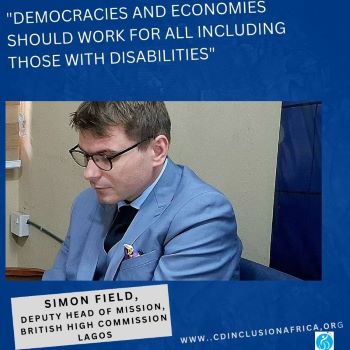
Simon Field, the Deputy Head of British Mission in Lagos, after introducing his team shared that their mission is to understand what CDIA is doing and more important to charge the centre to remain focused and consistent in its work. According to His Excellency Simon Field “The society becomes better place to live if everyone irrespective of disabilities status is given a chance to live at their maximum potential”
Yinka Olaito, sharing some of the outstanding results the centre had achieved
After this, Yinka Olaito, took the diplomatic team through a presentation on what the centre had done and where it is going. According to Yinka Olaito “ The organization is poised to make meaningful changes and this had driven the management to work conscientiously around its focal points: Advocacy, PWDs rights, Inclusive media”
He further stated “The organization had in the past eighteen months of its standing alone from (became a corporate entity) its parent’s organization- Africa Foundation for Young Media Professionals, had achieved several milestones”.
These according to him include reaching over 16 Million target audience, raised its voice against financial exclusion of PWDs rights, accessibility of Nigeria Airports, championed PWDs rights as well as contributed to enactment of Disability Bill in Osun sate Nigeria.
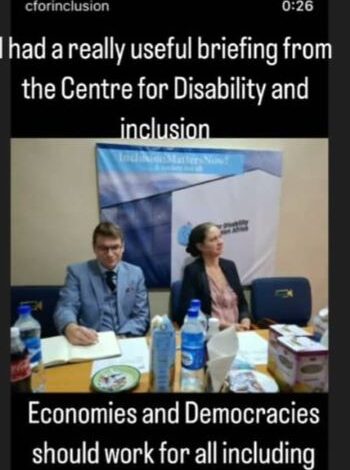
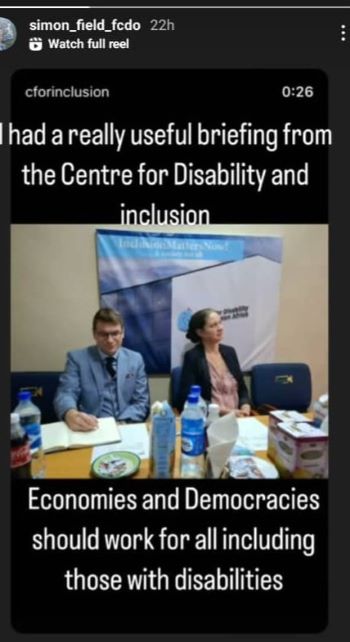
Simon Field and Kathrine Femandes( British Deputy Head of Mission and Second -secretary-Political at Deputh British High Commission Lagos)
In his remark after the Presentation, Simon Field stated “ I had a really useful briefing from the Centre for Disability and Inclusion Africa. Economies and Democracies must work for all including those with Disabilities
A business career presents a wealth of opportunities for young adults with disabilities. Far from being limiting, the dynamic nature of business allows for diverse roles that can be tailored to individual strengths and talents. By embracing a career in business, young adults with disabilities can not only achieve personal success but also contribute unique perspectives that drive innovation and inclusivity in the workplace.
A work Environment that Suits Your Need
In today’s business landscape, the ability to customize your work environment is crucial, particularly for young adults with disabilities. Many positions now offer the flexibility to work remotely or to adjust working hours, empowering you to work in ways that best fit your physical and mental needs. This flexibility allows for necessary breaks and adaptations in the workspace, ensuring optimal performance and well-being.
Cultivating Essential Skills
A career in business is a powerful avenue for developing key life skills such as communication, problem-solving, and critical thinking. These skills are invaluable, helping to equalize the playing field with peers and navigate complex business scenarios effectively. The more you immerse yourself in business challenges, the better equipped you become to handle professional and personal obstacles, enhancing your overall life experience.
Achieve Financial Stability and Independence
One of the most significant advantages of pursuing a business career is the potential for economic independence. Financial stability is essential for anyone, but for young adults with disabilities, it can be particularly empowering. A stable income allows you to make decisions based on your desires rather than your limitations. With financial independence, you gain control over your life, making it easier to plan for the future, invest in personal growth, and contribute to your community.
Unlock Entrepreneurial Opportunities
A business background primes you for entrepreneurship, where you can design a business model that specifically accommodates your needs and passions. Entrepreneurship challenges traditional employment barriers, providing the flexibility to innovate and drive change in your chosen field. This not only leads to personal fulfillment but also has the potential to impact others positively, establishing you as a leader and innovator in the business community.
The Power of Effective Networking
In the digital era, the art of in-person networking remains a crucial career builder, especially for young adults with disabilities seeking to break through barriers. Attending industry events and meetings not only bolsters your visibility but also opens doors to tailored opportunities and essential resources. To network effectively, actively engage, follow up with new contacts, and leverage these relationships to align with your professional goals. Despite the conveniences of online connections, face-to-face interactions hold unmatched potential for fostering meaningful collaborations and advancements.
Advocate for Yourself in the Workplace
Navigating the business world enhances your ability to advocate for yourself, an essential skill that ensures you receive the necessary accommodations to succeed. As you advance in your career, mastering self-advocacy allows you to effectively communicate your needs and rights, improving your workplace environment. This proactive approach not only benefits your career development but also serves as a benchmark for inclusivity, promoting a more equitable work culture.
Building Confidence Through Success
Achieving success in a business role boosts confidence and self-esteem, especially for young adults with disabilities who may encounter doubt and discrimination. Each success, big or small, validates your capabilities and contributes to a stronger sense of self-worth. By excelling in your role and exceeding expectations, you challenge and change societal perceptions, showcasing that your talents surpass any perceived limitations. This newfound confidence empowers you to pursue broader goals with vigor and resilience.
Choosing a business career can open doors to numerous opportunities for young adults with disabilities. This field not only values diverse perspectives but also provides the flexibility and support needed to thrive professionally. By stepping into the world of business, you can build a fulfilling career that leverages your unique strengths and contributes to a more inclusive workforce. The path is yours to shape, offering both personal growth and the chance to make a lasting impact.
(Photo credit : Freepik) Join the Centre for Disability and Inclusion Africa in championing a transformative society that embraces the rights and uniqueness of persons with disabilities across Africa