
No Barrier to Justice: CDIA Demands Action to End Violence Against Women with Disabilities
The Centre for Disability and Inclusion Africa (CDIA) has called for stronger, more inclusive and accountable systems to prevent and respond to violence against women and girls with disabilities, emphasising that disability must never be a barrier to protection, dignity or access to justice.
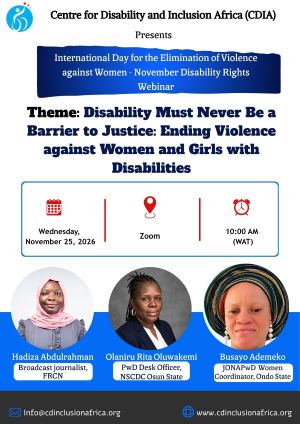
The call was made during the November edition of CDIA’s Disability Rights Webinar Series, held virtually on Wednesday, 25 November 2026, to commemorate the International Day for the Elimination of Violence Against Women and mark the beginning of the 16 Days of Activism Against Gender-Based Violence. The webinar, themed “Disability Must Never Be a Barrier to Justice: Ending Violence Against Women and Girls with Disabilities,” brought together advocates and institutional representatives to examine the barriers survivors face and identify practical solutions.
Opening the session, Tunde Okunlola and Busola Oladotun highlighted the heightened risks confronting women and girls with disabilities. They stressed the importance of centring their experiences in gender-based violence discussions and addressing disability-related barriers in prevention, reporting and response mechanisms.
Speaking on the media’s role, Hadiza Abdulrahman, a broadcast journalist with the Federal Radio Corporation of Nigeria (FRCN), challenged journalists to move beyond reporting incidents of violence and investigate the institutional barriers survivors encounter when seeking justice.
She identified inaccessible police stations, communication difficulties and inadequate follow-up on reported cases as significant challenges. She also emphasised the importance of portraying women with disabilities as rights holders rather than helpless victims. “Women with disabilities must not be portrayed as helpless or defined by their impairments. They are rights holders,” she stated. Hadiza called on media organisations to include women with disabilities as credible sources and experts in stories affecting them, while investing in disability-inclusion training to promote responsible reporting and accountability.
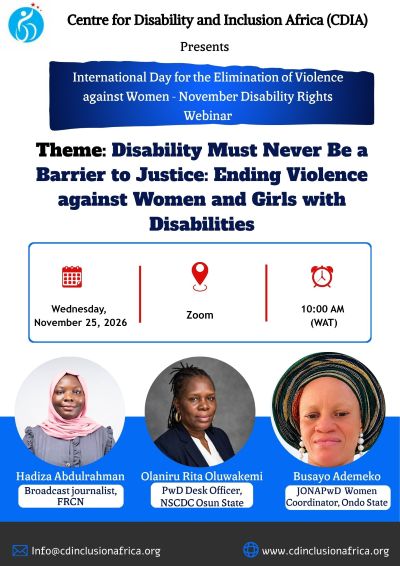
Adding an advocacy perspective, Busayo Ademeko, JONAPwD Women Coordinator, Ondo State, highlighted discrimination, limited healthcare access and violence against women with disabilities. Drawing on her advocacy experience, she called for sustained public awareness, stronger protection mechanisms and improved legal safeguards.
The discussion also examined the responsibility of security agencies in ensuring protection and access to justice. Rita Olaniru Oluwakemi, Persons with Disabilities (PwD) Desk Officer, Nigeria Security and Civil Defence Corps (NSCDC), Osun State, emphasised the need for trained personnel, functional disability desks and stronger partnerships with non-governmental organisations.
Reaffirming the agency’s commitment, she stated: “When it comes to women and girls with disability being violated, NSCDC Osun don’t take it for granted.”
Her contribution reinforced the importance of institutional capacity building, sensitisation and collaboration among security agencies, civil society organisations, parents and communities.
Across the discussions, a common message emerged: ending violence against women and girls with disabilities requires more than awareness. It demands accessible reporting channels, survivor-centred support services, trained professionals and institutions that can be held accountable. Equally important is ensuring that women with disabilities actively participate in shaping the policies and programmes designed to protect them.
In her closing remarks, Busola thanked the speakers and participants, noting that insights from the webinar would be documented and shared through reports and recommendations with relevant stakeholders.
As the 16 Days of Activism continues, CDIA calls on government institutions, security agencies, media organisations, civil society groups and communities to translate commitments into practical action.
Guided by the principle of “Nothing About Us Without Us,” efforts to end gender-based violence must recognise women and girls with disabilities as rights holders entitled to safety, dignity, autonomy and equal protection under the law.
Disability must never be a barrier to justice. No woman or girl should be left behind.