
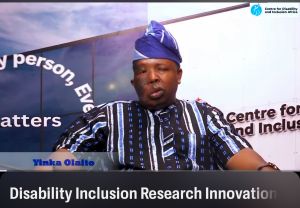
CDIA Takes Nigeria’s AI Research to London PENDA Conference 2026
Evidence, lived experiences and stakeholder co-creation must shape the future of artificial intelligence in inclusive education, says Yinka Olaito at the international disability research conference.
Artificial Intelligence (AI) presents significant opportunities to transform education and improve access, participation and personalised learning for learners with disabilities. However, a critical question remains: Can AI truly advance inclusive education if learners with disabilities are excluded from its design and implementation?
This question was central to the presentation by Yinka Olaito, Executive Director of the Centre for Disability and Inclusion Africa (CDIA), at the PENDA 2026 Conference, held on 26–27 November 2026 at the London School of Hygiene and Tropical Medicine (LSHTM), United Kingdom.
Speaking under the subsection conference theme, Education: Inclusion, Olaito delivered an oral presentation titled “Can Artificial Intelligence Advance Inclusive Education? Evidence and Co-Creation with Learners with Disabilities in Nigeria.” His presentation highlighted CDIA’s research and innovation efforts to explore how AI can address educational inequalities and create more inclusive learning opportunities in Nigeria.
The session was chaired and moderated by Ricardo Abates of the University of Cambridge, with other panellists including Julia de Kadt of Sightsavers and Francis Phiri of Gallaudet University.
Understanding the Nigerian Context
Despite Nigeria’s progressive disability rights and inclusive education policies, implementation remains challenging. Learners with disabilities continue to face inaccessible school infrastructure, inadequate assistive devices, limited inclusive learning materials, insufficient teacher preparation, non-inclusive teaching methods and funding constraints.
Against this background, CDIA conducted research to examine AI’s potential to address these barriers and identify priorities for its effective and equitable adoption.
The quantitative study engaged 292 respondents across Nigeria’s six geopolitical zones, including learners with disabilities, teachers, parents and caregivers, policymakers and AI experts. Notably, persons with disabilities constituted 68 per cent of respondents, ensuring that their lived experiences and priorities were central to the research.
What the Research Revealed
Findings highlighted inadequate assistive technology, inaccessible learning environments, financial constraints and insufficient inclusive learning materials as major barriers to educational participation. Although smartphones were the most commonly accessible technology, access to specialised assistive devices remained limited.
Encouragingly, 86.7 per cent of respondents expressed willingness to use AI, indicating considerable openness to its potential in inclusive education.
However, stakeholder priorities varied. Learners with disabilities identified writing and reading assistance, speech recognition, text-to-speech, AI-powered tutors and sign-language interpretation as priority applications.
Teachers highlighted AI-powered assessment but reported limited familiarity with AI and inadequate training. Parents and caregivers expressed interest in AI tutors and sign-language interpretation while raising concerns about privacy and safety. Policymakers recognised opportunities for personalised learning, teacher training, data-driven planning and policy monitoring.
These findings demonstrate AI’s potential to improve educational experiences, provided its applications respond to the actual needs of learners and other stakeholders.
Moving from Research to Policy and Action
For CDIA, generating evidence must translate into practical action, policy engagement and sustainable collaboration.
The research findings were previously presented at the British Council Language in Education 2025 International Conference. Subsequently, the organisation convened a stakeholder co-creation workshop to examine the findings, identify implementation priorities and explore pathways for advancing AI-driven inclusive education.
The workshop produced a policy brief and contributed to the establishment of an AI and Disability Consortium, providing a platform for continued research, advocacy, collaboration and policy engagement.
This process demonstrates the value of connecting research evidence with lived experiences and stakeholder participation to influence decisions and drive meaningful change.
Building an Inclusive Education and AI Future: Nothing About Us Without Us
A central message from the research is that technology alone cannot eliminate systemic exclusion. Introducing AI into classrooms without addressing existing inequalities risks creating new barriers rather than removing them.
Advancing inclusive education through AI requires investment in accessible and affordable technologies, improved infrastructure, teacher capacity development, inclusive learning resources and stronger implementation of existing disability and education policies.
Equally important is ensuring that persons with disabilities participate meaningfully in the design, testing, implementation and governance of AI solutions.
As the PENDA research initiative, funded by the UK Foreign, Commonwealth and Development Office, concludes its eight-year programme of strengthening evidence on disability inclusion across low- and middle-income countries, the conference provided an important opportunity to share learning, reflect on research and strengthen partnerships.
For CDIA, participation in PENDA 2026 reinforces its commitment to evidence-based disability inclusion and innovation that responds to the realities of persons with disabilities.
The future of education will increasingly be shaped by artificial intelligence. Nigeria must ensure that learners with disabilities are not left behind. They must not merely benefit from AI innovation; they must actively shape it.
Nothing About Us Without Us