
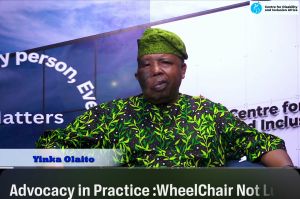
CDIA Showcases Disability-Led Transport Advocacy at PENDA Conference UK, 2026
Yinka Olaito highlights how CDIA’s #WheelchairNotLuggage campaign is challenging transport discrimination and advancing disability rights in Nigeria.
The Centre for Disability Inclusion Africa (CDIA) has showcased its disability-led advocacy efforts to challenge transport exclusion in Nigeria at the PENDA Conference 2026, held on November 26–27 at the London School of Hygiene and Tropical Medicine (LSHTM), United Kingdom.
Representing the organisation, CDIA’s Executive Director, Yinka Olaito, delivered an oral presentation titled “Wheelchairs Are Rights, Not Luggage: Evidence from a Disability-Led Advocacy Campaign to Challenge Transport Exclusion in Nigeria.” The presentation featured under the conference theme Rehabilitation and Assistive Technology, within the broader area of Advocacy in Practice.
Olaito highlighted CDIA’s #WheelchairNotLuggage campaign, which seeks to challenge discriminatory transport practices and promote recognition of wheelchairs as essential mobility equipment rather than luggage.
Challenging transport exclusion through advocacy
Transport exclusion remains a significant barrier to the social, economic and civic participation of persons with disabilities. In Nigeria, wheelchair users continue to encounter discriminatory practices, including situations where transport operators treat their wheelchairs as luggage rather than essential assistive equipment.
These practices undermine dignity, independence and equal participation, restricting access to employment, education, healthcare and other opportunities.
To address this challenge, CDIA implemented the #WheelchairNotLuggage campaign, combining disability-led advocacy, public awareness, media engagement and stakeholder mobilisation. Four organisations of persons with disabilities (OPDs) and 10 disability advocates participated in campaign activities and dissemination, ensuring that the lived experiences and voices of persons with disabilities remained central to the initiative.
Campaign reaches over 12 million people
Sharing the campaign’s achievements, Olaito reported that #WheelchairNotLuggage generated an estimated reach of more than 12 million people. Its media visibility included over 20 newspaper stories, coverage across five radio and television stations, and a podcast conversation.
These platforms amplified wheelchair users’ experiences and brought transport discrimination into wider public discourse. Participation by OPDs and disability advocates also helped frame individual experiences as broader concerns about accessibility, equal rights and institutional responsibility.
However, Olaito noted that public awareness alone does not necessarily translate into changes in transport practices.
Limited funding restricted CDIA’s ability to conduct sufficient face-to-face engagements at motor garages, reducing opportunities for direct dialogue with transport operators. Similarly, limited sustained engagement with the National Union of Road Transport Workers (NURTW) and other transport workers’ associations constrained the campaign’s influence on operators and its potential to achieve behavioural change.
Lessons for disability-inclusive action
The campaign reinforced an important lesson: media advocacy is valuable for amplifying disability rights issues, but lasting change requires sustained engagement with the institutions and stakeholders responsible for implementing inclusive practices.
Olaito highlighted the need for adequately resourced advocacy involving transport unions, operators, government agencies and other duty bearers. He also underscored the importance of disability-led approaches that enable persons with disabilities and their representative organisations to shape advocacy priorities, influence solutions and demand accountability.
Contributing to the global disability inclusion conversation
The session was chaired and moderated by Anne Mackinnon, Disability and Assistive Technology Research Lead at the United Kingdom’s Foreign, Commonwealth and Development Office (FCDO). Other contributors included Léa Guignard of the Enablement Foundation, who presented “The Village Effect: Rethinking Disability Care in Uganda,” and Ellie Cole of University College London.
Bout PENDA Conference 2026
The PENDA Conference brought together researchers, practitioners, policymakers and organisations of persons with disabilities to share evidence on what works in disability-inclusive development.
The conference marked the culmination of the FCDO-funded PENDA research initiative, which worked over eight years with partners across 11 countries, including Nigeria, to strengthen evidence on disability inclusion, access to services and participation.
CDIA’s participation provided an opportunity to bring Nigeria’s advocacy experience into this international conversation and demonstrate the potential of disability-led approaches to challenge systemic exclusion.
For CDIA, the message remains clear: wheelchairs are not luggage. They are essential mobility equipment that enable independence, dignity and participation. Transport inclusion is not a favour; it is a matter of rights and equal citizenship.