Safe and Included: CDIA Pushes for Digital Safety and Inclusion for Persons with Disabilities
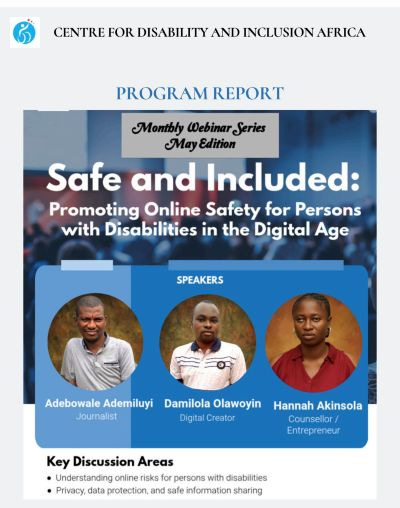
The growing importance of digital technology in everyday life has brought both opportunities and risks for persons with disabilities, a reality that took center stage during the May 2026 edition of the Disability Rights Webinar Series organized by Centre for Disability and Inclusion Africa (CDIA).
Held under the theme “Safe and Included: Promoting Online Safety for Persons with Disabilities,” the virtual session convened disability advocates, journalists, digital rights experts, and inclusion stakeholders to examine the growing threats faced by persons with disabilities in online spaces and the urgent need for safer, more inclusive digital environments.
Opening the session, CDIA Senior program Officer, Busola Oladotun welcomed participants and emphasized the increasing role digital technology plays in advancing independence, communication, education, and inclusion for persons with disabilities. She noted that assistive technologies such as screen readers, speech recognition tools, and communication aids are all powered by digital innovations, making online accessibility and safety critical to full participation in modern society.
However, while technology has created new opportunities, speakers warned that digital platforms are also reproducing many of the same prejudices and exclusion experienced offline.
One of the keynote contributors, Damiola Olawoyin, highlighted how cultural misconceptions and societal stereotypes about disabilities have migrated into online spaces. Sharing personal experiences and examples, he described how persons with disabilities frequently encounter cyberbullying, mockery, harassment, and discriminatory comments on social media platforms.

Damilola Olawoyin,
According to him, online abuse against persons with disabilities often reflects long-standing societal attitudes that portray disability through pity, ridicule, or stigma. He stressed the need for stronger public education, digital literacy, and enforcement of disability rights protections in the digital ecosystem.
The conversation also examined the importance of online privacy and digital safety practices. Miss Hannah Akinsola emphasized the need for persons with disabilities to receive adequate digital training to help them navigate online risks safely. She encouraged participants to prioritize data protection, privacy awareness, and responsible internet use, particularly in an era where cyber fraud, phishing, identity theft, and online manipulation are becoming increasingly common.
Participants discussed the dangers of cyberbullying and online exploitation, especially for persons with intellectual and visual impairments who may be more vulnerable to manipulation or privacy invasion. Speakers advised users to exercise caution when sharing personal information online and to verify digital contacts carefully before building trust.
The webinar further explored accessibility gaps that continue to limit equal participation in digital spaces. Adebowale Ademiluyi spoke extensively on the challenges persons with disabilities face while using social media platforms and digital applications. He identified major concerns including inadequate accessibility software for blind users, limited voice interpretation options for persons with hearing impairments, and poor compliance with universal design standards.

Ademiluyi Adebowale.
Adebowale also condemned the unauthorized use of photographs and videos of persons with disabilities on social media platforms without consent, describing it as a serious violation of privacy and dignity. Participants agreed that many content creators and online influencers continue to perpetuate harmful narratives by using disability-related content for sensationalism, pity-driven engagement, or mockery.
Contributors called for stronger collaboration between disability advocates, technology companies, media organizations, and policymakers to improve digital accessibility and protect persons with disabilities from abuse and discrimination online.
The session featured contributions from participants across different locations, including Ghana and Ekiti State, who shared lived experiences and practical recommendations for improving online safety and inclusion.
As part of the way forward, CDIA announced plans to organize digital safety and literacy trainings specifically tailored for persons with disabilities. The organization also committed to developing accessible educational materials that will help individuals recognize, document, and report cases of online abuse, cyberbullying, and privacy violations.
Other proposed action points included engaging app developers and technology companies to improve accessibility features such as enhanced screen readers and voice interpretation systems, establishing peer support networks for persons with disabilities, and promoting respectful and non-derogatory reporting of disability issues in the media.
Participants also emphasized the importance of enforcing existing disability rights laws and ensuring that cases of online abuse and discrimination are properly addressed by relevant authorities.
The webinar concluded with a strong collective message: digital inclusion must go beyond access to technology; it must also guarantee safety, dignity, privacy, and equal participation for persons with disabilities in online spaces.
Through conversations like this, Centre for Disability and Inclusion Africa continues to advance advocacy for a digital society where persons with disabilities are not only connected, but also protected, respected, and fully included.
#internetsafety #PersosnwithDisabilities Safe and included, Promoting Online Safety for Persons with Disabilities, a project report of Centre for Disability and Inclusion Africa Read full report here or use this link https://www.linkedin.com/feed/update/urn:li:activity:7463209063103889408/