Ai and inclusive Education for Learners with Disabilities in Nigeria report

Admitted should mean being Included, SWDs are…

Inclusive accommodation in Nigerian higher institutions is about equal access designing campuses, learning systems, and support services that work for all students, regardless of physical status, including students with disabilities. It is well established that disability itself does not hold people back; rather, discrimination and systemic barriers are what prevent individuals from pushing the limits of their innate abilities.

Nigeria’s higher institutions remain a source of concern for many students with disabilities and, by extension, disability inclusion nonprofits such as the Centre for Disability and Inclusion Africa (CDIA). While other African countries, including South Africa and others, are making measurable progress in ensuring that education is accessible to young people with disabilities, many Nigerian campuses remain backward and largely inaccessible.

Over time, the Centre for Disability and Inclusion Africa has sent passionate appeals to the leadership of frontline universities across Nigeria, urging them to establish and implement protocols that can accelerate the development of inclusive campuses. Unfortunately, responses to these efforts have largely been lukewarm. In response, we shifted focus to empowering a small number of students with disabilities building their confidence incrementally so they can make bold, informed requests as legitimate stakeholders within their institutions. Even this approach has not yielded the level of progress or speed we had hoped for.
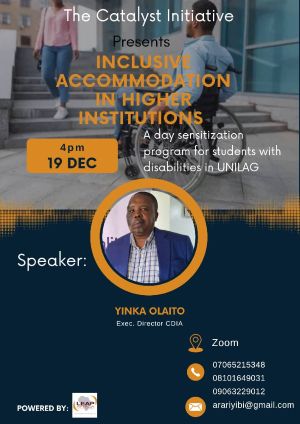
We now have another opportunity to elevate this conversation. Our Executive Director will be leading a critical dialogue as part of a project by The Catalysts Initiative an association of young people committed to building an inclusive society. The event is scheduled to hold on Friday, 19 December 2025, at 4:00 p.m., via Zoom.

A key message we intend to promote among participants is that when Nigerian higher institutions raise the bar on inclusive accommodation, the entire system benefits. It advances equity and dignity, enhances academic success, fosters independence and active participation, and—most importantly ensures that Nigerian higher institutions meet their legal obligations and ethical responsibilities.

READ MORE
Inclusion demands

PWDS human rights in Nigeria, solutions we offer

Persons with disabilities are humans. Having an impairment does not make a person less human than others in the society. There are enough provisions within the United Nations Chartered Rights of Persons with Disabilities, African Chartered rights of Persons with Disabilities as well as Discriminations Against Persons with Disabilities Acts which guarantees human and inalienable rights of persons with disabilities, whether male or females in Nigeria.

Unfortunately like in other countries, persons with disabilities (PWDs) are daily being denied their rights. These rights cut across, from education, health, financial, accessibility, protection against assault and discrimination as well as right to a decent life, jobs among many others.

Some of the reasons for these may be social-cultural, lack of strong will on the part of the state actors as well as non-state actors.  Another major factor that we have noticed in the course of our field work is that there is low awareness on the part of the impaired as well as their parents on rights that should be accorded to them.

A foundation of this aberrant is traceable to the fact that society had already bastardized the psyche of an average persons with disabilities through its social approach to PWDs issues. As a result, and in many cases this makes many of them to think they are not desirable or count within the society. The attitude of many persons with disabilities, especially those who are not lucky to have quality education, is that of a beggar without a choice.

The centre after careful assessment of the impact of policy and legislature measure Nigeria presently have showed a weak system that can really make any sustainable or meaningful changes except something is done urgently. We have noticed constant violations of PWDs rights, many of which are not reported because of fear and attack or of future neglect of care.

In several cases, Disability Agencies, Boards across the states where these are already established by laws, lack necessary tools that can help them rise to the occasion of defending PWDs rights. A major concern though which is common in many of the states in Nigeria is that there is a low awareness about the existence of such board/Agency and the roles they are supposed to play in amplifying the necessary changes desired. To add to this, the diversity of quality personnel and inclusion of PWDs staff members within such agency had also been called into question.

As concerned organization, we constantly challenge many of these irregularities through our policy, advocacy and PWDs human rights  projects as well as  media exposure of such abuses through our collaboration with a media house the organization jointly run with the Africa Foundation for Young Media Professionals. Our advocacy visits and interaction with specialized Agencies, relevant professional bodies, policy makers are also yielding fruit. Read story here

In a recent event, the organization was confronted with fragrant assault, denial of a bank customer, who is a professional PWD in Ibadan being denied and excluded his financial right. We escalated this through our newspaper medium and within days, the rights of the man were restored.

We cannot all keep quiet, there must be continuous conversations around PWDs human rights with a determination to end such. We invite you to join us in this crusade. 

Three other major issues we are confronting headlong for now are Albinos rights to vote, financial inclusion as well as education rights which because of their skin texture, low vision must be addressed. We call on the Independent National Electoral Commission (INEC), Nigerian Banks as well as Education authorities to address these issues.

READ MORE