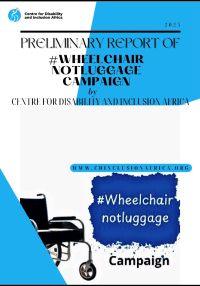
#WheekchairNotLuggage

CDIA launches preliminary report on #WheelchairnotLuggagecampaign

As part of its commitment to protect rights abuses of persons with disabilities in Nigeria, with a special focus on physical-mobility cluster who are wheelchair users, The Centre for Disability and Inclusion Africa had officially launched its preliminary on its national campaign launched in January 2025 tagged #Wheelchairnotluggage.

As our community will recall the major essence of the campaign is he campaign seeks to confront ongoing human rights abuses experienced by individuals with mobility challenges, particularly those using wheelchairs. Core Issues Addressed CDIA highlights widespread discriminatory practices in Nigeria’s transport sector, including: Refusals to transport wheelchair users. Inhumane treatment by transport personnel. Extra fees charged for wheelchairs, as though they were baggage.

The legal foundation of the campaign was centered around The campaign anchors itself in Nigeria’s Discrimination Against Persons with Disabilities (Prohibition) Act, 2018, which clearly prohibits such discrimination CDIA’s Executive Director, Yinka Olaito, emphasized: “A wheelchair is a personal mobility aid, not luggage… Refusing to transport someone with a wheelchair or treating it as excess baggage is a violation of their rights, and offenders may face criminal charges.”

While the campaign is still ongoing, you may want to read present key outcomes as well as future outlook of the campaign in this link. Besides, we still ask that you support the campaign next action steps/activities

READ MORE
Diversity, Equity and Inclusion strategy

DEI? How strategic are you?

The global challenges around Diversity, Equity and Inclusion(DEI) may seem strong because of the position of USA on the issue. The truth is DEI remains the best choice if we must not leave close to 2 billion individuals behind. Truly, the ecosystem is not perfect but how many systems in our world are?

The problem lies in how inclusion is often performed. Many institutions showcase token gestures: a one-day awareness event, a picture of a wheelchair user on a brochure, or a social media campaign during commemorative days.

These efforts may win applause, but they rarely dismantle the barriers that matter: physical, digital, economic, and attitudinal. Real disability inclusion is not cosmetic. It is structural. It means accessible buildings, equitable hiring practices, adaptive technology in classrooms and workplaces, and policies that place persons with disabilities at the center of development, not at the margins.

And let’s be clear: inclusion is not charity. It is justice. Persons with disabilities are not asking for sympathy; they are demanding fairness. They bring skills, perspectives, and creativity that enrich societies and economies.

Research shows that companies that employ and support persons with disabilities are more innovative, productive, and resilient. Inclusion is not just the right thing to do. it’s the smart thing to do.

When disability is treated as a “special” issue or a trendy hashtag, we trivialize decades of advocacy and struggle. Persons with disabilities have fought for recognition, legal protection, and dignity.

To reduce their struggle to a fad is insulting. The real test of a just society is not how it treats its most privileged citizens, but how it ensures equity for those most excluded.

This is why leaders in business, government, and civil society must stop seeing disability inclusion as optional. It is not an afterthought. It is not a nice-to-have. It is a non-negotiable. Every ramp built, every policy enforced, every inclusive curriculum adopted, and every barrier removed is a step toward justice long overdue.

Disability inclusion is not about trends. It is about transformation. It is about building societies where no one is invisible, where no one is left behind. The question is simple: will we continue treating inclusion as fashion or will we finally make it our foundation?

READ MORE