The Closure. Impact of the #JusticeforUche Campaign
The Centre for Disability and Inclusion with mixed feelings is bringing a closure to #JusticeforUcheCampaign. Between January and June 2026, the Centre for Disability and Inclusion Africa (CDIA) led the #JusticeforUche campaign, a strategic advocacy initiative that transformed the experience of one visually impaired nurse into a nationwide conversation on disability rights, institutional accountability, and inclusive education in Nigeria.
The campaign was launched after Uche Olivia, a registered nurse with visual impairment, publicly alleged that she was denied reasonable accommodation during an entrance examination for a post-basic mental health nursing programme. Her account highlighted a challenge faced by many persons with disabilities: exclusion from educational and professional opportunities due to inaccessible systems and practices.
CDIA responded by positioning the issue not as an isolated grievance, but as a broader human rights concern linked to the Discrimination Against Persons with Disabilities (Prohibition) Act in Nigeria. The campaign sought to demand justice for Uche, raise public awareness of the legal obligation to provide reasonable accommodation, influence institutional reform, and mobilise citizens, disability organisations, media stakeholders, and policymakers around the cause of inclusion.
The campaign achieved significant visibility and engagement. More than 14 million stakeholders were reached, generating over 40 million impressions across media platforms. An estimated 96% of frontline media houses in Nigeria provided coverage, including national newspapers, online publications, radio stations, and television networks across the South and West of the country. This extensive coverage amplified the campaign’s message and contributed to its rapid spread across digital platforms.
As public attention intensified, the Forum of Lawyers with Disabilities became involved and indicated readiness to pursue legal action against the institution at the centre of the allegations The FederalNeuoro-Psyschaitric Post Basic Mental Health Nursing School Enugu.
This development prompted efforts toward a noted lobbying effort to appease to the victim through direct engagement with the victim which was turned down.. However, the legal process was later complicated by the withdrawal of a key witness and Uche’s subsequent admission to an academic programme outside Nigeria, which affected the prospects for court proceedings.
Despite these challenges, the campaign delivered important outcomes. It significantly increased national awareness of disability discrimination and the importance of reasonable accommodation. Through coordinated media engagement, opinion articles, interviews, and digital storytelling, the narrative shifted from sympathy for an individual to a demand for systemic reform. The hashtag #JusticeforUcheOlivia became a rallying point for disability advocates and citizens who shared similar experiences and called for institutional accountability.
The campaign also strengthened the public understanding that disability inclusion is fundamentally a rights issue, not a charity initiative. It provided an evidence-based platform for engaging policymakers and educational institutions on compliance with disability legislation and reinforced CDIA’s position as a leading voice for disability policy, advocacy, and inclusive media in Africa.
Several lessons emerged from the campaign, including the need for stronger institutional responsiveness, sustained coalition-building, and closer examination of barriers that may discourage witnesses and vulnerable individuals from pursuing justice.
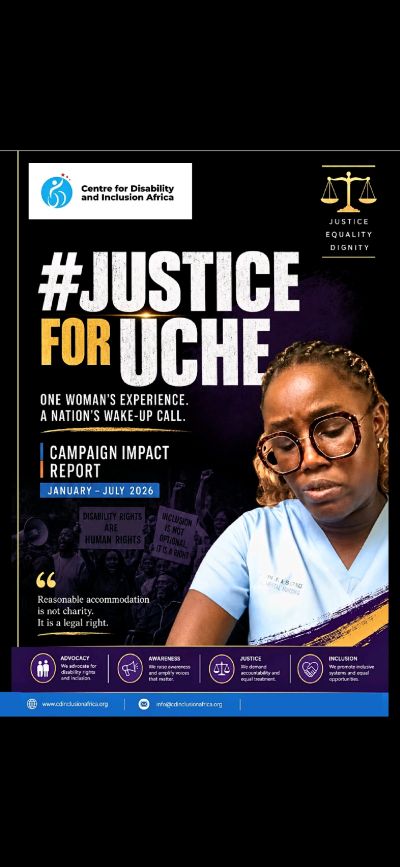
Read full report here or click this link https://www.linkedin.com/feed/update/urn:li:activity:7484961742993940480/
Overall, #JusticeforUche stands as a powerful example of how strategic communications and advocacy can elevate a single voice into a movement for national reflection and reform. While long-term policy outcomes are still evolving, the campaign has already made a meaningful contribution to advancing disability inclusion and reinforcing the principle that equal opportunity requires accessible systems, reasonable accommodation, and accountable institutions.