Call for Actions

Intellectual and Developmental Disabilities in Nigeria, Stakeholders issued Key recommendation’s

At the recently held virtual Town Hall meeting of stakeholders’ convened by the Centre for Disability and Inclusion Africa, in Lagos Nigeria on March 26, 2025 2025. Stakeholders while calling for concerted and urgent efforts from everyone, jointly agreed on the following
DISABILITY RIGHTS WEBINAR SERIES, MARCH 2025 

KEY RECCOMMENDATIONB

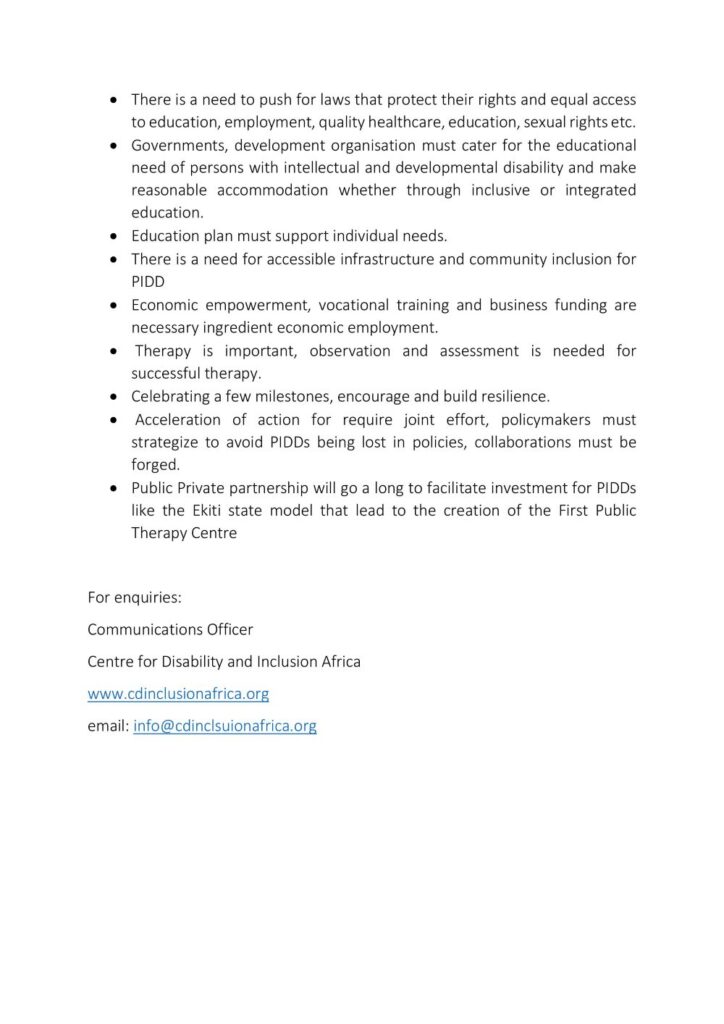
Lagos Nigeria, March 26, 2025 key recommendation of PIDD stakeholders meeting

Objective: is to educate the public, persons with intellectual and developmental disability, caregivers, and parents about their rights and share strategy for support, integration and independence.

 Key Recommendations

  • Promoting independence, inclusion and equal opportunities for people with intellectual and developmental disabilities requires a multifaceted approach that addresses social, educational, employment, health and community needs.
  •  Parental acceptance of the condition and early Intervention is important for integration and independence of PIDD.
  • Government should adopt inclusive budgeting that makes provision for Persons with disabilities.
  •  Family Support and involvement, Parents peer support groups helps to understand how to support PIDDS and helps connect and find support parents.
  • There is need for more advocacy and awareness among the public: these include curriculum to teach children about disabilities, collaboration with more content creator/ media organisation for more coverage and content that counters myths, taboos and misconceptions raise awareness.
  • Provision of training and learning support for teachers, caregivers, and employers to better understand the needs and strengths of people with IDD.
  • There is a need to push for laws that protect their rights and equal access to education, employment, quality healthcare, education, sexual rights etc.
  • Governments, development organisation must cater for the educational need of persons with intellectual and developmental disability and make reasonable accommodation whether through inclusive or integrated education.
  • Education plan must support individual needs.
  • There is a need for accessible infrastructure and community inclusion for PIDD
  • Economic empowerment, vocational training and business funding are necessary ingredient economic employment.
  •  Therapy is important, observation and assessment is needed for successful therapy.
  • Celebrating a few milestones, encourage and build resilience.
  •  Acceleration of action for require joint effort, policymakers must strategize to avoid PIDDs being lost in policies, collaborations must be forged.
  • Public Private partnership will go a long to facilitate investment for PIDDs like the Ekiti state model that lead to the creation of the First Public Therapy Centre

For enquiries:

Communications Officer

Centre for Disability and Inclusion Africa

www.cdinclusionafrica.org

email: info@cdinclsuionafrica.org

READ MORE
Albinism challenges in Nigeria

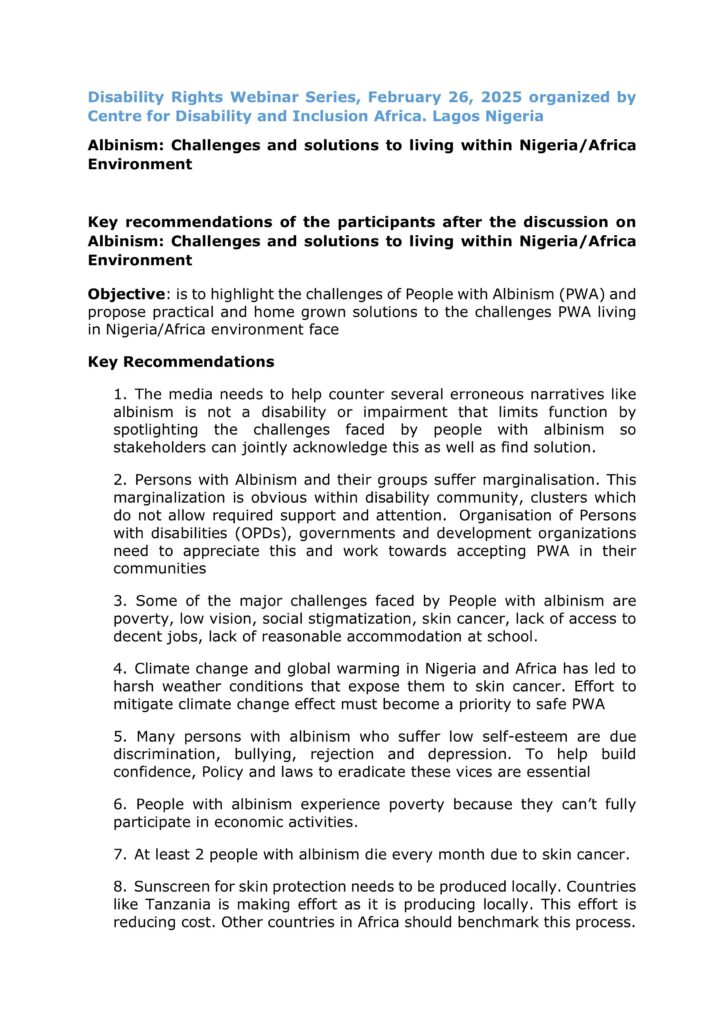
Albinism Challenges, Stakeholders offer key recommendations

Albinism comes with different challenges and can be quite expensive to maintain. In many instances, rights of Persons with Albinism are being denied our of ignorance or a deliberate attempt.

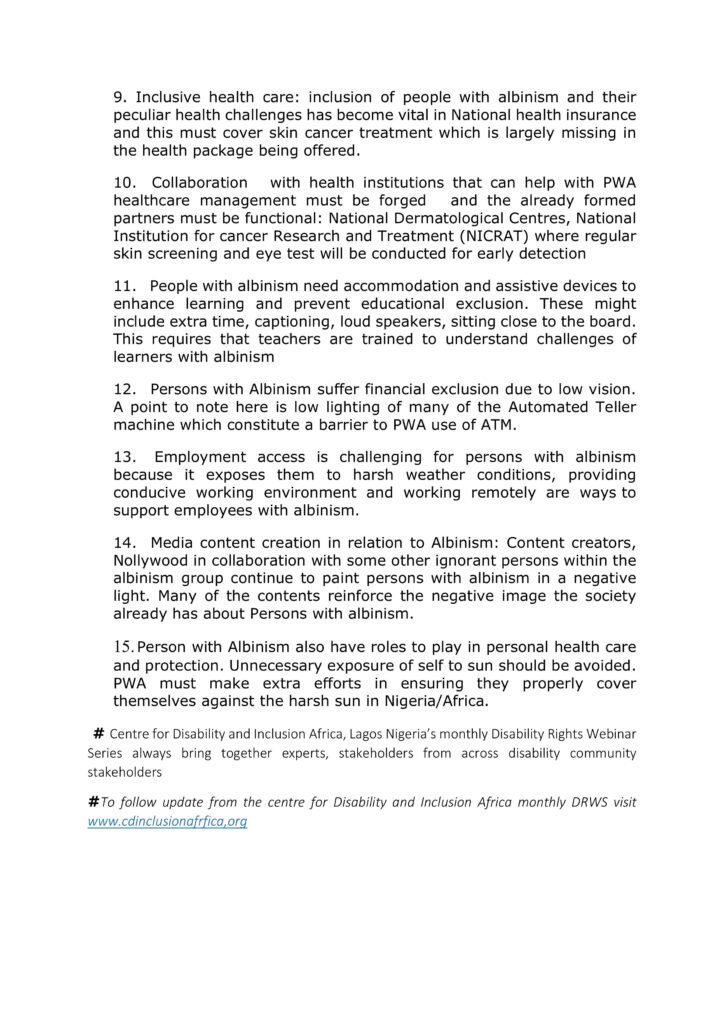
At the centre for Disability and Inclusion Africa’s monthly Disability Rights Webinar Series which held on February 26, 2025. Stakeholders rose with key recommendations. Here below is the key issues raised

If youi prefer PDF format, please check this link https://www.linkedin.com/feed/update/urn:li:ugcPost:7304804919276929026/?actorCompanyId=104643128

READ MORE
#WheekchairNotLuggage

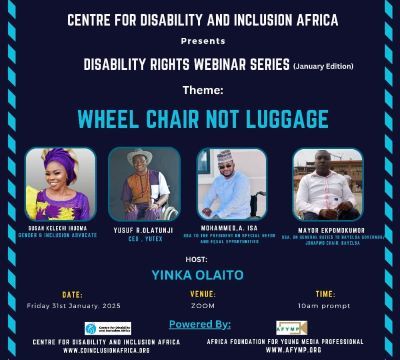
CDIA and other Stakeholders issued a communique on “Wheel Chair Not Luggage

Communique issued at the end of Wheel Chair Not Luggage Stakeholders meeting/Webinar with the theme: Wheel Chair Not Luggage which held on Friday 31st January, 2025

Preamble

The challenges of Persons with disabilities in Nigeria are huge. Abuse of their rights are most prevalent and there seems to be no sustainable efforts to stem this. The focus of the stakeholders for this meeting was narrowed down to challenges faced by physical-mobility individuals especially those who use wheel chairs. The meeting had in attendance, Government officials, Organization of Persons with disabilities organisations, member of different media houses, Persons with disabilities among others

Objective: is to promote the freedom of movement of wheelchair users, counter the misinformation about wheelchair being a luggage instead of being mobility aid, highlight the challenges associated with a using wheelchair and come up with solutions that will enhance the accessibility and mobility of wheelchairs. 

Key Resolutions

  • Wheelchairs are mobility aid and should never be considered as luggage by transport operators whether as a matter of ignorance, due to misinformation or negative societal perception Transport operators must provide reasonable accommodation for wheelchair users in their service delivery. Wheelchair mobility gives users independence, confidence and sense of participation. To  an wheelchair user this mobility equipment gives opportunity to  go work, study, and leadership opportunities.
  • Accessibility of physical facilities whether public or private facilities is a key component of an inclusive society.
  • Mobility challenges for wheelchair users can be classified into upstream challenges (manufacturer/design challenges, comfort) and downstream challenges are challenges associated with non-compliance with accessibility code and universal design.
  •  The discrimination Against Persons with Disabilities (Prohibition) Act (2018) is a major milestone in attaining a disability inclusive society. Wheelchair use by anyone who needs it is backed in the law DAPDA 2018
  •  There is a need for wheelchair users to unite and organised themselves to sensitize and engage with major stakeholders in the Nigerian transport system such as the ministries of transportation, NUTRW for advocacy and public reorientation.
  •  There is a need for continuous re- orientation and public   sensitization for wheelchairs users’ community and the general public.
  • Continuous advocacy will drive empathy, knowledge in service delivery among transport service operators.
  • There is a need to push for policy change which prioritizes accessible infrastructures, universal designs and address gaps that allow wheelchair to be treated as aid not luggage.
  • There is a need to train transport service providers on disability, inclusion
  • There is a need for political will and finance to prioritize mainstreaming disability inclusion.
  • Major stakeholders in public transportation should be part of this conversation.
  • Behavioural change materials can be used to sensitize public road transporters and advocacy material should be translated into local languages.
READ MORE