
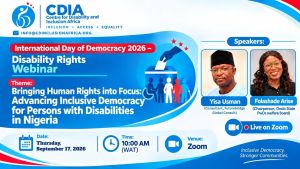
Making Inclusive Democracy Work for Persons with Disabilities in Nigeria
As the world marked the International Day of Democracy, the Centre for Disability and Inclusion Africa (CDIA) convened a timely conversation on advancing inclusive democracy for persons with disabilities in Nigeria. The webinar brought together disability advocates, electoral stakeholders and participants from Nigeria and Kenya to examine a fundamental question: Howdo we move from recognizing disability rights in law to ensuring that those rights are experienced in practice?
The keynote speaker, Mr. Yisa Usman emphasized that legal recognition is only the starting point. For democratic participation to become meaningful, there must be a complete implementation chain: disability to disaggregated data, rights, policy, participation in planning, budgeting, procurement, training, deployment, accessibility, participation, outcomes and accountability.
The Electoral Act 2026 provides an important foundation by requiring the National Register of Voters to include disability status disaggregated by type of disability. It also requires reasonable steps to support voters with disabilities through measures including Braille, large embossed print, electronic devices, sign-language interpretation and, where appropriate, off-site voting.
For CDIA, however, the central issue is implementation. Data must answer three practical questions: Who needs support? What support is required? And where should it be deployed? These answers should directly inform electoral budgets, procurement specifications, training, logistics and deployment.
INEC’s recent engagement with the Joint National Association of Persons with Disabilities (JONAPWD) and organisations of Persons with Disabilities further demonstrates the importance of this approach. On 16 September 2026, INEC reported that 137,487 persons with disabilities had been captured in available registration data before the Automated Fingerprint Identification System (AFIS) exercise. The figure should not be interpreted as the total population of registered voters with disabilities; rather, it represents disability-related data available to the Commission at that stage.
Mr. Lanre Olakusibe shared practical experiences from the recent Osun gubernatorial election, highlighting progress alongside continuing challenges involving awareness, physical accessibility, transportation, assistive materials and the preparedness of polling officials. His reflections reinforced the need to involve persons with disabilities from the earliest stages of electoral planning, rather than attempting to retrofit accessibility after decisions have already been made.
Participants also discussed barriers to political candidacy, including the cost of political party application forms. Inclusive democracy must extend beyond the right to vote to the opportunity to contest, participate in political parties and contribute to public decision-making.
The Kenyan perspective, shared by Karen Muruiki, demonstrated that these challenges extend beyond Nigeria. Kenya’s Persons with Disabilities Act, 2025 expressly recognises the civic and political rights of persons with disabilities and requires accessible voting procedures, facilities and materials.
The webinar concluded with a clear agenda for action. Centre for Disability and inclusion Africa will document the proceedings and share recommendations with policymakers, INEC and relevant authorities; engage the National Commission for Persons with Disabilities on identified accessibility concerns; advocate for disability inclusion education in primary school curricula; raise barriers created by political nomination fees; and continue pressing for adequately trained personnel to be deployed on election day.
Five practical reforms emerged: mandatory accessibility-readiness checklists for polling units; disability-competence assessments for frontline officials; direct links between disability data and electoral budgeting and procurement; public post-election reporting on inclusion outcomes; and meaningful participation of persons with disabilities and their representative organisations throughout planning, implementation and evaluation.
Inclusive democracy is not achieved when rights exist only on paper. It is achieved when institutions have the systems, resources, people and accountability mechanisms required to make those rights accessible to everyone.
You can read full report here or click this link https://lnkd.in/p/ePzZ29AF