
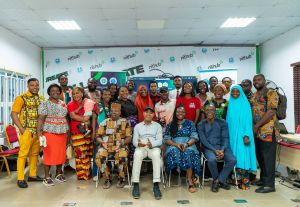
AI Ability for Inclusive Education Consortium launched
Communique
Co-creation Workshop On Advancing Inclusive Education Through Artificial Intelligence
13 August 2026 | NiTHub, University of Lagos
Convened by: Nigerian Artificial Intelligence Research Laboratory (NAIRL), University of Lagos
In partnership with: Centre for Disability and Inclusion Africa (CDIA)
Preamble: From Research to Action
The Nigerian Artificial Intelligence Research Laboratory (NAIRL), University of Lagos, in partnership with the Centre for Disability and Inclusion Africa (CDIA), convened a multi-stakeholder Co-Creation Workshop on Advancing Inclusive Education through Artificial Intelligence on 13 August 2026 at NiTHub, University of Lagos.
The workshop brought together persons with disabilities and their representative organizations, parents and caregivers, special educators, policymakers, AI and technology developers, technology lawyers, researchers and disability advocates to translate evidence into practical action.
The workshop built on the CDIA research report, “Artificial Intelligence and Inclusive Education for Learners with Disabilities in Nigeria: Opportunities and Challenges,” which identified six priorities for harnessing AI to advance inclusive education:
Improve school and digital infrastructure.
Expand access to assistive technologies.
Build teachers’ AI and inclusive education capacity.
Strengthen inclusive education policies.
Develop ethical and accessible AI solutions.
Foster multi-stakeholder collaboration.
What Stakeholders Prioritised
Through a co-creation process, participants reordered these priorities and agreed that collaboration must come first, followed by the enabling conditions needed for responsible and effective AI adoption:
1. Collaborate → 2. Strengthen Policy → 3. Develop Ethical & Accessible AI → 4. Build Teacher Capacity → 5. Improve Infrastructure → 6. Expand Assistive Technology → 7. Test, Evaluate & Scale.
Participants emphasized that persons with disabilities must be co-designers and co-owners—not merely end users—of AI solutions. AI-enabled education must respond to individual learning needs rather than promote “one-size-fits-all” solutions.
Key Decisions
Participants agreed in principle to establish an AI and Inclusive Education Consortium, also proposed as an “AI’s Ability Working Group,” bringing together government, educators, researchers, technology developers, disability organisations, persons with disabilities, caregivers, legal and policy experts and other relevant stakeholders.
The proposed consortium will:
Map and build on existing AI, assistive technology and inclusive education solutions.
Identify scalable, affordable and accessible innovations.
Review policy and implementation gaps.
Develop principles for ethical, accessible and disability-inclusive AI.
Support teacher AI literacy and capacity development.
Identify funding and public-private partnership opportunities.
Coordinate pilots, evidence generation, monitoring and scale-up.
Immediate Priorities
Participants identified the following immediate actions:
Establish the AI and Inclusive Education Consortium.
Map existing solutions and identify what works.
Review AI and inclusive education policies and implementation gaps.
Develop a pilot Teacher AI Literacy Programme.
Co-design and test ethical, accessible AI solutions with persons with disabilities.
Explore PPPs to improve digital infrastructure and access to assistive technologies.
Establish mechanisms to monitor, document and learn from pilot interventions.
Our Shared Commitment
Participants affirmed that:
AI must be a tool for inclusion not another source of exclusion.
Achieving this will require strong policy, meaningful participation of persons with disabilities, capable teachers, accessible infrastructure, ethical technology, sustainable financing and sustained collaboration.
The workshop therefore marks a shift from research to action, from consultation to co-creation, and from technology for persons with disabilities to technology designed with and by them.
The commitment is clear: bring stakeholders together, build what works, test it with users, learn from the evidence—and scale inclusion.
Issued on 13 August 2026
Co-Creation Workshop on Advancing Inclusive Education through Artificial Intelligence
Nigerian Artificial Intelligence Research Laboratory (NAIRL), University of Lagos & Centre for Disability and Inclusion Africa (CDIA)