
From Access to Engagement: Why Inclusive Education Needs a Rethink
Inclusive education is often discussed in terms of infrastructure, enrolment, and policy commitments. But what happens after learners with disabilities enter the classroom? Do they feel seen, supported, and meaningfully engaged? These critical questions shaped a recent session in the Disability Rights Webinar Series hosted by the Centre for Disability and Inclusion Africa (CDIA), which convened educators, policymakers, and disability advocates to examine a deeper, more practical vision of inclusion.
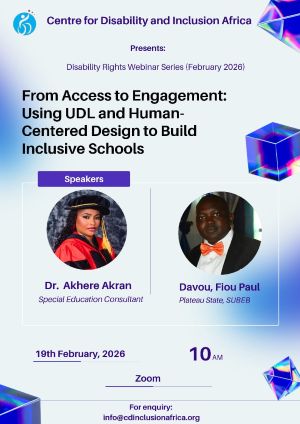
Held virtually on 19 February 2026, the webinar, themed “From Access to Engagement: Using Universal Design for Learning (UDL) and Human-Centered Design (HCD) for Inclusive Education,” focused on bridging a persistent gap in Nigeria’s education landscape: the difference between providing access and ensuring genuine participation.
Why Access Alone Is Not Enough
Despite growing policy recognition of inclusive education in Nigeria, many learners with disabilities continue to face barriers that limit not only entry into schools but their ability to thrive within them. Challenges such as overcrowded classrooms, insufficient teacher preparation, rigid curricula, and entrenched social attitudes often undermine well-intentioned inclusion efforts.
A recurring concern during the webinar was that inclusion is still too frequently framed as a matter of accommodations reactive measures applied after difficulties emerge rather than proactive design. This mindset, participants agreed, risks creating environments where learners are present but not fully engaged.
Inclusion as a Mindset and Leadership Issue
One of the session’s most compelling insights came from Dr. Mariam Akhere Akran, a special educator and diversity strategist, who challenged common assumptions about inclusive education. She argued that inclusion is not primarily a financial problem but a question of mindset, leadership, and intentional design.

Dr Mariam Akhere Akran
Viewing disability as a form of human diversity rather than deficit, she explained, fundamentally shifts how educators approach teaching and learning. When teachers prioritise empathy, psychological safety, and flexibility, classrooms become more responsive to all learners — not just those with identified disabilities.
This perspective also counters the widespread belief that inclusion is inherently expensive. Many inclusive practices, she noted, involve low-cost adjustments in lesson planning, communication, and student engagement strategies rather than major structural investments.
Universal Design for Learning: Planning for Variability
Central to the discussion was Universal Design for Learning (UDL), presented as a framework for anticipating learner variability from the outset. Instead of designing lessons for an “average” student, UDL encourages educators to recognise that learners differ in how they engage with information, process concepts, and express understanding.
The webinar highlighted three foundational UDL principles:
- Multiple Means of Engagement – Supporting motivation and sustained participation
- Multiple Means of Representation – Delivering content in varied formats
- Multiple Means of Action and Expression – Allowing diverse ways to demonstrate learning
Participants were encouraged to see UDL not as an add-on technique but as a design philosophy embedded at the planning stage of teaching.
Moving from Physical Access to Meaningful Engagement

PAul Davou Fiou
While physical accessibility and enrolment remain vital, speakers emphasized that these measures alone do not define inclusion. Paul Davou Fiou, representing the Special Education Unit of the Plateau State Universal Basic Education Board, observed that many initiatives still focus narrowly on getting learners into schools without sufficiently addressing classroom participation and learning outcomes. Access without engagement, he stressed, can inadvertently reproduce exclusion within the classroom itself. True inclusion requires adaptable curricula, interactive teaching methods, and deliberate attention to learner agency.
Human-Centered Design: Designing With Learners
Complementing UDL, Human-Centered Design (HCD) was introduced as an approach that prioritises the lived experiences of learners and families. Rather than importing generic solutions, HCD advocates context-sensitive strategies shaped by local realities. This includes actively incorporating student and parent voices into curriculum development and policy processes an especially important consideration in contexts where stigma, trauma, or cultural misconceptions influence educational experiences.
Addressing Systemic Barriers
Importantly, the conversation framed many obstacles to inclusion as systemic rather than individual failures. Overcrowded classrooms, limited teacher training, and weak policy implementation mechanisms were recognised as structural issues requiring coordinated responses.
To this end, participants explored strategic priorities such as integrating Universal Design principles into curriculum reform, strengthening teacher training institutions, establishing cross-sector design teams, and reinforcing accountability systems.
From Dialogue to Action
Beyond knowledge sharing, the webinar fostered robust engagement among participants, reflecting a growing appetite for practical, scalable solutions. Increased awareness of UDL and HCD concepts, coupled with strong multi-stakeholder dialogue, marked key outcomes of the session.
A Broader Vision for Inclusion
The discussions ultimately pointed toward the need for a coherent national inclusion framework one that aligns policy, pedagogy, and governance while embedding monitoring and evaluation mechanisms to track real-world impact.
Inclusive education, as underscored throughout the webinar, is not simply about removing barriers to entry. It is about designing learning environments where every student can participate, contribute, and succeed. As CDIA continues to convene conversations at the intersection of disability rights and development, one message stands clear: sustainable inclusion begins not at the school gate, but at the heart of how we design learning itself.
Read Full Report here or https://www.linkedin.com/feed/update/urn:li:ugcPost:7430249982064029696/?actorCompanyId=104643128