Inclusion in Nigeria

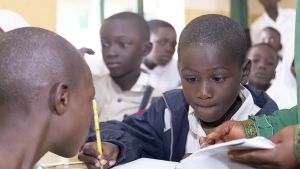
Promoting Inclusive Education for Children with Disabilities in Nigeria

To reach real peace in the world, we will have to begin with the children.” – Mahatma Gandhi.

This quote is just one of many quotes that denotes how imperative it is for children to have access to education in order to have a promising and fortified future.

However, in Nigeria today, education is embroiled in loads of challenges and many children are being denied access to a good education due to the narratives surrounding its effectiveness. This is especially so for children with disabilities. Educational system in Nigeria is one of the less funded sectors and this has shattered the hope of good and affordable education for children in Nigeria.

If Nigerian children, especially the ones with disabilities, must ascend a promising future in the educational sector, inclusiveness as well as access must be prioritized.

Inclusive education upholds the famous theme “education for all” because it promotes equality in giving good and quality education to children. It bridges the gap that causes disparities in giving good education to the abilities and disabilities and makes them equal. This ideology has to be promoted to make the disabled contribute their quota to the growth of humanity and have a sense of belonging. Inclusive education is creating a school environment that is accepting and supportive of all children regardless of their disabilities or abilities.

If Inclusive education will work, Nigeria government must:

Create awareness and sensitization about disability issues: Inclusive education can be promoted in diverse ways. This is the best way to effectively bridge the disparities between children with disabilities and those with none. To do this right, one of the ways is to create awareness and sensitization about disability issues. In a stereotypical society where people are quick to backlash or talk down on people with disabilities, inclusive education can’t be promoted or utilized effectively.

Value of inclusive education must form the core of sensitization and awareness. This must be the central message and must be hammered consistently. Reorientation of teachers and every stakeholder must be given priority. Effective channels of disseminating information must reach the teachers, parents, school administrators, and students.  The channels for disseminating information regarding the importance of inclusive education can be through seminars, training, flyers, radio, television newspapers, etc.

Special education curriculum: for the students, the government can introduce special education subjects into the curriculum for primary and secondary students so they are able to communicate with and appreciate children with special needs or with disabilities. A change of orientation that disabilities are not mostly contagious messages should be spread to ease the tension of ignorant parents. The belief system that promotes disabilities is contagious may work against inclusive education. Radio jingles, drama, television shows in different languages should be encouraged.

-The use of inclusive teaching methods: Teaching methods always differ based on the type of students but this can change by using inclusive teaching which accommodates all ranges of students. A focus on teaching strategies which are engaging, interactive and provide multiple ways for students to demonstrate their understanding will help a lot.

Another teaching method that can also help here is known as Differentiated Instruction (DI). Here, teachers will give different instructions to students in the class based on their strengths and meeting the individual needs of students. This will require teaching methods to be the same but assessment and evaluation can be varied based on the specific situation of the students. This is because the level of understanding may differ.  For children with no disabilities, a fusion of simple and complex assessment may apply but for braille users, simple assessment should be introduced at first. This will help in promoting inclusive education in Africa.

Recruitment of qualified and well-equipped teachers: We must acknowledge education is crucial. Teachers do have a great role to play here.

If Nigerians are determined to promote inclusive, good and quality education, the right kind of teachers have to be recruited. Inclusive education can become an integral part of education if the teacher can at least communicate with every student through a form each can comprehend. At least even if this is at the basic level. This may require a level of overhauling the present educational courses at the higher institution levels. Those in the class already can do well with some training.

Photo credit: Smile project

READ MORE
Digital Rights

How to promote inclusivity through digital  communication

In this age of digital connectivity, social media platforms have become indispensable tools for driving social change and pushing the bounds of unthinkable thoughts. Digital media platforms have become central to exchange of information by enabling the connection of people and ideas everywhere across the globe.

 In recent times, digital platforms have made significant use when strategically deployed can promote inclusivity through its various features that enable People with disability to have access to media contents. The interface is enhancing the user experience for all.

In this piece we will like to suggest the use of certain features to ensure everyone gets access to contents regardless of their disabilities.

1.Alternative text: “alt text” for short, is simply a descriptive caption that can be added to images or videos shared on social media. The target of this feature is primarily people with visual impairments who use screen readers to access contents online. When alt text is included, screen readers can convey a brief description of the image or video, providing context that may otherwise be lost.

Twitter and Instagram platforms had given users the opportunity to add alt text to their media uploads. This simple yet powerful function allows content creators to describe the content of their images in a few words. By doing so, they make their content accessible to those who rely on screen readers, ensuring that everyone can engage with and understand the message.

2.use of video content: There has been a surge in the use of video content on social media. No doubt this poses challenges for people with hearing impairments. This is where closed captioning comes in to play. Closed captions are synchronized text displayed on videos, providing a transcript of the spoken content as well as descriptions of relevant audio elements such as music or sound effects.

YouTube and Facebook offer tools for adding closed captions to videos. By doing so, content creators not only make their content accessible to the hearing-impaired but also improve the overall user experience by enabling viewers to engage with videos in environments where audio may be muted or inconvenient.

3.High Contrast Mode; this is another feature in digital interfaces and operating systems that can significantly promote inclusivity, especially for individuals with vision-related disabilities. High Contrast Mode is designed to improve the visibility and legibility of content on screens by increasing the contrast between text and background colors, employing bold, high-contrast color schemes, applying simplified design and adjusting text sizes in some cases.

4.Text-to-Speech (TTS) is a feature that promotes inclusivity in the digital realm by breaking down barriers for individuals with disabilities, enhancing accessibility, and ensuring that information is readily available to a broader audience. Some platforms offer TTS functionality, allowing text-based content to be converted into speech for users with visual impairments.

The feature can read out the content of websites, digital books, e-readers and other text-based files. This makes information accessible to visually impaired people.

5.Screen Reader Compatibility: For individuals with visual impairments, screen readers are essential tools that bridge the gap between them and the online space. Screen readers are software applications that convert digital text and other content into synthesized speech. They allow users to navigate websites, read emails, and interact with various digital interfaces.

Digital platforms now offer commendable opportunities for promoting inclusivity through the incorporation of inclusive design features with far-reaching implications. Individuals with disabilities can actively participate in the online conversation, share their experiences, and access information and entertainment just like anyone else.

Inclusive digital communications not only fulfil a moral imperative but also expands the reach of organization’s communications, content creators to a wider and more diverse audience. As technology continues to advance, it is crucial for social media platforms to maintain their commitment to inclusivity, making the online space more accessible, welcoming and safe for all.

READ MORE

Inclusive and sustainable society? How is it everyone’s duty?

In a recent conversation with team members, our executive director, Yinka Olaito shared some insights on how everyone can make a change in the journey to an inclusive and sustainable society, we just want to share

The world we live in is dangerously tilted in favour of some persons with noted abilities because of belief system, class, status or position. No wonder there is a clamour for a just, equitable society from different angles. Knowing this is a reality, persons with disabilities’ challenges are grossly compounded as they are side-lined. It is only a handful of these over 80 Million global populations that are noticed or given a voice. This is often always at a cost of pushing harder for recognition through undeniable achievements.

While everyone may continue to point accusing fingers to only those who are in power alone, because they have enormous resources entrusted to them to make a change, the reality is, everyone can start the crusade of lighting the dark places from their own corners.

The truth is with disabilities or not, each one of us can play a role if truly we desire an inclusive and sustainable society. Here below are how’s?

1-Respect differences in all: Our individual, family and ethnic biases often push us unconsciously to think we are superior in a way. This shows in our speech, relationship with others and how we frame events and people around us.

Everyone can move the crusade for an inclusive and sustainable society up by an inch if we all learn to respect differences in one another’s abilities. No one is useless. Value can be seen in the way we react or deal with people around us whether they have disabilities or not,

2- Speak up, do not ignore: In many instances in the course of our daily lives, we see injustice and keep silent either because we do not want to rock the boat or we are concerned about our own lives’ issues.  Silence empowers the oppressors.

Injustice against persons with disabilities may begin from home where preferences are given to bright and active children over the ones who are slow and do not pick things fast. We see some of these anomalies at home and we move on unconcerned hoping the ‘victim’ should rise up and defend him/herself. Learn to speak up for others at home, at work among many other places.

3-Speak or call on your representatives in government: We may not be able to do much in terms of policy change but we can call on our elective representatives in government to create an enabling environment that will make a sustainable and inclusive society thrive.

Some say “I do not have such access to my political representative”. But you have social media platforms where you can express your constructive opinions. Make it a duty to post something around your concern for inclusive and sustainable society every day. Over time some other concerned members will join you and this will go viral.

4-Collaborate with others: in every tribe and nations/ethnos, there are people with similar pains/concerns who are looking for persons with shared interest they can work with so they can make the change collectively. Check with your neighbours, put up a post on your society media and build such community if none exists. Do the little you can do in support of disability and inclusion in your community. Before long such little efforts will make crucial impact

5- Give resources to organizations who are in the forefront of the crusade: There may be few organizations out there, especially in a nation like ours and others, but the truth is it is easier to know those who are doing this for money. It does not take a long time to see behind the veil.

But of note is the fact that there are genuine organizations out there with passion and commitment to seeing this reality in place. Even if you do not have anything to give, you are likely to know those with resources who can help. Refer or connect such individuals/organizations to these identified organizations. You are already contributing to this in a way.

In closing, the Centre for Disability and Inclusion Africa is in the forefront of pushing for a transformative and inclusive society across Africa. We appeal to you to donate, give, support our advocacy, empowerment, disability rights issue and policy change we are pushing. We have a major event in September 2023 and others before the year runs out

We also aim to build a highly impactful training centre where inclusion advocates can be empowered and released across Africa so they can change each community at a time. We are just a mail and call away.

READ MORE
Africa

34 African Journalists trained as disability and Inclusion reporting fellows

Media has the power to shape perception of the society about anything. Its framing, whether international or not, will go a long way in affecting either negatively or not how the society treats or accept the entity.

A number of African journalists (34 in all) from different media houses across Africa have been selected as Centre for Disability and Inclusion Africa to be trained on professional ways to report. This initiative was inaugurated after a survey that revealed capacity gaps of journalists in this specialized reporting. This project was done in collaboration with Africa Foundation for Young Media Professionals,

These journalists were selected after a rigorous call for application and shortlisting process that lasted for about three weeks.   These fellows will go through hybrid training and mentorship sessions as well as story writing and news gatherings ethics around Disability and inclusion reporting son they can all add value to this crucial beat that is missing in many of the newsrooms.

Some of the journalists selected

Disability and inclusion reporting, raising the voices of the marginalized in the society is funded by Africa Foundation for Young Media professionals with support from MacArthur Foundation through CMEDIA Project led by WOle Soyinjka Centre for Investigative Journalism

Since there is no justice or inclusive society without diversity, it has become important for the media not to leave behind over a billion humans with disabilities around the world. Today we found out that the media is not given attention to disability and inclusion issues. The problem is, most media houses do not have data to write great story or do not understand the urgency associated with leaving this huge population behind.”” Yinka Olaito, Executive director of Africa Foundation for Young Media Professionals said in his release.

Yinka Olaito leading a session during the training

“Africa Has its own larger share of these one Billion People so there is an urgent need for the media to be empowered to do its job in this area. This has created a need for African journalists to rise up to this challenge and someone must stand up to equip them for ethical professional coverage of this. Hence the institution of this fellowship.

The beneficiaries of this six months’ fellowship are from Nigeria, Kenya, Ghana, Democratic Republic of Congo etc

The training which used hybrid method held in Ibadan and Abuja Nigeria.

Watch media coverage of the event here

READ MORE