
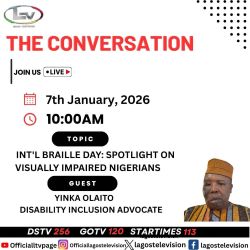
CDIA Sends a Strong Message on World Braille Day 2026
World braille Day, marked annually on January 4, commemorates the birth of Louis Braille, whose revolutionary invention transformed access to information for millions of blind and visually impaired people worldwide. Braille remains a powerful tool for literacy, learning, and independence, enabling blind and partially sighted persons to read the same books, periodicals, and educational materials as those printed in standard visual formats.
Beyond its practical value, Braille is fundamental to education, freedom of expression, access to information, and social inclusion. Its importance is firmly recognized by the United Nations and enshrined in Article 2 of the Convention on the Rights of Persons with Disabilities (CRPD), which affirms accessible communication as a basic human right, not a privilege.
Yoruba Language talk on Honor FM Ibadan- “Gbagede Oro
However, World Braille Day must go beyond ceremonial celebration. It is also a critical moment to raise awareness about the lived realities of persons with visual impairments—whether partial sight loss, long-distance vision challenges, or total blindness. Globally, over 2.2 billion people live with some form of visual impairment, according to the World Health Organization. In Nigeria alone, an estimated 1.3 million people are affected. These figures underscore the urgency of sustained advocacy, inclusive policies, and systemic reform.
Selaye on Harmony FM Ilorin
Across Nigeria and much of Africa, many visually impaired persons continue to face deep-rooted discrimination and social exclusion. Too often, they are treated as less than fully human, with stigma extending even into families, where some parents and caregivers struggle to publicly identify with or support their children. These social attitudes are compounded by weak implementation of disability inclusion policies at various levels of government.
Yoruba news on Fresh FM Ibadan
As a result, access to quality education, healthcare, financial services, social protection and employment opportunities for visually impaired persons continues to deteriorate. This reality reinforces the need for deliberate, strategic advocacy, robust policy engagement, and accountability-driven inclusion efforts.
In line with this commitment, the Executive Director of the Centre for Disability and Inclusion Africa (CDIA) used World Braille Day 2026 as a platform for high-impact media engagements and advocacy interventions across multiple radio and media outlets, in both local languages and English. These engagements focused on promoting Braille literacy, challenging harmful stereotypes, and calling for stronger government action to uphold the rights of persons with visual impairments.
World Braille Day is not only a celebration of an invention it is a call to action. CDIA remains steadfast in amplifying this call until accessibility, dignity, and inclusion become lived realities for all.