
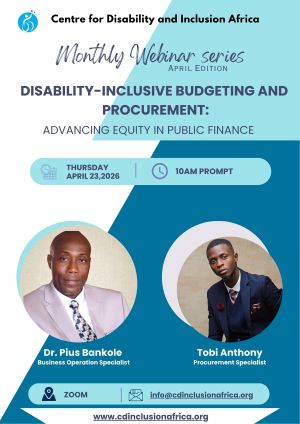
No Inclusion, No Impact: Rethinking Public Procurement in Nigeria and Africa
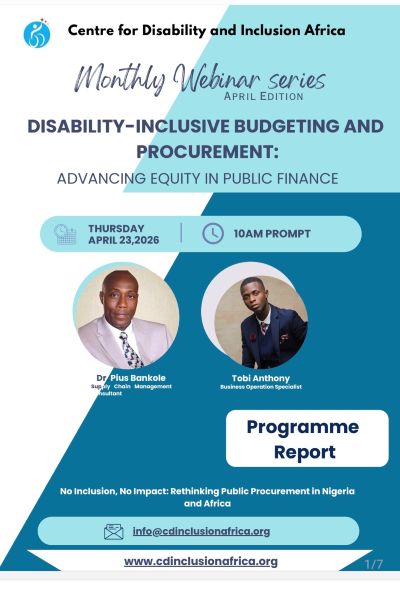
The April 2026 Disabilitit Rights webinar Series by the Centre for Disability and Inclusion Africa convened stakeholders, professionals, and advocates for a timely conversation on one of the most overlooked levers of inclusion public finance. The latest edition of the Disability Rights Webinar Series brought disability-inclusive budgeting and procurement into sharp focus, reframing them not as technical processes, but as powerful tools for equity, access, and economic participation.
At the heart of the conversation was a simple but critical idea: inclusion must begin at the planning table. Without embedding disability considerations into how governments allocate and spend resources, inclusion risks remaining aspirational rather than actionable.
Inclusion Is Not Charity It Is Strategy
Opening the session, procurement expert Tobi Antony challenged conventional thinking by positioning disability inclusion as an economic imperative. Public finance, he noted, is designed to drive both economic stability and social welfare. Excluding persons with disabilities from budgeting and procurement processes undermines both goals.
Rather than viewing inclusion as a social add-on, Antony emphasized that it should be treated as a strategic investment one that strengthens systems, improves efficiency, and expands market participation. In practical terms, this means designing budgets that anticipate accessibility needs and procurement systems that intentionally create space for persons with disabilities to participate.
Budgeting and Procurement: Two Sides of the Same Coin
A key takeaway from the session was the inseparable relationship between budgeting and procurement. Budgeting defines priorities it is where governments decide what matters. Procurement, on the other hand, is where those priorities are executed.
As Antony explained, procurement cannot exist without budgeting. A well-designed budget ensures that resources are allocated for inclusive initiatives, while effective procurement ensures that those resources deliver value. This alignment is especially critical in contexts where inefficiencies, corruption, or poor planning often derail public projects.
Drawing from private sector practices, Antony highlighted the importance of data-driven decision-making, cost optimization, and value-for-money assessments. These approaches, he argued, could significantly strengthen public procurement systems across Africa if adapted thoughtfully.
Expanding the Role of Persons with Disabilities
Beyond policy frameworks, the webinar explored how persons with disabilities can actively participate in procurement ecosystems. The conversation moved beyond representation to real economic inclusion.
Participants discussed two key entry points:
- As internal stakeholders, contributing to policy design, oversight, and implementation within government institutions.
- As external suppliers, competing for and delivering public contracts.
This dual approach shifts the narrative—from beneficiaries of policy to drivers of economic activity. It also aligns with broader development goals around inclusive growth and equitable access to opportunities.
Understanding Procurement Beyond Transactions
Adding depth to the discussion, Dr. Pius Bankole unpacked the distinction between purchasing and procurement terms often used interchangeably but fundamentally different in scope.
Purchasing, he explained, is transactional: the act of acquiring goods and services. Procurement, however, is strategic. It encompasses planning, sourcing, contracting, and evaluation. This broader perspective underscores why inclusion must be integrated at every stage—not just at the point of purchase.
Bankole also stressed the importance of robust budget preparation and allocation as the foundation for effective procurement. Without clear financial planning, even the most well-intentioned procurement processes can fall short.
Lived Experience Meets Systemic Barriers
The conversation gained further resonance with insights from Yisa Usman, who brought a lived-experience perspective to the discussion. While acknowledging the existence of policies and legal frameworks that support disability inclusion, Usman highlighted a persistent gap between policy and practice.
For many persons with disabilities, systemic barriers—ranging from inaccessible processes to limited awareness among decision-makers—continue to restrict meaningful participation. His contribution served as a reminder that legislation alone is not enough; implementation is where real change happens.
From Advocacy to Collaboration
A recurring theme throughout the webinar was the need to rethink advocacy strategies. Rather than approaching government institutions with confrontation, speakers encouraged a more collaborative approach—one that builds partnerships, fosters dialogue, and aligns shared interests.
Engaging policymakers, procurement officers, and legislators early in the budgeting process can help ensure that disability inclusion is not an afterthought. It also creates opportunities to influence how resources are allocated and monitored.
The Road Ahead
As the session concluded, one message stood out: inclusive budgeting and procurement are not optional they are essential to building resilient, equitable societies.
For organizations, governments, and advocates, the path forward is clear. It requires shifting mindsets, strengthening systems, and centering inclusion at every stage of public finance. It also demands sustained engagement turning conversations like this into concrete actions that improve lives.
At the Centre for Disability and Inclusion Africa, this work continues. By convening conversations, amplifying expertise, and driving advocacy, the organization remains committed to ensuring that no one is left behind not in policy, not in planning, and certainly not in the allocation of resources.
Because when inclusion is built into the system, everyone benefits.
You can read full report here or herehttps://www.linkedin.com/feed/update/urn:li:ugcPost:7453101052884598785/?actorCompanyId=104643128