
Amplify Your Stories or Be Misrepresented, Olaito charges PWDs
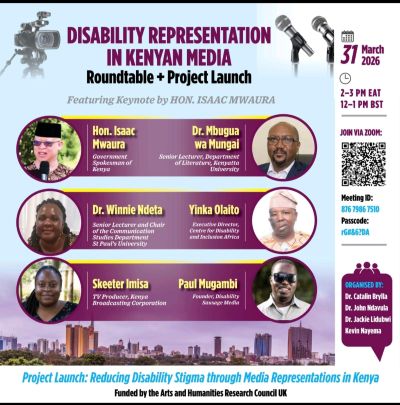
At a workshop organized by Changing Attitudes Through Media Representations of Disability, an international research programme exploring social change through media representations of disability in the UK and Kenya, held on March 31, 2026, media and disability advocates gathered to interrogate how people with disabilities can shape their portrayal in the media. The event featured a roundtable on disability representation in Kenyan media alongside a project launch.
The keynote address at the event was delivered by Honourable Isaac Mwaura , Kenya Government Spokesperson as well as national Coordinator, Albinism Society of kenya. In his speech Hon Isaac sound a note of warning “The person with the megaphone, the person who is helping to tell the story will shape the narrative”
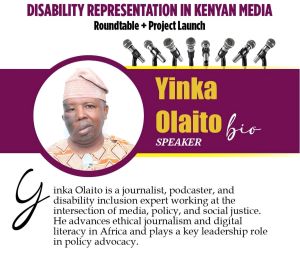
Speaking at the forum, disability inclusion advocate and media professional Yinka Olaito challenged persons with disabilities to take greater ownership of their narratives, emphasizing that influence in media begins with the ability to tell compelling, relatable stories.
“Every person with a disability has a story,” Olaito said, “but the real question is whether that story is worth telling in a way that resonates with audiences.”
He stressed that storytelling remains a critical tool for visibility and influence, urging individuals within the disability community to build their capacity to communicate lived-experiences effectively. According to him, media organizations are constantly in search of authentic and engaging content, but only stories delivered with clarity and conviction gain traction.
Olaito noted that beyond having powerful experiences, the ability to present them convincingly determines whether they will shape public perception. “You can have a good story, but if it is not told well, it may fail to connect,” he said.
He also highlighted internal challenges within the disability ecosystem, particularly disunity and inconsistent terminology, which he said weaken collective advocacy efforts. Calling for greater cohesion, he argued that a unified voice would strengthen the community’s bargaining power in influencing media narratives.
“Language is powerful, and without agreement on how we define ourselves, it becomes harder to project a strong, collective identity,” he added.
In a push for structural change, Olaito encouraged investment in disability-led media platforms, including podcasts, television, and print outlets. Such platforms, he said, would provide opportunities for self-representation and reduce reliance on mainstream media gatekeepers.
“Media organisations have their own priorities, including profitability. But when we build and own our platforms, we can tell our stories on our terms and for public good,” he said.
He further urged persons with disabilities to increase their public visibility and accessibility, noting that media outlets often seek out individuals who are already active and recognizable within public discourse.
“Media wants voices that are visible and available. If we are not seen or heard, we risk being excluded from the conversation,” Olaito warned.
Other prominent speakers at the event include: Dr Mbugua wa Mungai, a senior lecturer and former Director of Disability Services at Kenyatta University, Dr Winnie Ndeta, Chair of Communication Studies at St. Paul’s University, Skeeter Imisa, a television producer at Kenya Broadcasting Corporation, The project is led by Dr Catalin Brylla of Bournemouth University, alongside Kenyan-based researchers Dr John Ndavula (Murang’a University of Technology), Dr Jackline Lidubwi (Africa Nazarene University), and Kevin Nayema, a research associate. Other key project partners, including the Kenya Broadcasting Corporation (KBC), Signs TV, the Kenya Union of Journalists (KUJ), and the Action Network for the Disabled (ANDY),
The workshop underscored a growing consensus among stakeholders that improving disability representation in media requires both systemic change and proactive engagement from the community itself.
Participants agreed that as conversations around inclusion gain momentum globally, empowering persons with disabilities to shape their own narratives will be critical to changing perceptions and dismantling stereotypes