
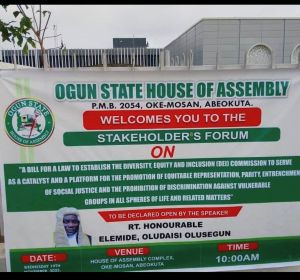
CDIA Flags Critical Gaps at Ogun State DEI Bill, Commission Public Hearing
Centre for Disability and Inclusion Africa, committed to shaping policy and advancing the human rights of persons with disabilities across Nigeria and Africa, actively participated in the Ogun State House of Assembly’s public hearing on the proposed Diversity, Equity and Inclusion Bill and the establishment of a corresponding Commission on Wednesday, November 19, 2025, highlighting several critical loopholes in the bill—intended to protect women, children, persons with disabilities, and other vulnerable groups—which the Centre and other stakeholders strongly raised for review.
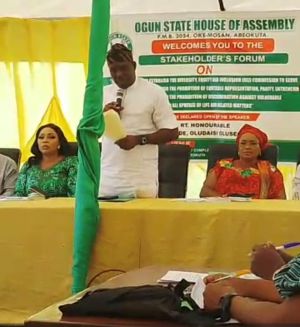
Hon Elemide olusegun, Ogun State House of Assembly Speaker, Sitting- Hon. Bakare omoloa, Chairman Women Affairs committee Ogun state house of Assembly 9In green native dress and Deputy Speaker and sponsor of the bill- Rt. hon. Ajayi Lateefat
In his speech, The Speaker of the Ogun State House of Assembly, Rt, Hon. Elemide Olusegun Said “The house bill No. 023/OG/2025 which proposed a law to Establish the diversity, Equity and inclusion (DEI)Commission is to serve as catalyst and platform for the promotion of Equitable representation, party entrenchment of social justice and the prohibition of Discrimination Against vulnerable Groups in all the sphere of life and related matters”. To Olusegun, the bill is borne out of the need to foster public orientation and encourage equity and inclusion of vulnerable people”
The Deputy Speaker of the House Rt. Hon. Ajayi Bolanle Lateefat who sponsored the bill in her own speech also maintained “As the sponsor of the bill, I believe the DEI Bill and commission will serve as a platform for change where the voices of the marginalized will be heard and thereby promote inclusive practice in governance and Social life”
The House Committee Chairman for Women Affairs, Hon. Bakare, Omolola Olanrewaju(mrs0 also affirmed “As the chairman, house committee on Women Affairs, I recognize the importance of this bill in addressing the systemic inequality and biases that have long plagued our society the DEI Commission will serve as a platform for change, providing an avenue for marginalized voices to be heard and promoting inclusion practices in governance, economy and social life”
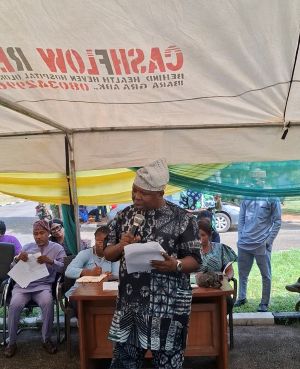
Yinka Olaito making his submission
In his submission at the public hearing, Yinka Olaito raised three fundamental issues that need consideration before the bill is passed and the commission established. The three issues are: suitability concerns and challenges associated with the proposed name and scope of the Commission,t he technical and conceptual risks of categorizing disability under “vulnerable groups”, including the implications for policy, perception, and rights protection and outlined, suggested sections within the bill that may work against disability inclusion if the House decides to proceed with the current name and structure of the DEI Commission.
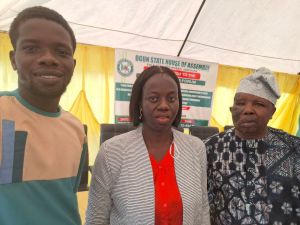
CDIA TEam at the public hearing
According to Yinka Olaito, miscommunication may block legislative and public support when public and legislators frequently form opinions based on a bill’s title alone. Controversial interpretations may overshadow the bill’s real intent”. In addition, he also maintained “The bill’s actual purpose is broader and more accurately reflected under a different name as the central aim of the bill is to protect women, children, PWDs, and other socially excluded groups, issues better framed under social protection and human rights, not Western-style DEI constructs.
Another major issue according to Yinka Olaito is that “The DEI label may be perceived as foreign, so a precise name which reflect the context.” Comrade Yinka Folarin of the CDHR on his own submission argued “Why was there an urgent DEI bill when the Ogun state Disability and inclusion Bill which had been passed since 2017 is yet to be implemented.
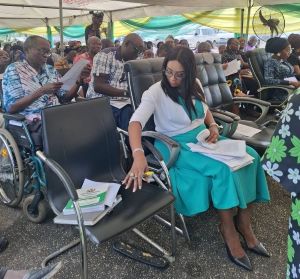
Members of the public/participants at the Public hearing
About, essence of public hearing
The primary purpose of a public hearing is to create an avenue for citizens to present information, insights, and opinions to government officials or committees on proposed decisions that may impact their community. These engagements strengthen transparency, accountability, and public participation, ensuring that government actions reflect the realities, needs, and concerns of the people.
Public hearings also serve key objectives that support effective governance. They enable officials to gather expert input and diverse perspectives, promote openness by making deliberations public, and provide a structured platform for citizens to express support, opposition, or questions. They further enhance accountability by allowing the public to scrutinize decisions and demand explanations where necessary. In cases such as zoning or land-use matters, public hearings also act as semi-judicial forums where affected parties can present grievances, evidence, or testimony related to the issue under consideration.
N.B first published in Nigeria Grassroot News newspaper