
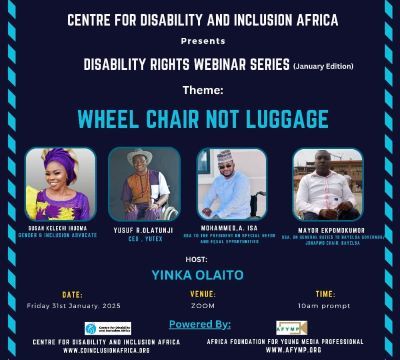
CDIA and other Stakeholders issued a communique on “Wheel Chair Not Luggage
Communique issued at the end of Wheel Chair Not Luggage Stakeholders meeting/Webinar with the theme: Wheel Chair Not Luggage which held on Friday 31st January, 2025
Preamble
The challenges of Persons with disabilities in Nigeria are huge. Abuse of their rights are most prevalent and there seems to be no sustainable efforts to stem this. The focus of the stakeholders for this meeting was narrowed down to challenges faced by physical-mobility individuals especially those who use wheel chairs. The meeting had in attendance, Government officials, Organization of Persons with disabilities organisations, member of different media houses, Persons with disabilities among others
Objective: is to promote the freedom of movement of wheelchair users, counter the misinformation about wheelchair being a luggage instead of being mobility aid, highlight the challenges associated with a using wheelchair and come up with solutions that will enhance the accessibility and mobility of wheelchairs.
Key Resolutions
- Wheelchairs are mobility aid and should never be considered as luggage by transport operators whether as a matter of ignorance, due to misinformation or negative societal perception Transport operators must provide reasonable accommodation for wheelchair users in their service delivery. Wheelchair mobility gives users independence, confidence and sense of participation. To an wheelchair user this mobility equipment gives opportunity to go work, study, and leadership opportunities.
- Accessibility of physical facilities whether public or private facilities is a key component of an inclusive society.
- Mobility challenges for wheelchair users can be classified into upstream challenges (manufacturer/design challenges, comfort) and downstream challenges are challenges associated with non-compliance with accessibility code and universal design.
- The discrimination Against Persons with Disabilities (Prohibition) Act (2018) is a major milestone in attaining a disability inclusive society. Wheelchair use by anyone who needs it is backed in the law DAPDA 2018
- There is a need for wheelchair users to unite and organised themselves to sensitize and engage with major stakeholders in the Nigerian transport system such as the ministries of transportation, NUTRW for advocacy and public reorientation.
- There is a need for continuous re- orientation and public sensitization for wheelchairs users’ community and the general public.
- Continuous advocacy will drive empathy, knowledge in service delivery among transport service operators.
- There is a need to push for policy change which prioritizes accessible infrastructures, universal designs and address gaps that allow wheelchair to be treated as aid not luggage.
- There is a need to train transport service providers on disability, inclusion
- There is a need for political will and finance to prioritize mainstreaming disability inclusion.
- Major stakeholders in public transportation should be part of this conversation.
- Behavioural change materials can be used to sensitize public road transporters and advocacy material should be translated into local languages.